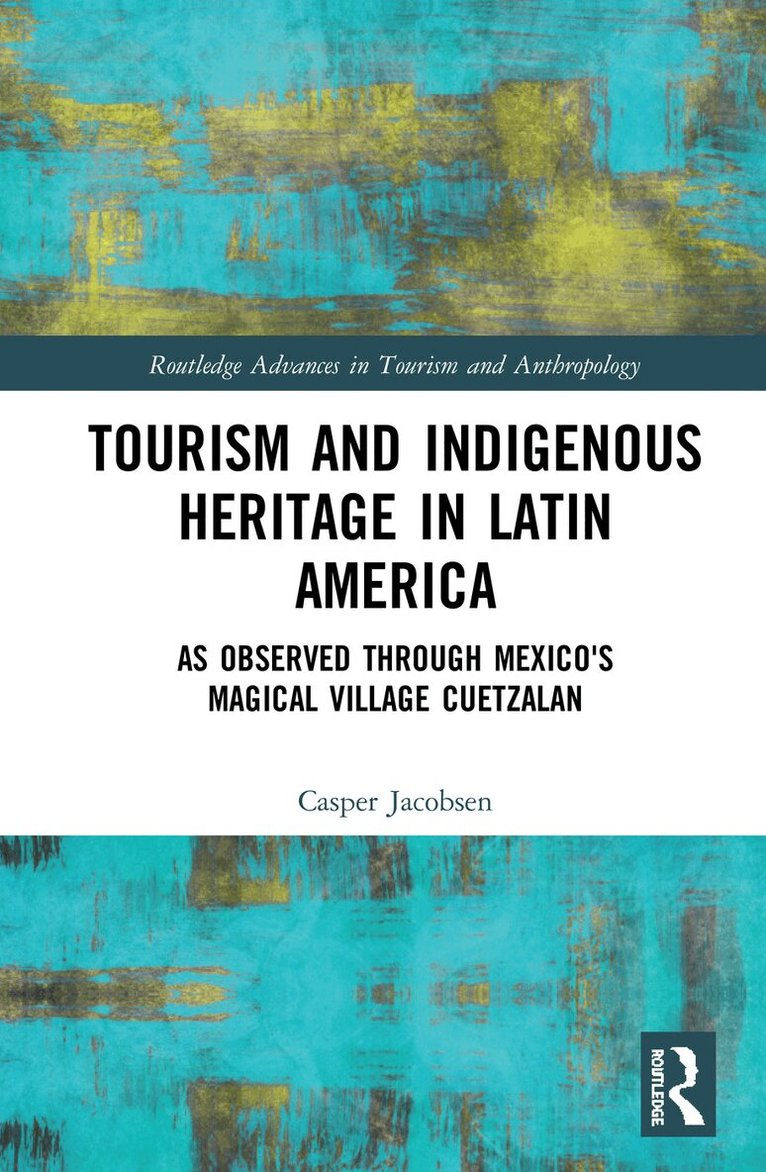
Häftad, Engelska, 2020
Tourism and Indigenous Heritage in Latin America
As Observed through Mexico's Magical Village Cuetzalan
Del i serien Routledge Advances in Tourism and Anthropology
708 kr
Beställningsvara. Skickas inom 10-15 vardagar. Fri frakt över 249 kr.
Beskrivning
Produktinformation
- Utgivningsdatum: 2020-06-30
- Mått: 156 x 234 x 13 mm
- Vikt: 380 g
- Format: Häftad
- Språk: Engelska
- Serie: Routledge Advances in Tourism and Anthropology
- Antal sidor: 194
- Förlag: Taylor & Francis Ltd
- ISBN: 9780367587352
Utforska kategorier
Mer om författaren
Casper Jacobsen holds a PhD in American Indian Languages and Cultures, and is a postdoctoral fellow at the University of Copenhagen and the State University of New York at Albany, USA. His research focuses on the history and heritage of indigenous peoples in pre-Hispanic, colonial, and contemporary Latin America.
Recensioner i media
"Going beyond the sustainability and empowerment frameworks frequently employed in the tourism literature, Casper Jacobsen’s Tourism and indigenous heritage in Latin America: As observed through Mexico’s Magical Village Cuetzalan offers the reader a critical examination of the emergence of multicultourism, defined by the author as a neoliberal governmentality frame that fuses multicultural politics of recognition with tourism, while conceptualizing indigenous heritage as a ‘national resource’ to be exploited in tourism initiatives." - Laura Paola Vizcaino-Suárez, Journal of Heritage Tourism"Although this book analyses a specific Mexican community, it offers crucial insights into the global politics of recognition in the name of tangible and intangible heritage, especially UNESCO’s World Heritage programme..Jacobsen’s discussion of his methodological approach in Chapter 3 includes a thoughtful description of his interview process and the challenges and benefits of doing field research while accompanied by family members. These sections would be especially helpful for early-career scholars preparing to embark on their own projects...It provides a concrete example of the perils of the politics of recognition for marginalized communities by revealing how the official embrace of Indigenous heritage can function as yet another form of dispossession, and is thus of interest to a broad range of scholars of tourism, heritage studies and Indigenous studies, and scholars of the politics of recognition in and beyond Latin America." Lisa Pinley Covert, Journal of Latin American Studies
Betyg & recensioner
0 recensioner
Inga recensioner tillgängliga.