• Fri frakt över 249 kr
  • •
  • Snabba leveranser
  • •
  • Billiga böcker
Kundservice

Du är på sajten för privatpersoner.

Företag, bibliotek eller offentlig verksamhet?

Du handlar på classic.bokus.com, där alla dina funktioner finns intakta.
Till classic.bokus.com
Bokus logotyp. Gå till startsidan.
  • Erbjudanden
  • Nyheter
  • Student
  • Topplistor
  • Barn & ungdom
  • Bokus Play
  • E-böcker
  • Pocketböcker
  • Spel & pussel

10% rabatt på allt med kod NYSTART10 →

Sidfot

Mina sidor

    Hjälp

    • Kundservice
    • Vanliga frågor och svar
    • Frakt och leverans
    • Retur vid ångerrätt
    • Reklamera vara
    • Betalning
    • Köpvillkor
    • Allmänna villkor
    • Information om webbplatsens tillgänglighet

    Om Bokus

    • Om oss
    • Pressrum
    • För studenter
    • För företag
    • För bibliotek och offentlig verksamhet
    • För leverantörer
    • Hållbarhet

    Populärt

    • Aktuella erbjudanden
    • Presentkort
    • Studentlitteratur
    • Nya böcker
    • Topplistor
    • Signerade böcker
    • Engelska böcker

    Inspiration

    • Boktips
    • BookTok
    • Populära bokserier
    • Barnbokskaraktärer
    • Populära författare
    Logotyp för Bokus
    Följ oss på Facebook (extern länk)Följ oss på Instagram (extern länk)Följ oss på YouTube (extern länk)Följ oss på TikTok (extern länk)
    bokus @ CookiesAnpassa cookiesIntegritetspolicyKöpvillkor
    Till Citymail hemsida (extern länk)Till Budbee hemsida (extern länk)Till Postnord hemsida (extern länk)Till Schenker hemsida (extern länk)Till Early Bird hemsida (extern länk)Till Walleys hemsida (extern länk)
    1. Psykologi och pedagogik
    2. Pedagogik
    3. Pedagogisk metodik

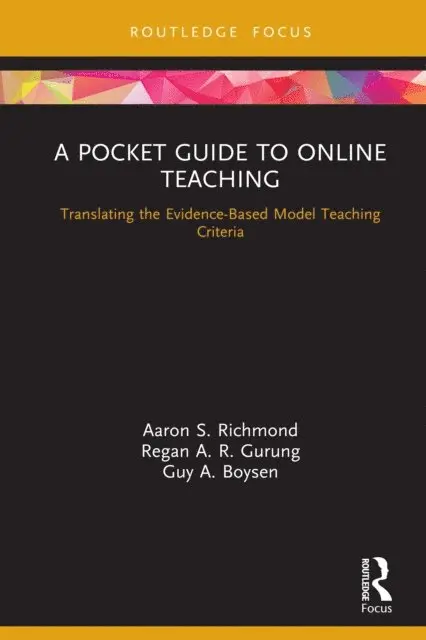
    Pocket Guide to Online Teaching

    Translating the Evidence-Based Model Teaching Criteria

    AvAaron S. Richmond,Regan A. R. Gurung

    Inbunden, Engelska, 2021

    935 kr

    Beställningsvara. Skickas inom 10-15 vardagar. Fri frakt över 249 kr.

    Beskrivning

    This pithy yet thorough book provides an evidence-based guide on how to prepare for online teaching, especially for those who are making a swift transition from face-to-face to online instruction. Guided by the Model Teaching Characteristics created by The Society for the Teaching of Psychology, this book covers important topics like: how to adapt to expected and unexpected changes in teaching, how to evaluate yourself and your peers, and tips on working smarter/optimizing working practices with the resources available. The features of the book include: Practical examples exploring how to solve the typical problems of designing and instructing online courses. Interactive "Worked Examples" and "Working Smarter" callouts throughout the book which offer practical demonstrations to help teachers learn new skills. Further reading and resources to build on knowledge about online education. End of chapter checklists which summarizes suggestions about how to be a model online teacher. This essential resource will provide support for teachers of all levels and disciplines, from novice to the most experienced, during the transition to online teaching.

    Produktinformation

    • Utgivningsdatum:2021-03-09
    • Mått:152 x 229 x 13 mm
    • Vikt:700 g
    • Format:Inbunden
    • Språk:Engelska
    • Antal sidor:70
    • Förlag:Taylor & Francis Ltd
    • ISBN:9780367646684

    Utforska kategorier

    • Pedagogisk metodik inom Psykologi och pedagogik

    Mer om författaren

    Aaron S. Richmond is a Professor of Educational Psychology at Metropolitan State University of Denver, USA. He studies how humans learn and develop and the application of this knowledge to classroom instruction and assessment. Regan A. R. Gurung is Professor of Psychological Science and Director of the General Psychology Program at Oregon State University, USA. His research focuses on reducing prejudice, racism, and sexism, and the factors influencing learning.Guy A. Boysen is a Professor of Psychology at McKendree University, USA. His scholarship emphasizes the teaching of psychology, professional development of teachers, and stigma toward mental illness.

    Innehållsförteckning

    • DedicationPreface1. Apples and Oranges, But Still Fruit: Model Teaching Universals and Differences1.1. Confessions of Three Skeptical Teachers The Background of Model Teaching What is Model Teaching? How is Teaching Different Online? Becoming a Model Online Teacher 1.2. Stop, Think, Reflect: The Model Online Teaching Checklist for Training1.3. Tips For Continued Learning About Model Online Teaching2. Students Interaction with Content2.1. Adapting Student Interaction with Content in Online CourseInteraction with Content Through Student Learning Objectives The Syllabus and Your LMS is a Vehicle for Course Content Interaction with Content Depends on Course Design, Structure, and Clarity Model Online Teachers use Course Templates to Organize Content Special Considerations for Online Interactions with Content Broadening Instructional Methods 2.2. Stop, Think, Reflect: The Model Online Teaching Checklist for Student Interaction with Content 2.3. Tips For Continued Learning About Students Interacting with Content3. Student to Student Interaction3.1. Adapting Student-to-Student Interaction: How to Build a Community of Online Learners Establishing Student-to-Student Interaction Through Discussions ForumsFostering Student Community with Online DiscussionCommunicating Discussion ExpectationsFostering Student Learning with Online Discussion Create Collaborative and Cooperative Online Learning Opportunities Establishing a Community of Learners Necessitates Mitigation of Student-to-Student Conflict 3.2. Stop, Think, Reflect: The Model Online Teaching Checklist for Student-to-Student Contact3.3. Tips For Continued Learning About Student-to-Student Interactions4. Instructor-to-Student Interaction4.1. Adapting to Online Instruction to Promote Instructor to Student Interaction Use the Syllabus to Interact with Students Use Various Instructional Methods and Skills to Interact with Students Practice Effective Online Teaching Skills The Great Debate: Do Model Online Teachers use Synchronous or Asynchronous Learning? Interact with Students via Student Evaluations of Teaching Interact with Students Through Student Feedback 4.2. Stop, Think, Reflect: The Model Online Teaching Checklist for Instructor-to-Student Interaction4.3. Tips For Continued Learning About Online Instructor-to-Student Interaction5. Online Assessment5.1. How to Adapt Assessment to Online Instructiona. The Process of Assessing Student Learning OnlineCommunicating Learning ObjectivesAlignment of Learning Objectives, Assignments, and ActivitiesProviding Constructive Feedback OnlineMaking Assessment-based Changesb. Teaching Effectiveness Assessment Process5.2. Stop, Think, Reflect: The Model Online Teaching Checklist for Assessment5.3. Tips for Continued Learning About Online AssessmentReferencesIndex