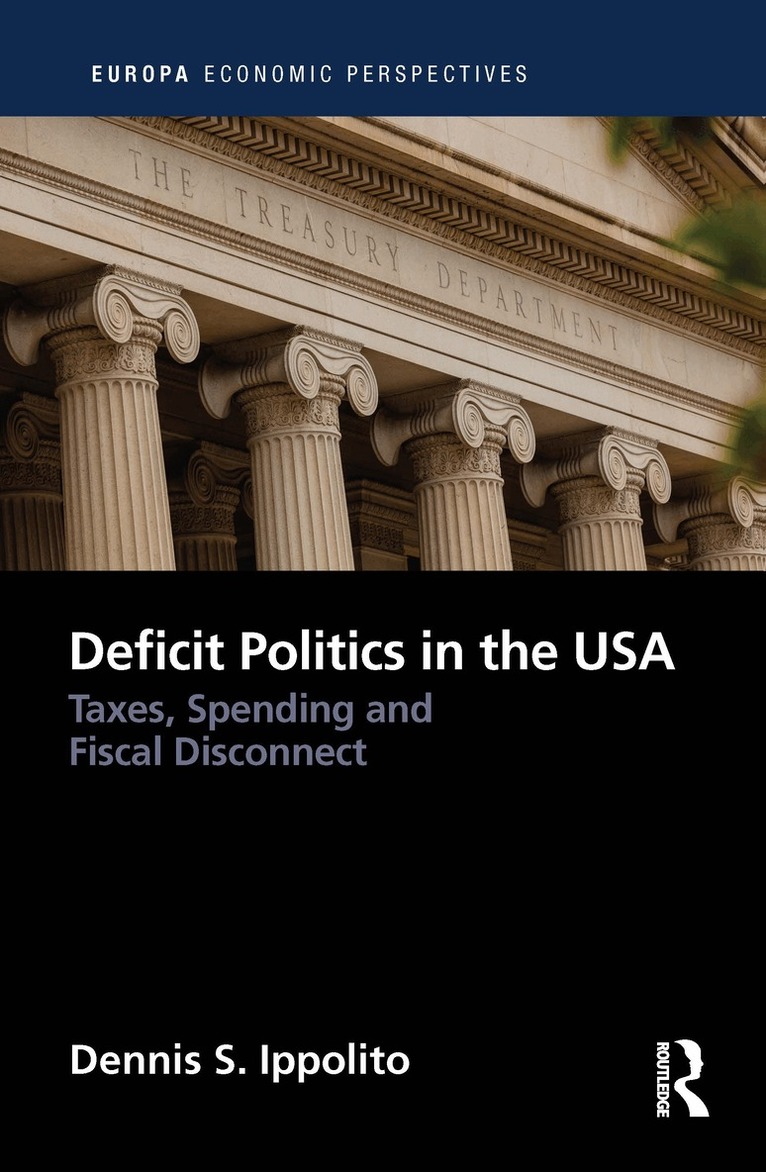
Inbunden, Engelska, 2022
Deficit Politics in the United States
Taxes, Spending and Fiscal Disconnect
Del i serien Europa Economic Perspectives
2111 kr
Beställningsvara. Skickas inom 10-15 vardagar. Fri frakt över 249 kr.
Beskrivning
Produktinformation
- Utgivningsdatum: 2022-02-23
- Mått: 156 x 234 x 17 mm
- Vikt: 520 g
- Format: Inbunden
- Språk: Engelska
- Serie: Europa Economic Perspectives
- Antal sidor: 224
- Förlag: Taylor & Francis Ltd
- ISBN: 9780367765064
Utforska kategorier
Mer om författaren
Dennis S. Ippolito is the Eugene McElvaney Professor of Political Science at Southern Methodist University. His most recent book on budget policy was a revised edition of Why Budgets Matter: Budget Policy and American Politics (Pennsylvania State University Press, 2015), the first edition of which was published in 2003. His other books on budget policy include: Deficits, Debt, and the New Politics of Tax Policy (Cambridge University Press, 2012); Budget Policy and the Future of Defense (National Defense University Press/Institute for National Strategic Studies, 1994); Uncertain Legacies: Federal Budget Policy from Roosevelt through Reagan (University Press of Virginia, 1990); Hidden Spending: The Politics of Federal Credit Programs (University of North Carolina Press, 1984); Congressional Spending (Cornell University Press, 1981); and The Budget and National Politics (W.H. Freeman, 1978). In 2010, he received the Aaron B. Wildavsky Award for Lifetime Scholarly Achievement in Public Budgeting and Finance from the Association for Budgeting and Financial Management of the American Society for Public Administration.
Recensioner i media
Ippolito (Southern Methodist Univ.) provides an exceptionally detailed account of the political debates over US fiscal policy from the nation's founding to the Trump era. As the title implies, the book weaves together the political and economic history of the United States. Ippolito reminds readers that an aversion to public debt characterized the first 150 years of US history. Unprecedented deficits since then—caused by low taxes and high spending—were grudgingly accepted and budget surpluses became rare. Ippolito emphasizes that a seemingly permanent bipartisan consensus—that debt should finance increases in public spending—now controls fiscal policy. The result is that “voters need not decide how big a government they are willing to pay for.” Ippolito augments the narrative with well-placed tables derived from primary sources and presented in a style and format that are consistent regardless of the period covered or the specific policy context examined. Social historians, political scientists, economists, and public policy scholars will want to keep this volume handy for its historical context, vital for any number of scholarly purposes.--J. E. Herbel, Kennesaw State University, CHOICE
Betyg & recensioner
0 recensioner
Inga recensioner tillgängliga.