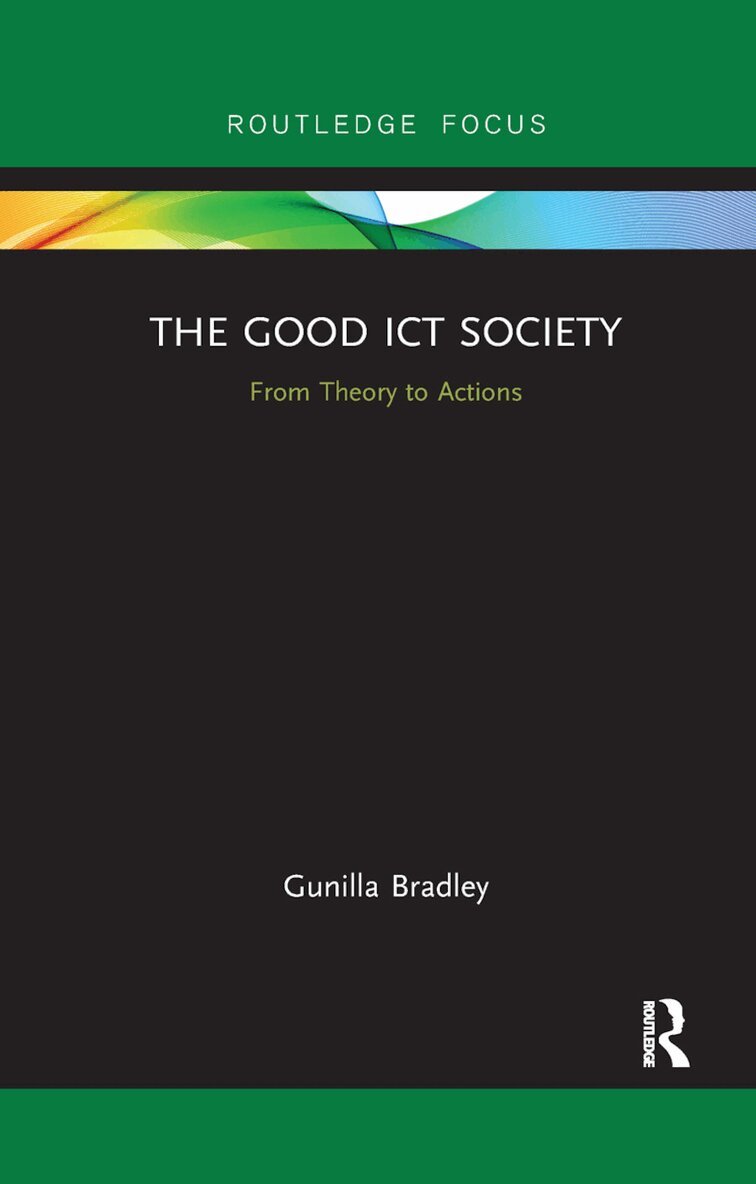
Good ICT Society
From Theory to Actions
379 kr
Beställningsvara. Skickas inom 10-15 vardagar. Fri frakt över 249 kr.
Du är på sajten för privatpersoner.
379 kr
Beställningsvara. Skickas inom 10-15 vardagar. Fri frakt över 249 kr.
Gunilla Bradley is Professor Emerita in Informatics at Royal Institute of Technology (KTH) – School of ICT in Stockholm. GB is originally a psychologist and has a broad background in the social and behavioral sciences. Her research concerns the interplay between Information and Communication Technology (ICT), Human Beings, and Society – Social Informatics. Her cross disciplinary research groups were first hosted by Stockholm University for twenty years. She has then been a visiting professor at Stanford University two years and professor of Technology and Social Change at the Royal Institute of Technology. From 1997–2001 she served as professor in Informatics at Umeå University and Mid Sweden University. In 1997 she received the prestigious Namur Award from IFIP for her pioneering research to increase the social awareness of the impact of ICT. Gunilla has authored thirteen books and contributed extensively in international scientific journals and the popular science press. Her latest book Social and Community Informatics – Humans on the Net (Routledge 2006) is widely used in both ICT related disciplines and in the social sciences. In 2008 Gunilla was invited as guest professor in Salzburg. She initiated and chaired the annual IADIS conference on "ICT, Society and Humans" for some years. In 2010 she was honored by a "Fest Symposium" at Linnaeus University in Sweden and a "Festschrift" (Eds. Haftor & Mirijamdotter, 2011). More than 60 distinguished researchers from all continents of the world contributed with chapters. Gunilla is currently writing the book The Good Information and Communication Society – From Theory to Action (Routledge).
This book provides excellent insight, by a prominent scientist, into the socio-technical and human quality aspects of information and communication technology.Gavriel Salvendy is a professor of Industrial Engineering at Purdue University and Chair Professor and Head of the Department of Industrial Engineering at Tsinghua University, Beijing, P.R. of Chinahttp://www.iems.ucf.edu/salvendy/More than fifty years of sustained empirical research on the psychosocial and organizational consequences of information and communication technologies is Gunilla Bradley’s contribution to understanding how computerization has transformed the world, politics and economy, the work setting, and our private lives. Today we find ourselves in an environment where computer, information, and media technologies have become indispensable and have converged to confound and, indeed, dissolve former distinctions between our public, work, and private lives. Yet, as much as there is the negative to this convergence, there is equally also the positive. It is with the wisdom gained from her decades of research and with great empathy and optimism for the human condition that Gunilla Bradley reflects on the choices before us. She asks us to evaluate the life conditions that we want, the characteristics of a good work environment and technologies that help us attain our goals, and properties of our social structures, norms, and values systems that promote a positive climate for our world and societies that have been transformed by computerization. Alice Robbin, Indiana University Bloomington, USAAt times an introduction to concepts, at others a plea for action, this little book of wisdom is also a cross between an autobiography and a diary – it brings together in one place the latest in a lifetime of work. Its 100 or so pages really show how policy, people and practices all need to be brought together when co-creating digital technologies. Look out especially for Gunilla Bradley’s manifestos! Diane Whitehouse, Chair – ICT and Society Technical Committee, International Federation for Information ProcessingIn this latest book, Gunilla Bradley’s rich experience shines through again. She explains the mix of high-end virtual technology with her usual gentle philosopher’s approach to reflect her true convergence model mastery. Her brilliance in explaining how these (sometimes) worrisome technologies are changing the way people interact, sets the bench mark for other researchers. Thank you Gunilla.Elspeth McKay, Associate Professor, School of Business IT and Logistics, RMIT University, AustraliaThis book draws on Gunilla Bradley’s research carried out during more than four decades. Gunilla introduced psycho-social aspects in computerization of work life and she has widened this perspective to a model which demonstrates the convergence of information and communication technologies which in turn involves globalization and convergence of life roles and life environments. In this book Gunilla shows us how this development and her work can be used to inspire broader issues, like peace and ecological, social and economic sustainability. I recommend this book, particularly to students in the area of information systems, computer science, media technology, and related areas. It gives both insight in the historical development and in issues that the ICT development have caused, for better and worse, including some ideas on how to address these through Trees of Action.Anita Mirijamdotter, Professor of Informatics, Department of Informatics, Linnaeus University, Sweden
Gunilla Bradley, G.E. Bradley, H.W. Hendrick
Inbunden, 1994
2 705 kr
Ann Rudinow Sætnan, Ingrid Schneider, Nicola Green
Häftad, 2020
566 kr
Jonathan Paul Marshall, James Goodman, Didar Zowghi, Francesca da Rimini
Häftad, 2020
680 kr
Michalis Kontopodis, Christos Varvantakis, Christoph Wulf
Häftad, 2019
709 kr
Gunilla Bradley, G.E. Bradley, H.W. Hendrick
Inbunden, 1994
2 705 kr
Du är på sajten för privatpersoner.
379 kr
Beställningsvara. Skickas inom 10-15 vardagar. Fri frakt över 249 kr.
Gunilla Bradley is Professor Emerita in Informatics at Royal Institute of Technology (KTH) – School of ICT in Stockholm. GB is originally a psychologist and has a broad background in the social and behavioral sciences. Her research concerns the interplay between Information and Communication Technology (ICT), Human Beings, and Society – Social Informatics. Her cross disciplinary research groups were first hosted by Stockholm University for twenty years. She has then been a visiting professor at Stanford University two years and professor of Technology and Social Change at the Royal Institute of Technology. From 1997–2001 she served as professor in Informatics at Umeå University and Mid Sweden University. In 1997 she received the prestigious Namur Award from IFIP for her pioneering research to increase the social awareness of the impact of ICT. Gunilla has authored thirteen books and contributed extensively in international scientific journals and the popular science press. Her latest book Social and Community Informatics – Humans on the Net (Routledge 2006) is widely used in both ICT related disciplines and in the social sciences. In 2008 Gunilla was invited as guest professor in Salzburg. She initiated and chaired the annual IADIS conference on "ICT, Society and Humans" for some years. In 2010 she was honored by a "Fest Symposium" at Linnaeus University in Sweden and a "Festschrift" (Eds. Haftor & Mirijamdotter, 2011). More than 60 distinguished researchers from all continents of the world contributed with chapters. Gunilla is currently writing the book The Good Information and Communication Society – From Theory to Action (Routledge).
This book provides excellent insight, by a prominent scientist, into the socio-technical and human quality aspects of information and communication technology.Gavriel Salvendy is a professor of Industrial Engineering at Purdue University and Chair Professor and Head of the Department of Industrial Engineering at Tsinghua University, Beijing, P.R. of Chinahttp://www.iems.ucf.edu/salvendy/More than fifty years of sustained empirical research on the psychosocial and organizational consequences of information and communication technologies is Gunilla Bradley’s contribution to understanding how computerization has transformed the world, politics and economy, the work setting, and our private lives. Today we find ourselves in an environment where computer, information, and media technologies have become indispensable and have converged to confound and, indeed, dissolve former distinctions between our public, work, and private lives. Yet, as much as there is the negative to this convergence, there is equally also the positive. It is with the wisdom gained from her decades of research and with great empathy and optimism for the human condition that Gunilla Bradley reflects on the choices before us. She asks us to evaluate the life conditions that we want, the characteristics of a good work environment and technologies that help us attain our goals, and properties of our social structures, norms, and values systems that promote a positive climate for our world and societies that have been transformed by computerization. Alice Robbin, Indiana University Bloomington, USAAt times an introduction to concepts, at others a plea for action, this little book of wisdom is also a cross between an autobiography and a diary – it brings together in one place the latest in a lifetime of work. Its 100 or so pages really show how policy, people and practices all need to be brought together when co-creating digital technologies. Look out especially for Gunilla Bradley’s manifestos! Diane Whitehouse, Chair – ICT and Society Technical Committee, International Federation for Information ProcessingIn this latest book, Gunilla Bradley’s rich experience shines through again. She explains the mix of high-end virtual technology with her usual gentle philosopher’s approach to reflect her true convergence model mastery. Her brilliance in explaining how these (sometimes) worrisome technologies are changing the way people interact, sets the bench mark for other researchers. Thank you Gunilla.Elspeth McKay, Associate Professor, School of Business IT and Logistics, RMIT University, AustraliaThis book draws on Gunilla Bradley’s research carried out during more than four decades. Gunilla introduced psycho-social aspects in computerization of work life and she has widened this perspective to a model which demonstrates the convergence of information and communication technologies which in turn involves globalization and convergence of life roles and life environments. In this book Gunilla shows us how this development and her work can be used to inspire broader issues, like peace and ecological, social and economic sustainability. I recommend this book, particularly to students in the area of information systems, computer science, media technology, and related areas. It gives both insight in the historical development and in issues that the ICT development have caused, for better and worse, including some ideas on how to address these through Trees of Action.Anita Mirijamdotter, Professor of Informatics, Department of Informatics, Linnaeus University, Sweden
Gunilla Bradley, G.E. Bradley, H.W. Hendrick
Inbunden, 1994
2 705 kr
Ann Rudinow Sætnan, Ingrid Schneider, Nicola Green
Häftad, 2020
566 kr
Jonathan Paul Marshall, James Goodman, Didar Zowghi, Francesca da Rimini
Häftad, 2020
680 kr
Michalis Kontopodis, Christos Varvantakis, Christoph Wulf
Häftad, 2019
709 kr
Gunilla Bradley, G.E. Bradley, H.W. Hendrick
Inbunden, 1994
2 705 kr