• Fri frakt över 249 kr
  • •
  • Snabba leveranser
  • •
  • Billiga böcker
Kundservice

Du är på sajten för privatpersoner.

Företag, bibliotek eller offentlig verksamhet?

Du handlar på classic.bokus.com, där alla dina funktioner finns intakta.
Till classic.bokus.com
Bokus logotyp. Gå till startsidan.
  • Erbjudanden
  • Nyheter
  • Student
  • Topplistor
  • Barn & ungdom
  • Bokus Play
  • E-böcker
  • Pocketböcker
  • Spel & pussel

10% rabatt på allt med kod NYSTART10 →

Sidfot

Mina sidor

    Hjälp

    • Kundservice
    • Vanliga frågor och svar
    • Frakt och leverans
    • Retur vid ångerrätt
    • Reklamera vara
    • Betalning
    • Köpvillkor
    • Allmänna villkor
    • Information om webbplatsens tillgänglighet

    Om Bokus

    • Om oss
    • Pressrum
    • För studenter
    • För företag
    • För bibliotek och offentlig verksamhet
    • För leverantörer
    • Hållbarhet

    Populärt

    • Aktuella erbjudanden
    • Presentkort
    • Studentlitteratur
    • Nya böcker
    • Topplistor
    • Signerade böcker
    • Engelska böcker

    Inspiration

    • Boktips
    • BookTok
    • Populära bokserier
    • Barnbokskaraktärer
    • Populära författare
    Logotyp för Bokus
    Följ oss på Facebook (extern länk)Följ oss på Instagram (extern länk)Följ oss på YouTube (extern länk)Följ oss på TikTok (extern länk)
    bokus @ CookiesAnpassa cookiesIntegritetspolicyKöpvillkor
    Till Citymail hemsida (extern länk)Till Budbee hemsida (extern länk)Till Postnord hemsida (extern länk)Till Schenker hemsida (extern länk)Till Early Bird hemsida (extern länk)Till Walleys hemsida (extern länk)
    1. Naturvetenskap och teknik
    2. Matematik och naturvetenskap
    3. Matematik
    4. Matematikens grunder

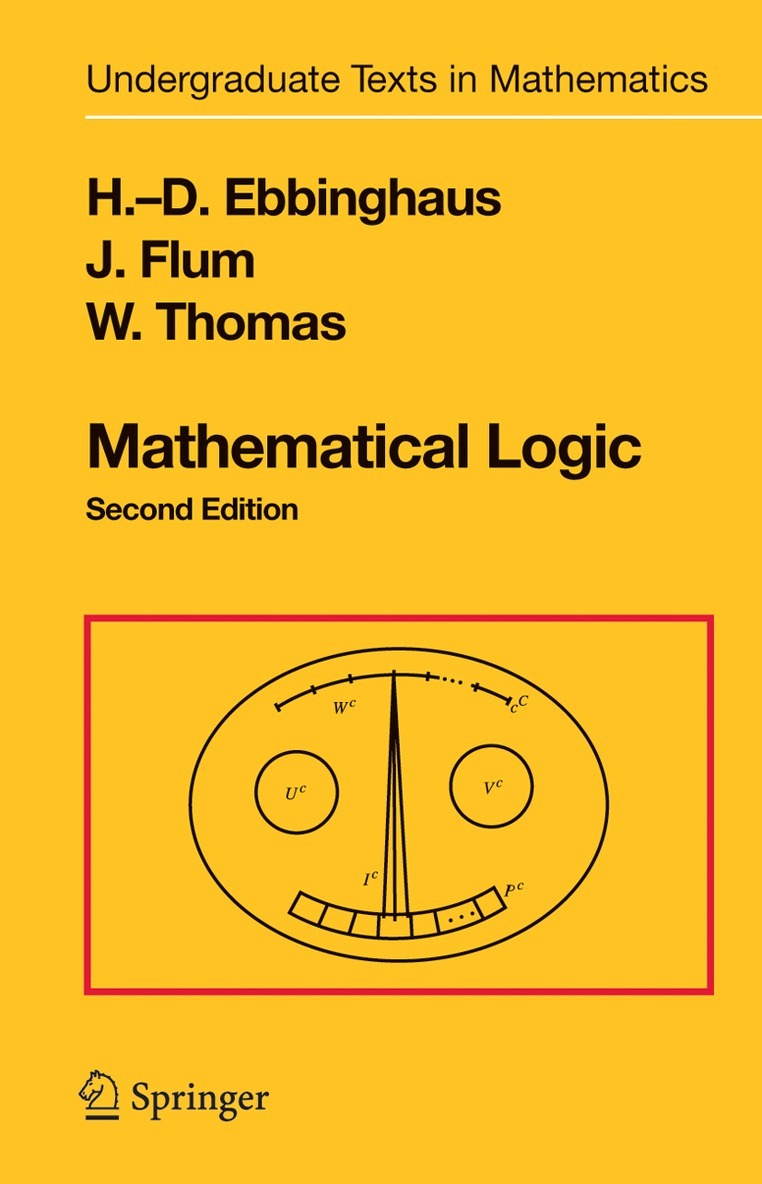
    Mathematical Logic

    AvH.-D. Ebbinghaus,J. Flum

    Inbunden, Engelska, 1994

    Del i serien Undergraduate Texts in Mathematics

    867 kr

    Beställningsvara. Skickas inom 5-8 vardagar. Fri frakt över 249 kr.

    Beskrivning

    What is a mathematical proof? How can proofs be justified? Are there limitations to provability? To what extent can machines carry out mathe­ matical proofs? Only in this century has there been success in obtaining substantial and satisfactory answers. The present book contains a systematic discussion of these results. The investigations are centered around first-order logic. Our first goal is Godel's completeness theorem, which shows that the con­ sequence relation coincides with formal provability: By means of a calcu­ lus consisting of simple formal inference rules, one can obtain all conse­ quences of a given axiom system (and in particular, imitate all mathemat­ ical proofs). A short digression into model theory will help us to analyze the expres­ sive power of the first-order language, and it will turn out that there are certain deficiencies. For example, the first-order language does not allow the formulation of an adequate axiom system for arithmetic or analysis. On the other hand, this difficulty can be overcome--even in the framework of first-order logic-by developing mathematics in set-theoretic terms. We explain the prerequisites from set theory necessary for this purpose and then treat the subtle relation between logic and set theory in a thorough manner.

    Produktinformation

    • Utgivningsdatum:1994-06-10
    • Mått:155 x 235 x 21 mm
    • Vikt:596 g
    • Format:Inbunden
    • Språk:Engelska
    • Serie:Undergraduate Texts in Mathematics
    • Antal sidor:291
    • Upplaga:2
    • Förlag:Springer-Verlag New York Inc.
    • ISBN:9780387942582

    Utforska kategorier

    • Matematikens grunder inom Naturvetenskap och teknik

    Recensioner i media

    "...the book remains my text of choice for this type of material, and I highly recommend it to anyone teaching a first logic course at this level." - Journal of Symbolic Logic

    Innehållsförteckning

    • A.- I Introduction.- II Syntax of First-Order Languages.- III Semantics of First-Order Languages.- IV A Sequent Calculus.- V The Completeness Theorem.- VI The Löwenheim-Skolem and the Compactness Theorem.- VII The Scope of First-Order Logic.- VIII Syntactic Interpretations and Normal Forms.- B.- IX Extensions of First-Order Logic.- X Limitations of the Formal Method.- XI Free Models and Logic Programming.- XII An Algebraic Characterization of Elementary Equivalence.- XIII Lindström’s Theorems.- References.- Symbol Index.