• Fri frakt över 249 kr
  • •
  • Snabba leveranser
  • •
  • Billiga böcker
Kundservice

Du är på sajten för privatpersoner.

Företag, bibliotek eller offentlig verksamhet?

Du handlar på classic.bokus.com, där alla dina funktioner finns intakta.
Till classic.bokus.com
Bokus logotyp. Gå till startsidan.
  • Erbjudanden
  • Nyheter
  • Student
  • Topplistor
  • Barn & ungdom
  • Bokus Play
  • E-böcker
  • Pocketböcker
  • Spel & pussel

10% rabatt på allt med kod: NYSTART10 →

Sidfot

Mina sidor

    Hjälp

    • Kundservice
    • Vanliga frågor och svar
    • Frakt och leverans
    • Retur vid ångerrätt
    • Reklamera vara
    • Betalning
    • Köpvillkor
    • Allmänna villkor
    • Information om webbplatsens tillgänglighet

    Om Bokus

    • Om oss
    • Pressrum
    • För studenter
    • För företag
    • För bibliotek och offentlig verksamhet
    • För leverantörer
    • Hållbarhet

    Populärt

    • Aktuella erbjudanden
    • Presentkort
    • Studentlitteratur
    • Nya böcker
    • Topplistor
    • Signerade böcker
    • Engelska böcker

    Inspiration

    • Boktips
    • BookTok
    • Populära bokserier
    • Barnbokskaraktärer
    • Populära författare
    Logotyp för Bokus
    Följ oss på Facebook (extern länk)Följ oss på Instagram (extern länk)Följ oss på YouTube (extern länk)Följ oss på TikTok (extern länk)
    bokus @ CookiesAnpassa cookiesIntegritetspolicyKöpvillkor
    Till Citymail hemsida (extern länk)Till Budbee hemsida (extern länk)Till Postnord hemsida (extern länk)Till Schenker hemsida (extern länk)Till Early Bird hemsida (extern länk)Till Walleys hemsida (extern länk)
    1. Naturvetenskap och teknik
    2. Matematik och naturvetenskap
    3. Matematik

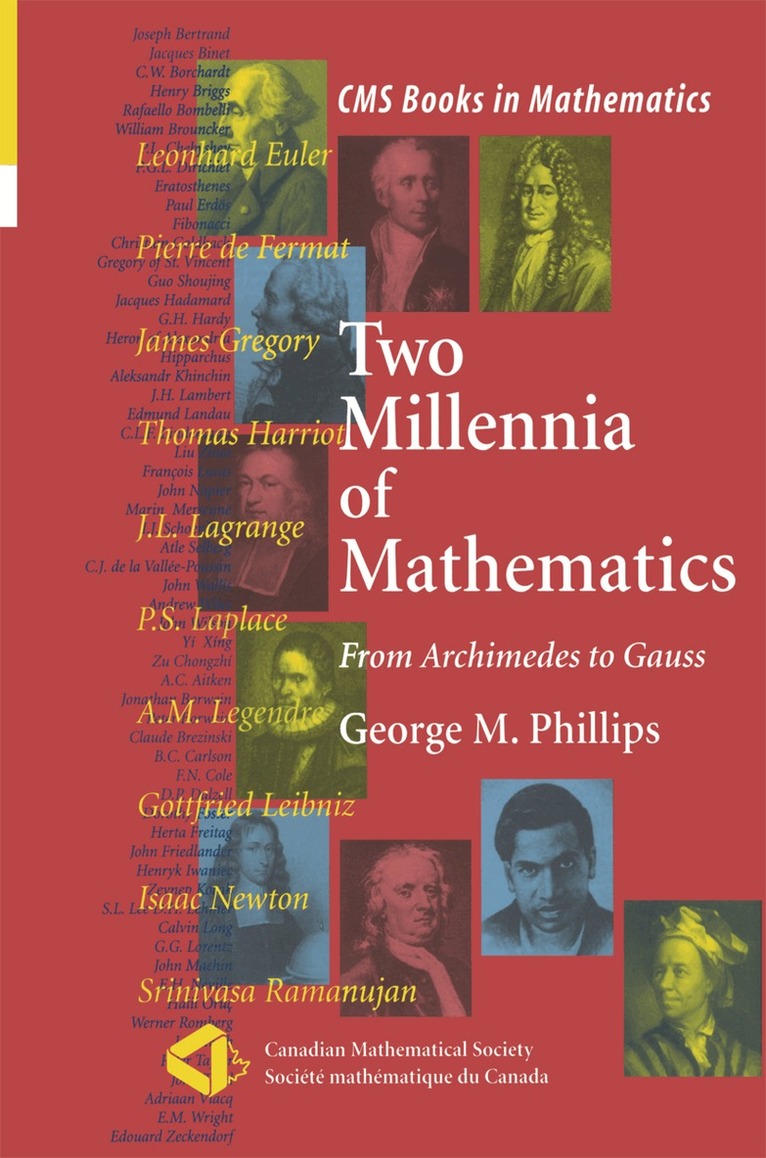
    Two Millennia of Mathematics

    From Archimedes to Gauss

    AvGeorge M. Phillips

    Inbunden, Engelska, 2000

    Del i serien CMS Books in Mathematics

    1 301 kr

    Beställningsvara. Skickas inom 10-15 vardagar. Fri frakt över 249 kr.

    Fler format och utgåvor

    E-bok

    1 105 kr

    Häftad

    870 kr

    Beskrivning

    This book is intended for those who love mathematics, including under­ graduate students of mathematics, more experienced students, and the vast number of amateurs, in the literal sense of those who do something for the love of it. I hope it will also be a useful source of material for those who teach mathematics. It is a collection of loosely connected topics in areas of mathematics that particularly interest me, ranging over the two millennia from the work of Archimedes, who died in the year 212 Be, to the Werke of Gauss, who was born in 1777, although there are some references outside this period. In view of its title, I must emphasize that this book is certainly not pretending to be a comprehensive history of the mathematics of this period, or even a complete account of the topics discussed. However, every chapter is written with the history of its topic in mind. It is fascinating, for example, to follow how both Napier and Briggs constructed their log­ arithms before many of the most relevant mathematical ideas had been discovered. Do I really mean "discovered"? There is an old question, "Is mathematics created or discovered?" Sometimes it seems a shame not to use the word "create" in praise of the first mathematician to write down some outstanding result. Yet the inner harmony that sings out from the best of mathematics seems to demand the word "discover.

    Produktinformation

    • Utgivningsdatum:2000-09-27
    • Mått:155 x 235 x 18 mm
    • Vikt:535 g
    • Format:Inbunden
    • Språk:Engelska
    • Serie:CMS Books in Mathematics
    • Antal sidor:223
    • Upplaga:2000
    • Förlag:Springer-Verlag New York Inc.
    • ISBN:9780387950228

    Utforska kategorier

    • Matematik inom Naturvetenskap och teknik

    Recensioner i media

    "In an ideal university the staff would supplement the standard courses by offering lectures in which they talked about topics which they particularly loved at a level which the students could understand. And, in an ideal university, the students would flock to such lectures. George Phillips' book consists of five short courses to be given at our ideal university. As the title is intended to suggest, the topics are treated with due respect for their history and all have their roots in the works of Gauss or earlier mathematicians. The level chosen is that of a first or second year student and the exposition uses the relaxed "explanation, theorem, proof"style of the best colloquium talks." London Mathematical Society Newsletter, October 2001 "In five chapters (From Archimedes to Gauss, Logarithms, Interpolation, Continued fractions, More number theory), the author shows that many interesting and important results in mahtematics have been discovered by ordinary people and not onl by great geniuses. Each chapter includes the history of its topic with an interpretation of the mathematical problems. The book shows how and why some results in mathematics have been discovered or obtained, by following the steps of well-known mathematicians who discovered them. It is a useful source of mathematical material for teachers, undergraduate students, students and the vast numbers of amateurs who love mathematics." European Mathematical Society Newsletter, Issue 41, September 2001

    Innehållsförteckning

    • 1 From Archimedes to Gauss.- 1.1 Archimedes and Pi.- 1.2 Variations on a Theme.- 1.3 Playing a Mean Game.- 1.4 Gauss and the AGM.- 2 Logarithms.- 2.1 Exponential Functions.- 2.2 Logarithmic Functions.- 2.3 Napier and Briggs.- 2.4 The Logarithm as an Area.- 2.5 Further Historical Notes.- 3 Interpolation.- 3.1 The Interpolating Polynomial.- 3.2 Newton’s Divided Differences.- 3.3 Finite Differences.- 3.4 Other Differences.- 3.5 Multivariate Interpolation.- 3.6 The Neville-Aitken Algorithm.- 3.7 Historical Notes.- 4 Continued Fractions.- 4.1 The Euclidean Algorithm.- 4.2 Linear Recurrence Relations.- 4.3 Fibonacci Numbers.- 4.4 Continued Fractions.- 4.5 Historical Notes.- 5 More Number Theory.- 5.1 The Prime Numbers.- 5.2 Congruences.- 5.3 Quadratic Residues.- 5.4 Diophantine Equations.- 5.5 Algebraic Integers.- 5.6 The equation x3 + y3 = z3.- 5.7 Euler and Sums of Cubes.- References.