• Fri frakt över 249 kr
  • •
  • Snabba leveranser
  • •
  • Billiga böcker
Kundservice

Du är på sajten för privatpersoner.

Företag, bibliotek eller offentlig verksamhet?

Du handlar på classic.bokus.com, där alla dina funktioner finns intakta.
Till classic.bokus.com
Bokus logotyp. Gå till startsidan.
  • Erbjudanden
  • Nyheter
  • Student
  • Topplistor
  • Barn & ungdom
  • Bokus Play
  • E-böcker
  • Pocketböcker
  • Spel & pussel

10% rabatt på allt med kod: NYSTART10 →

Sidfot

Mina sidor

    Hjälp

    • Kundservice
    • Vanliga frågor och svar
    • Frakt och leverans
    • Retur vid ångerrätt
    • Reklamera vara
    • Betalning
    • Köpvillkor
    • Allmänna villkor
    • Information om webbplatsens tillgänglighet

    Om Bokus

    • Om oss
    • Pressrum
    • För studenter
    • För företag
    • För bibliotek och offentlig verksamhet
    • För leverantörer
    • Hållbarhet

    Populärt

    • Aktuella erbjudanden
    • Presentkort
    • Studentlitteratur
    • Nya böcker
    • Topplistor
    • Signerade böcker
    • Engelska böcker

    Inspiration

    • Boktips
    • BookTok
    • Populära bokserier
    • Barnbokskaraktärer
    • Populära författare
    Logotyp för Bokus
    Följ oss på Facebook (extern länk)Följ oss på Instagram (extern länk)Följ oss på YouTube (extern länk)Följ oss på TikTok (extern länk)
    bokus @ CookiesAnpassa cookiesIntegritetspolicyKöpvillkor
    Till Citymail hemsida (extern länk)Till Budbee hemsida (extern länk)Till Postnord hemsida (extern länk)Till Schenker hemsida (extern länk)Till Early Bird hemsida (extern länk)Till Walleys hemsida (extern länk)
    1. Naturvetenskap och teknik
    2. Geovetenskap
    3. Geovetenskap

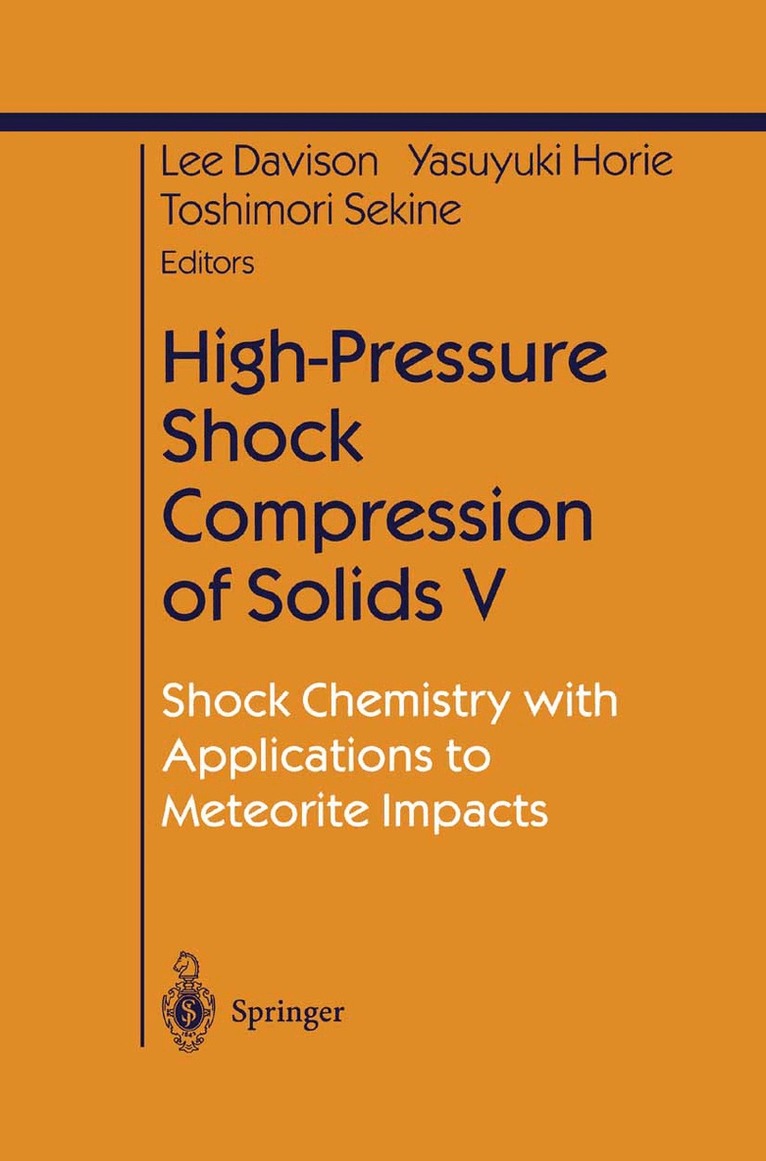
    High-Pressure Shock Compression of Solids V

    Shock Chemistry with Applications to Meteorite Impacts

    AvLee Davison,Yasuyuki Horie

    Inbunden, Engelska, 2002

    Del i serien Shock Wave and High Pressure Phenomena

    1 086 kr

    Beställningsvara. Skickas inom 10-15 vardagar. Fri frakt över 249 kr.

    Beskrivning

    Shock waves produce a wide variety of physical, chemical, mineralogical, and other effects in materials through which they pass. Since the beginning of civili­ zation, shock phenomena have been subjects of continuing interest, speculation, and enquiry. The interdisciplinary aspects of investigations of shock phenomena are especially noteworthy, and these investigations have been pursued by scien­ tists and engineers from a broad range of disciplines. Among the more novel and interesting investigations are those motivated by problems that arise in the Earth and planetary sciences. Such events as meteorite impacts produce the obvious cratering effects seen on the planets and their sat­ ellites. More subtle effects become apparent upon chemical and petrographic examination of the shock-compressed solid material. Shock waves are also prevalent in the larger universe, and have played a prominent role in shaping the solar system as we know it. The material in interstellar gas and dust clouds, comets, etc. , is processed by shock waves, producing important chemical effects, including formation of complex organic molecules. The process of accretion of planets involves impacts of dust particles at relative velocities ranging from a fraction of a millimeter per second to impacts of larger bodies at velocities as great as several tens of kilometers per second. The resulting shock waves cause both chemical and physical changes that are manifest in the bodies involved.

    Produktinformation

    • Utgivningsdatum:2002-09-10
    • Mått:155 x 235 x 20 mm
    • Vikt:571 g
    • Format:Inbunden
    • Språk:Engelska
    • Serie:Shock Wave and High Pressure Phenomena
    • Antal sidor:248
    • Förlag:Springer-Verlag New York Inc.
    • ISBN:9780387954943

    Utforska kategorier

    • Geovetenskap inom Naturvetenskap och teknik
    • Tillämpad fysik inom Naturvetenskap och teknik
    • Maskinteknik och material inom Naturvetenskap och teknik

    Innehållsförteckning

    • 1 Experimental Techniques for the Simulation of Shock Metamorphism: A Case Study on Calcite.- 1.1. Introduction.- 1.2. Experimental Techniques Used for the Simulation of Shock Metamorphism.- 1.3. Observations on Recovered Calcite Specimens.- 1.4. Discussion and Conclusions.- Acknowledgments.- References.- 2 Shock Experiments on a Preheated Basaltic Eucrite.- 2.1. Introduction.- 2.2. Experiments.- 2.3. Results.- 2.4. Discussion.- 2.5. Conclusions.- Acknowledgments.- References.- 3 Structural Evolution of Quartz and Feldspar Crystals and their Glasses by Shock Compression.- 3.1. Introduction.- 3.2. Structure of Diaplectic Glass.- 3.3. Structural Evolution of Silica and Feldspar Glasses by Shock Compression.- 3.4. Concluding Remarks.- Acknowledgments.- References.- 4 Shock Reactions of Carbon-Bearing Materials and Their Cosmochemical Significance.- 4.1. Introduction.- 4.2. Occurrence of Organic Matter and Shock Waves in Cosmic Space.- 4.3. Roles of Shock Waves in the Evolution of Volatiles Including Organic Materials.- 4.4. Experimental Approach to Shock Reactions of Organic Compounds and Its Implications for Cosmochemistry.- 4.5. Outlook: Toward Origin of Organic Compounds in Space.- Acknowlegdments.- References.- 5 Shock-Induced Phase Transitions in Oriented Pyrolytic Graphite.- 5.1. Introduction.- 5.2. Experimental.- 5.3. Textures of Postshock Samples.- 5.4. X-Ray Diffraction Analysis of Postshock Samples.- 5.5. Phase Transition of Graphite to Diamond or Diamond-Like Carbon.- 5.6. Phase Transition of Graphite to Carbyne.- 5.7. Phase Transition of Graphite to Concentric Shell Carbon.- 5.8. Conclusions.- References.- 6 Shock Wave Chemistry and Ultrafine Diamond from Explosives in China.- 6.1. Introduction.- 6.2. Shock-Wave Chemistry.- 6.3. Ultrafine Diamond from ExplosiveDetonation.- 6.4. Perspectives.- References.- 7 Redistribution of Radiogenic Lead in Plagioclase During Shock Metamorphism.- 7.1. Introduction.- 7.2. Experimental Program.- 7.3. Experimental Results.- 7.4. Shock Metamorphism and Incorporation of Radiogenic Lead.- 7.5. Lunar Plagioclase.- References.- 8 Terrestrial Acidification at the KIT Boundary.- 8.1. Introduction.- 8.2. Sr Isotopes Across the KTB.- 8.3. Weathering Reactions as a Source of Sr.- 8.4. Leaching of Base Cations from the KIT Boundary Layer.- 8.5. Discussion and Conclusions.- Acknowledgments.- References.- 9 Impact Processes oflce in the Solar System.- 9.1. Solar System Ices.- 9.2. Low-Velocity-Impact Processes.- 9.3. High-Velocity-Impact of lee.- References.- Author Index.