• Fri frakt över 249 kr
  • •
  • Snabba leveranser
  • •
  • Billiga böcker
Kundservice

Du är på sajten för privatpersoner.

Företag, bibliotek eller offentlig verksamhet?

Du handlar på classic.bokus.com, där alla dina funktioner finns intakta.
Till classic.bokus.com
Bokus logotyp. Gå till startsidan.
  • Erbjudanden
  • Nyheter
  • Student
  • Topplistor
  • Barn & ungdom
  • Bokus Play
  • E-böcker
  • Pocketböcker
  • Spel & pussel

10% rabatt på allt med kod NYSTART10 →

Sidfot

Mina sidor

    Hjälp

    • Kundservice
    • Vanliga frågor och svar
    • Frakt och leverans
    • Retur vid ångerrätt
    • Reklamera vara
    • Betalning
    • Köpvillkor
    • Allmänna villkor
    • Information om webbplatsens tillgänglighet

    Om Bokus

    • Om oss
    • Pressrum
    • För studenter
    • För företag
    • För bibliotek och offentlig verksamhet
    • För leverantörer
    • Hållbarhet

    Populärt

    • Aktuella erbjudanden
    • Presentkort
    • Studentlitteratur
    • Nya böcker
    • Topplistor
    • Signerade böcker
    • Engelska böcker

    Inspiration

    • Boktips
    • BookTok
    • Populära bokserier
    • Barnbokskaraktärer
    • Populära författare
    Logotyp för Bokus
    Följ oss på Facebook (extern länk)Följ oss på Instagram (extern länk)Följ oss på YouTube (extern länk)Följ oss på TikTok (extern länk)
    bokus @ CookiesAnpassa cookiesIntegritetspolicyKöpvillkor
    Till Citymail hemsida (extern länk)Till Budbee hemsida (extern länk)Till Postnord hemsida (extern länk)Till Schenker hemsida (extern länk)Till Early Bird hemsida (extern länk)Till Walleys hemsida (extern länk)
    1. Naturvetenskap och teknik
    2. Teknik och industri
    3. Energiteknik

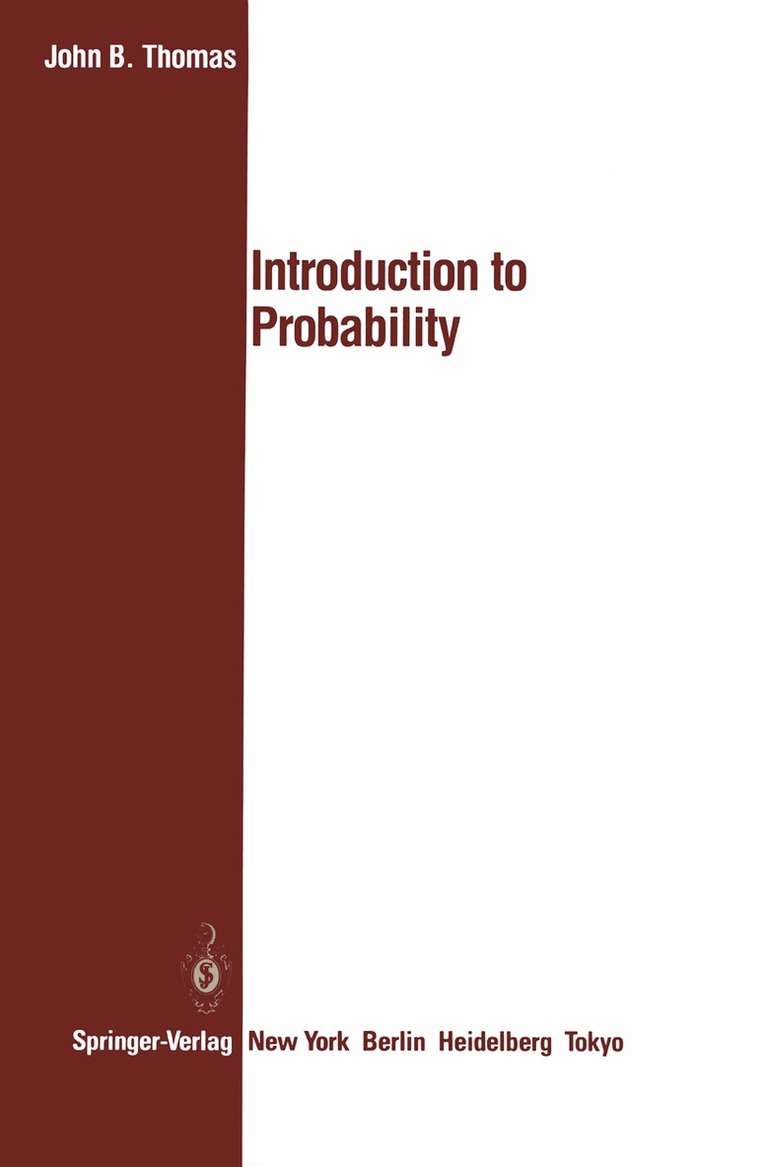
    Introduction to Probability

    AvJohn B. Thomas

    Häftad, Engelska, 1986

    Del i serien Springer Texts in Electrical Engineering

    546 kr

    Beställningsvara. Skickas inom 10-15 vardagar. Fri frakt över 249 kr.

    Fler format och utgåvor

    E-bok

    710 kr

    Beskrivning

    This book was written for an introductory one-term course in probability. It is intended to provide the minimum background in probability that is necessary for students interested in applications to engineering and the sciences. Although it is aimed primarily at upperclassmen and beginning graduate students, the only prere­ quisite is the standard calculus course usually required of under­ graduates in engineering and science. Most beginning students will have some intuitive notions of the meaning of probability based on experiences involving, for example, games of chance. This book develops from these notions a set of precise and ordered concepts comprising the elementary theory of probability. An attempt has been made to state theorems carefully, but the level of the proofs varies greatly from formal arguments to appeals to intuition. The book is in no way intended as a substi­ tu te for a rigorous mathematical treatment of probability. How­ ever, some small amount of the language of formal mathematics is used, so that the student may become better prepared (at least psychologically) either for more formal courses or for study of the literature. Numerous examples are provided throughout the book. Many of these are of an elementary nature and are intended merely to illustrate textual material. A reasonable number of problems of varying difficulty are provided. Instructors who adopt the text for classroom use may obtain a Solutions Manual for all of the problems by writing to the author.

    Produktinformation

    • Utgivningsdatum:1986-05-01
    • Mått:155 x 235 x undefined mm
    • Vikt:367 g
    • Format:Häftad
    • Språk:Engelska
    • Serie:Springer Texts in Electrical Engineering
    • Antal sidor:250
    • Förlag:Springer-Verlag New York Inc.
    • ISBN:9780387963198

    Utforska kategorier

    • Energiteknik inom Naturvetenskap och teknik
    • Teknik: allmänt inom Naturvetenskap och teknik

    Innehållsförteckning

    • 1-Introduction and Preliminary Concepts.- 1.1-Random Phenomena.- 1.2-Elements of Set Theory.- 1.3-A Classical Concept of Probability.- 1.4-Elements of Combinatorial Analysis.- 1.5-The Axiomatic Foundation of Probability Theory.- 1.6-Finite Sample Spaces.- 1.7-Fields, ?-Fields, and Infinite Sample Spaces.- 1.8-Conditional Probability and Independence.- Problems.- 2-Random Variables.- 2.1-Definition.- 2.2-Discrete Random Variables.- 2.3-Continuous Random Variables.- 2.4-Random Vectors.- 2.5-Independence of Random Variables.- Problems.- 8-Distribution and Density Functions.- 3.1-Distribution Functions.- 3.2-Properties of Distribution Functions.- 3.3-The Decomposition of Distribution Functions.- 3.4-Discrete Distributions and Densities.- 3.5-Continuous Distributions and Densities.- 3.6-Mixed Distributions and Densities.- 3.7-Further Properties and Comments.- 3.8-Bivariate Distributions.- 3.9-Bivariate Density Functions.- 3.10-Multivariate Distributions.- 3.11-Independence.- 3.12-Conditional Distributions.- Problems.- 4-Expectations and Characteristic Functions.- 4.1-Expectation.- 4.2-Moments.- 4.3-The Bienayme — Chebychev Theorem.- 4.4-The Moment Generating Function.- 4.5-The Chernoff Bound.- 4.6-The Characteristic Function.- 4.7-Covariances and Correlation Coefficients.- 4.8-Conditional Expectation.- 4.9-Least Mean-Squared Error Prediction.- Problems.- 5-The Binomial, Poisson, and Normal Distributions.- 5.1-The Binomial Distribution.- 5.2-The Poisson Distribution.- 5.3-The Normal or Gaussian Distribution.- 5.4-The Bivariate Normal Distribution.- 5.5-Rotations for Independence.- Problems.- 6-The Multivariate Normal Distribution.- 6.1-The Covariance Matrix.- 6.2-The Bivariate Normal Distribution in Matrix Form.- 6.3-The Multivariate Normal Distribution.- 6.4-MiscellaneousProperties of the Multivariate Normal Distribution.- 6.5-Linear Transformations on Normal Random Variables.- Problems.- 7-The Transformation of Random Variables.- 7.1-Discrete Random Variables.- 7.2-Continuous Random Variables; The Univariate Case.- 7.3-Continuous Random Variables; The Bivariate Case.- 7.4-Continuous Random Variables; A Special Case.- 7.5-Continuous Random Variables; The Multivariate Case.- Problems.- 8-Sequences of Random Variables.- 8.1-Convergence in the Deterministic Case.- 8.2-Convergence in Distribution.- 8.3-Convergence in Probability.- 8.4-Almost Sure Convergence.- 8.5-Convergence in r-th Mean.- 8.6-Relations Among Types of Convergence.- 8.7-Limit Theorems on Sums of Random Variables.- 8.8-The Weak Law of Large Numbers.- 8.9-The Strong Law of Large Numbers.- 8.10-The Central Limit Theorem.- Problems.- Appendices.- Appendix A — The Riemann-Stieltjes Integral.- Appendix B — The Dirac Delta Function.- Appendix C — Interchange of Order in Differentiation and Integration.- Appendix D — Some Elements of Matrix Theory.- Appendix E — The Differentiation of a Definite Integral.- Appendix F — A Monotone Non-Decreasing Function.- References.- Table I-The Unit Normal Distributions.