• Fri frakt över 249 kr
  • •
  • Snabba leveranser
  • •
  • Billiga böcker
Kundservice

Du är på sajten för privatpersoner.

Företag, bibliotek eller offentlig verksamhet?

Du handlar på classic.bokus.com, där alla dina funktioner finns intakta.
Till classic.bokus.com
Bokus logotyp. Gå till startsidan.
  • Erbjudanden
  • Nyheter
  • Student
  • Topplistor
  • Barn & ungdom
  • Bokus Play
  • E-böcker
  • Pocketböcker
  • Spel & pussel

10% rabatt på allt med kod: NYSTART10 →

Sidfot

Mina sidor

    Hjälp

    • Kundservice
    • Vanliga frågor och svar
    • Frakt och leverans
    • Retur vid ångerrätt
    • Reklamera vara
    • Betalning
    • Köpvillkor
    • Allmänna villkor
    • Information om webbplatsens tillgänglighet

    Om Bokus

    • Om oss
    • Pressrum
    • För studenter
    • För företag
    • För bibliotek och offentlig verksamhet
    • För leverantörer
    • Hållbarhet

    Populärt

    • Aktuella erbjudanden
    • Presentkort
    • Studentlitteratur
    • Nya böcker
    • Topplistor
    • Signerade böcker
    • Engelska böcker

    Inspiration

    • Boktips
    • BookTok
    • Populära bokserier
    • Barnbokskaraktärer
    • Populära författare
    Logotyp för Bokus
    Följ oss på Facebook (extern länk)Följ oss på Instagram (extern länk)Följ oss på YouTube (extern länk)Följ oss på TikTok (extern länk)
    bokus @ CookiesAnpassa cookiesIntegritetspolicyKöpvillkor
    Till Citymail hemsida (extern länk)Till Budbee hemsida (extern länk)Till Postnord hemsida (extern länk)Till Schenker hemsida (extern länk)Till Early Bird hemsida (extern länk)Till Walleys hemsida (extern länk)
    1. Data och IT
    2. Programmeringsböcker
    3. Programvaruutveckling

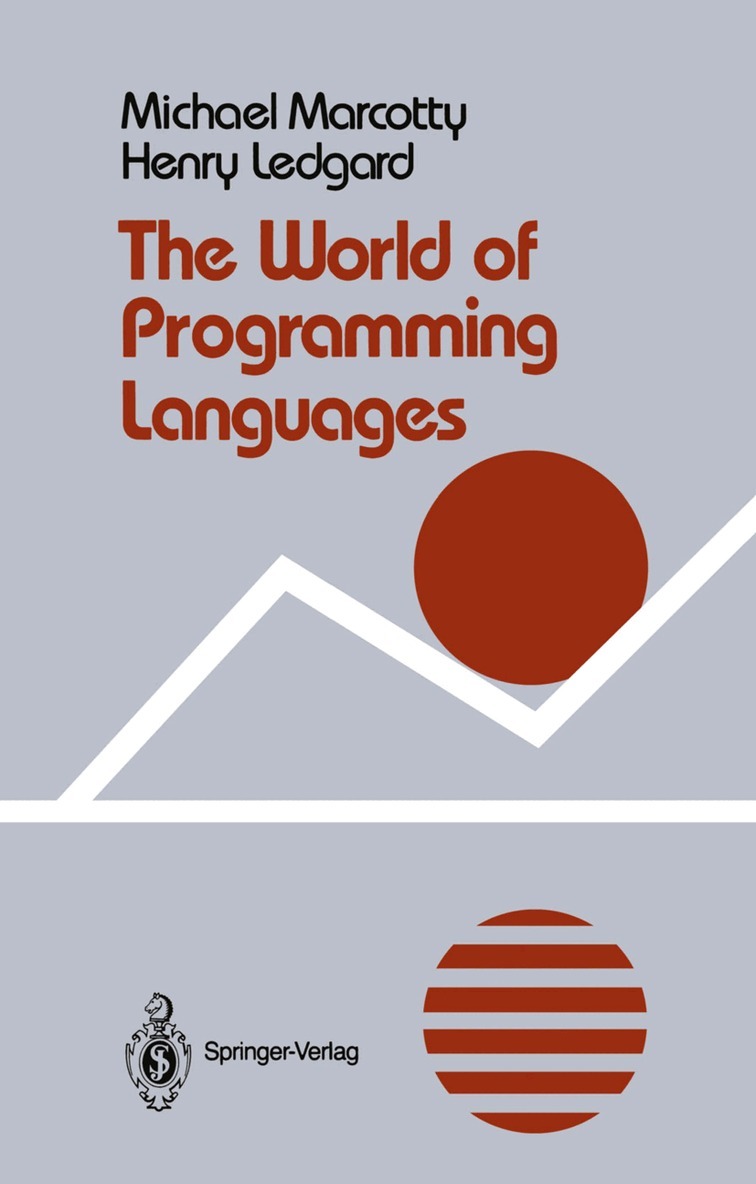
    World of Programming Languages

    AvMichael Marcotty,Henry Ledgard

    Häftad, Engelska, 1986

    Del i serien Springer Books on Professional Computing

    1 340 kr

    Beställningsvara. Skickas inom 10-15 vardagar. Fri frakt över 249 kr.

    Beskrivning

    The earth, viewed through the window of an airplane, shows a regularity and reptition of features, for example, hills, valleys, rivers, lakes, and forests. Nevertheless, there is great local variation; Vermont does not look like Utah. Similarly, if we rise above the details of a few programming languages, we can discern features that are common to many languages. This is the programming language landscape; the main features include variables, types, control structures, and input/output. Again, there is local variation; Pascal does not look like Basic. This work is a broad and comprehensive discussion of the principal features of the major programming languages. A Study of Concepts The text surveys the landscape of programming languages and its features. Each chapter concentrates on a single language concept. A simple model of the feature, expressed as a mini-language, is presented. This allows us to study an issue in depth and relative isolation. Each chapter concludes with a discussion of the way in which the concept is incorporated into some well-known languages. This permits a reasonably complete coverage of language issues.

    Produktinformation

    • Utgivningsdatum:1986-12-16
    • Mått:155 x 235 x 21 mm
    • Vikt:575 g
    • Format:Häftad
    • Språk:Engelska
    • Serie:Springer Books on Professional Computing
    • Antal sidor:360
    • Förlag:Springer-Verlag New York Inc.
    • ISBN:9780387964409

    Utforska kategorier

    • Programvaruutveckling inom Data och IT
    • Programmeringsböcker inom Data och IT

    Innehållsförteckning

    • Preface.- Acknowledgements.- 1. Introduction.- 1.1 The Building of the Tower of Babel.- 1.2 What Is a Programming Language?.- 1.3 Why Study Programming Languages?.- 1.4 What Should We Look for in a Language?.- 1.5 Language Design Issues.- 1.6 The Study of Programming Languages.- Further Reading.- 2. Elements of a Programming Language.- 2.1 Informal Description of Mini-language Core.- 2.2 Informal Semantics of Mini-language Core.- 2.3 Language Design and the Programming Process.- 2.4 The Definition of Programming Languages.- 2.5 The Formal Description of Syntax.- 2.6 Other Context-free Syntax Definitions.- Further Reading.- 3. Names, Locations, and Values.- 3.1 Mini-language Ref.- 3.2 Declarations.- 3.3 Assignment.- 3.4 Statements as Expressions.- 3.5 Where to Look: Algol 68, Smalltalk.- Further Reading.- 4. Control Structures.- 4.1 Mini-language Control.- 4.2 Basic Control Structures and Flowgraphs.- 4.3 Theorems on Control Structures.- 4.4 Other One-in, One-out Control Structures.- 4.5 The Goto Statement and Label Values.- 4.6 Conclusions.- 4.7 Where to Look: Pascal, Ada.- Further Reading.- 5. Data Types.- 5.1 Mini-language Type.- 5.2 The Meaning of Type.- 5.3 Primitive Types.- 5.4 Array Types.- 5.5 Record Types.- 5.6 Type Checking.- 5.7 Where to Look: Fortran, PL/I.- Further Reading.- 6. Input and Output.- 6.1 Mini-language Format.- 6.2 Varieties of Input-output Specifications.- 6.3 Communication with the Outside World.- 6.4 Where to Look: Fortran, Cobol, Ada.- Further Reading.- 7. Procedures and Parameters.- 7.1 Mini-language Procedures.- 7.2 Procedures as Abstractions.- 7.3 Arguments and Parameters.- 7.4 Value-returning Procedures.- 7.5 Coroutines.- 7.6 Where to Look: PL/I, Ada.- Further Reading.- 8. Nesting and Scope.- 8.1 Mini-language Scope.- 8.2 The Idea of Scope.- 8.3 Storage Allocation.- 8.4 Dynamic Scope.- 8.5 Where to Look: Pascal, PL/I, APL.- Further Reading.- 9. Definition of New Data Types.- 9.1 Mini-language Typedef.- 9.2 Type Definitions.- 9.3 Definition of Structured Types.- 9.4 User Defined Operators.- 9.5 Where to Look: Pascal, Algol 68.- Further Reading.- 10. Dynamically Varying Structures.- 10.1 Mini-language Structures.- 10.2 Dynamically Varying Data Structures.- 10.3 Pointers.- 10.4 Design Criteria for Data Structures.- 10.5 Dynamic Allocation of Storage.- 10.6 Where to Look: PL/I, Pascal, Ada.- Further Reading.- 11. Exception Handling.- 11.1 Mini-language Exceptions.- 11.2 Exceptions.- 11.3 Issues in Exception Handling.- 11.4 Where to Look: PL/I, Ada.- Further Reading.- 12. Parallel Processing.- 12.1 Mini-language Parallel.- 12.2 A First Solution to the Decoding Problem.- 12.3 Putting a Buffer in a Task.- 12.4 Interrupting.- 12.5 Issues in Parallel Processing.- 12.6 Where to Look: Concurrent Pascal, Modula-2, Ada.- Further Reading.- 13. Separately Compiled Modules.- 13.1 Mini-language Modules.- 13.2 Packaging Subprograms.- 13.3 Abstract Data Types.- 13.4 Where to Look: PL/I, Modula 2, Ada, Smalltalk.- Further Reading.- 14. The Swamp of Complexity.- 14.1 The Forms of Complexity.- 14.2 Escaping from the Swamp.- References.