• Fri frakt över 249 kr
  • •
  • Snabba leveranser
  • •
  • Billiga böcker
Kundservice

Du är på sajten för privatpersoner.

Företag, bibliotek eller offentlig verksamhet?

Du handlar på classic.bokus.com, där alla dina funktioner finns intakta.
Till classic.bokus.com
Bokus logotyp. Gå till startsidan.
  • Erbjudanden
  • Nyheter
  • Student
  • Topplistor
  • Barn & ungdom
  • Bokus Play
  • E-böcker
  • Pocketböcker
  • Spel & pussel

10% rabatt på allt med kod NYSTART10 →

Sidfot

Mina sidor

    Hjälp

    • Kundservice
    • Vanliga frågor och svar
    • Frakt och leverans
    • Retur vid ångerrätt
    • Reklamera vara
    • Betalning
    • Köpvillkor
    • Allmänna villkor
    • Information om webbplatsens tillgänglighet

    Om Bokus

    • Om oss
    • Pressrum
    • För studenter
    • För företag
    • För bibliotek och offentlig verksamhet
    • För leverantörer
    • Hållbarhet

    Populärt

    • Aktuella erbjudanden
    • Presentkort
    • Studentlitteratur
    • Nya böcker
    • Topplistor
    • Signerade böcker
    • Engelska böcker

    Inspiration

    • Boktips
    • BookTok
    • Populära bokserier
    • Barnbokskaraktärer
    • Populära författare
    Logotyp för Bokus
    Följ oss på Facebook (extern länk)Följ oss på Instagram (extern länk)Följ oss på YouTube (extern länk)Följ oss på TikTok (extern länk)
    bokus @ CookiesAnpassa cookiesIntegritetspolicyKöpvillkor
    Till Citymail hemsida (extern länk)Till Budbee hemsida (extern länk)Till Postnord hemsida (extern länk)Till Schenker hemsida (extern länk)Till Early Bird hemsida (extern länk)Till Walleys hemsida (extern länk)
    1. Psykologi och pedagogik
    2. Psykologi

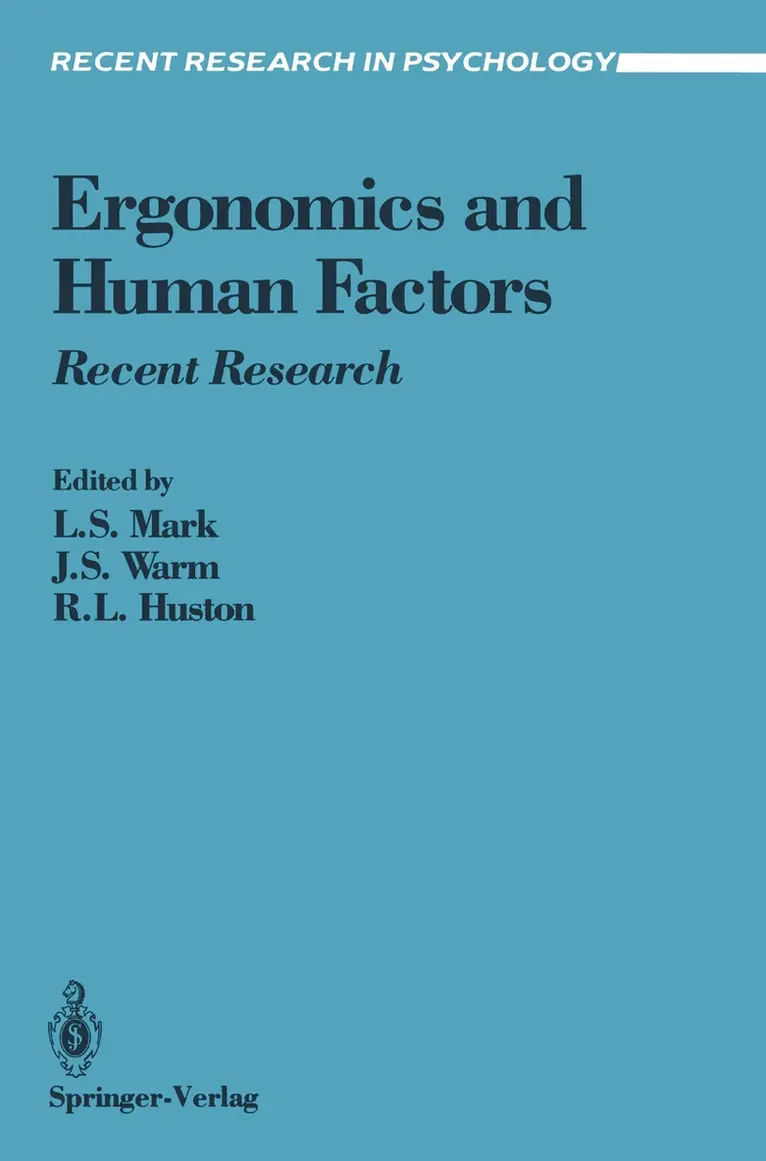
    Ergonomics and Human Factors

    Recent Research

    AvLeonard S. Mark,Joel S. Warm

    Häftad, Engelska, 1987

    Del i serien Recent Research in Psychology

    1 055 kr

    Beställningsvara. Skickas inom 10-15 vardagar. Fri frakt över 249 kr.

    Beskrivning

    And Applications To The Human-Computer Interface Michael E. Fotta AT&T Communications 16th FIr. Atrium II, Cincinnati, OH 45202 Artificial intelligence (AI) programs represent knowledge in a fashion similar to human knowledge and the activities of an AI system are closer to human behavior than that of traditional systems. Thus, AI enables the computer to act more like a human instead of making the human think and act more like a computer. This capability combined with applying human factors concepts to the interface can greatly improve the human-computer interface. This paper provides an intro­ duction to artificial intelligence and then proposes a number of methods for using AI to improve the human-machine inter­ action. AN INTRODUCTION TO ARTIFICIAL INTELLIGENCE Definition There are many definitions of artificial intelligence (AI) running from the very general to the very detailed. Perhaps the most well accepted general definition is that by Elaine Rich: "Artificial intelligence is the study of how to make computers do things at which, at the moment, people are better", (Rich, 1983). A good example of a detailed definition is provided by the Brattle Research Corporation; "In simplified terms, artificial intelligence works with pattern matching methods which attempt to describe objects, events or pro­ cesses in terms of their qualitative features and logical and compu­ tational relationships," (Mishkoff, 1985).

    Produktinformation

    • Utgivningsdatum:1987-05-18
    • Mått:155 x 235 x 17 mm
    • Vikt:458 g
    • Format:Häftad
    • Språk:Engelska
    • Serie:Recent Research in Psychology
    • Antal sidor:291
    • Förlag:Springer-Verlag New York Inc.
    • ISBN:9780387965116

    Utforska kategorier

    • Psykologi inom Psykologi och pedagogik

    Innehållsförteckning

    • Editors’ Introduction: An Overview of Ergonomics and Human Factors.- I. Human Information Processing.- 1. Overview Paper: Vigilance: Taxonomy and Utility.- 2. Event Asychrony and Task Demands in Sustained Attention.- 3. Overview Paper: Perception and Control of Self-Motion: Implications for Visual Simulation of Vehicular Locomotion.- 4. Overview Paper: An Overview of Cognitive Psychology.- 5. Error Factors in Recognition Memory.- 6. Visual Motion Processing and Display Design.- 7. Overview Paper: Skill Learning and Human Factors.- 8. The Speed and Accuracy of Movements as a Function of Constraints to Action.- 9. Topological Characteristics in the Acquisition of Coordination.- 10. Augmented Information Feedback and Task Constraints.- 11. Whole-Task and Part-Task Training in Dual Motor Tasks.- 12. Overview Paper: Consistent Mapping, Invariants and the Training of Perceptual-Motor Skills.- II. Fitting the Environment to the Person.- 13. Overview Paper: Falls in the Elderly: The Need for New Research.- 14. A Questionnaire Survey to Assess Rating of Physical Workplace Conditions, Somatic Discomfort and Work Efficiency Among VDT Users.- 15. Overview Paper: Health, Stress, and Workload In an Era of Workplace Change.- 16. Arousal Theory, Stress, and Performance: Problems of Incorporating Energetic Aspects of Behavior into Human-Machine Systems Function.- 17. Overview Paper: An Overview of Safety Engineering in Human Factors.- 18. Cognitive Aspects of Hazard Warning Labels.- 19. Application of Poisson Regression to the Injury Experience of Shiftworkers.- 20. An Examination of the Recovery Value of Various Restbreak Durations for an Analytical Task.- 21. Prediction of Blood Alcohol Concentration in Humans: Comments and Criticisms.- III. Human-Computer Interaction.- 22. OverviewPaper: Human-Computer Interaction: A Brief Glimpse of an Emerging Field.- 23. Individual Differences in Computer-Based Information Retrieval.- 24. I’ll Break Something and You Tell Me What Went Wrong: Methods for Evaluating the User Interface in Network Problem Determination Software.- 25. Objections to Objects: Limitations of Human Performance in the Use of Iconic Graphics.- 26. Overview Paper: Office Systems Documentation.- 27. Methods and Procedures in an On-Line System: A Proposed Solution.- 28. A Critical Incident Evaluation Tool for Software Documentation.- 29. Page Format and User Understanding of Command Language Computer Manuals.- 30. Overview Paper: Artificial Intelligence: An Introduction and Applications to the Human-Computer Interface.- 31. Natural Languages and Their Commercial Applications.- IV: An Assessment of the Human Factors Enterprise.- 32. Plenary Address: The Human Factors Technologies: Past Promises, Future Issues.