• Fri frakt över 249 kr
  • •
  • Snabba leveranser
  • •
  • Billiga böcker
Kundservice

Du är på sajten för privatpersoner.

Företag, bibliotek eller offentlig verksamhet?

Du handlar på classic.bokus.com, där alla dina funktioner finns intakta.
Till classic.bokus.com
Bokus logotyp. Gå till startsidan.
  • Erbjudanden
  • Student
  • Topplistor
  • Barn & ungdom
  • Bokus Play
  • E-böcker
  • Ljudböcker
  • Pocketböcker
  • Spel och pussel

5% studentrabatt – använd koden KURSBOK27 →

Sidfot

Mina sidor

    Hjälp

    • Kundservice
    • Vanliga frågor och svar
    • Frakt och leverans
    • Retur vid ångerrätt
    • Reklamera vara
    • Betalning
    • Köpvillkor
    • Allmänna villkor
    • Information om webbplatsens tillgänglighet

    Om Bokus

    • Om oss
    • Pressrum
    • För studenter
    • För företag
    • För bibliotek och offentlig verksamhet
    • För leverantörer
    • Hållbarhet

    Populärt

    • Aktuella erbjudanden
    • Presentkort
    • Studentlitteratur
    • Nya böcker
    • Topplistor
    • Signerade böcker
    • Engelska böcker

    Inspiration

    • Boktips
    • BookTok
    • Barnbokskaraktärer
    • Populära författare
    Logotyp för Bokus
    Följ oss på Facebook (extern länk)Följ oss på Instagram (extern länk)Följ oss på YouTube (extern länk)Följ oss på TikTok (extern länk)
    bokus @ CookiesAnpassa cookiesIntegritetspolicyKöpvillkor
    Till Citymail hemsida (extern länk)Till Budbee hemsida (extern länk)Till Postnord hemsida (extern länk)Till Schenker hemsida (extern länk)Till Early Bird hemsida (extern länk)Till Walleys hemsida (extern länk)
    1. Naturvetenskap och teknik
    2. Matematik och naturvetenskap
    3. Matematik
    4. Algebra

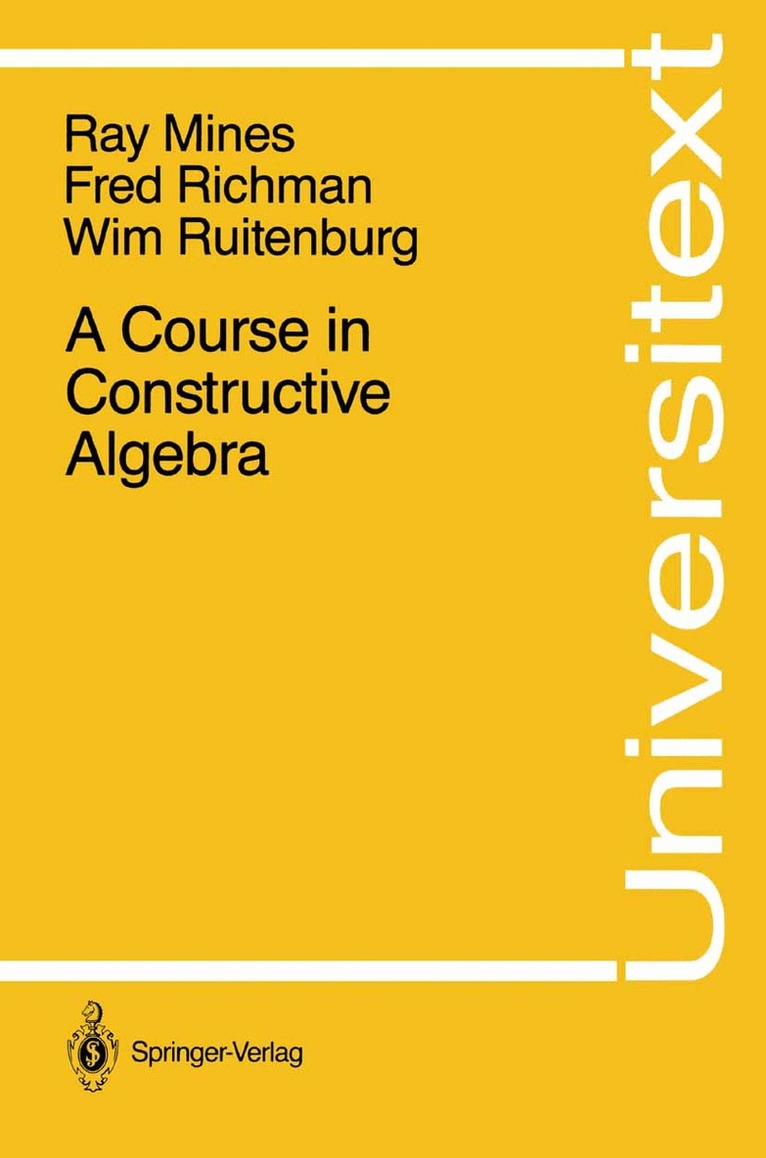
    Course in Constructive Algebra

    AvRay Mines,Fred Richman

    Häftad, Engelska, 1987

    Del i serien Universitext

    1 078 kr

    Beställningsvara. Skickas inom 10-15 vardagar. Fri frakt över 249 kr.

    Beskrivning

    The constructive approach to mathematics has enjoyed a renaissance, caused in large part by the appearance of Errett Bishop's book Foundations of constr"uctiue analysis in 1967, and by the subtle influences of the proliferation of powerful computers. Bishop demonstrated that pure mathematics can be developed from a constructive point of view while maintaining a continuity with classical terminology and spirit; much more of classical mathematics was preserved than had been thought possible, and no classically false theorems resulted, as had been the case in other constructive schools such as intuitionism and Russian constructivism. The computers created a widespread awareness of the intuitive notion of an effecti ve procedure, and of computation in principle, in addi tion to stimulating the study of constructive algebra for actual implementation, and from the point of view of recursive function theory. In analysis, constructive problems arise instantly because we must start with the real numbers, and there is no finite procedure for deciding whether two given real numbers are equal or not (the real numbers are not discrete) . The main thrust of constructive mathematics was in the direction of analysis, although several mathematicians, including Kronecker and van der waerden, made important contributions to construc­ tive algebra. Heyting, working in intuitionistic algebra, concentrated on issues raised by considering algebraic structures over the real numbers, and so developed a handmaiden'of analysis rather than a theory of discrete algebraic structures.

    Produktinformation

    • Utgivningsdatum:1987-12-18
    • Mått:155 x 235 x 20 mm
    • Vikt:546 g
    • Format:Häftad
    • Språk:Engelska
    • Serie:Universitext
    • Antal sidor:344
    • Upplaga:1988
    • Förlag:Springer-Verlag New York Inc.
    • ISBN:9780387966403

    Utforska kategorier

    • Algebra inom Naturvetenskap och teknik

    Innehållsförteckning

    • I. Sets.- 1. Constructive vs. classical mathematics.- 2. Sets, subsets and functions.- 3. Choice.- 4. Categories.- 5. Partially ordered sets and lattices.- 6. Well-founded sets and ordinals.- II. Basic Algebra.- 1. Groups.- 2. Rings and fields.- 3. Real numbers.- 4. Modules.- 5. Polynomial rings.- 6. Matrices and vector spaces.- 7. Determinants.- 8. Symmetric polynomials.- III. Rings And Modules.- 1. Quasi-regular ideals.- 2. Coherent and Noetherian modules.- 3. Localization.- 4. Tensor products.- 5. Flat modules.- 6. Local rings.- 7. Commutative local rings.- IV. Divisibility in Discrete Domains.- 1. Cancellation monoids.- 2. UFD's and Bézout domains.- 3. Dedekind-Hasse rings and Euclidean domains.- 4. Polynomial rings.- V. Principal Ideal Domains.- 1. Diagonalizing matrices.- 2. Finitely presented modules.- 3. Torsion modules, p-components, elementary divisors.- 4. Linear transformations.- VI. Field Theory.- 1. Integral extensions and impotent rings.- 2. Algebraic independence and transcendence bases.- 3. Splitting fields and algebraic closures.- 4. Separability and diagonalizability.- 5. Primitive elements.- 6. Separability and characteristic p.- 7. Perfect fields.- 8. Galois theory.- VII. Factoring Polynomials.- 1. Factorial and separably factorial fields.- 2. Extensions of (separably) factorial fields.- 3. Condition p.- 4. The fundamental theorem of algebra.- VIII. Commutative Noetherian Rings.- 1. The Hilbert basis theorem.- 2. Noether normalization and the Artin-Rees lemma.- 3. The Nullstellensatz.- 4. Tennenbaum' s approach to the Hilbert basis theorem.- 5. Primary ideals.- 6. Localization.- 7. Primary decomposition.- 8. Lasker-Noether rings.- 9. Fully Lasker-Noether rings.- 10. The principal ideal theorem.- IX. Finite Dimensional Algebras.- 1. Representations.- 2. The density theorem.- 3. The radical and summands.- 4. Wedderburn's theorem, part one.- 5. Matrix rings and division algebras.- X. Free Groups.- 1. Existence and uniqueness.- 2. Nielsen sets.- 3.Finitely generated subgroups.- 4. Detachable subgroups of finite-rank free groups.- 5. Conjugate subgroups.- XI. Abelian Groups.- 1. Finite-rank torsion-free groups.- 2. Divisible groups.- 3. Height functions on p-groups.- 4. Ulm's theorem.- 5. Construction of Ulm groups.- XII. Valuation Theory.- 1. Valuations.- 2. Locally precompact valuations.- 3. Pseudofactorial fields.- 4. Normed vector spaces.- 5. Real and complex fields.- 6. Hensel's lemma.- 7. Extensions of valuations.- 8. e and f.- XIII. Dedekind Domains.- 1. Dedekind sets of valuations.- 2. Ideal theory.- 3. Finite extensions.