• Fri frakt över 249 kr
  • •
  • Snabba leveranser
  • •
  • Billiga böcker
Kundservice

Du är på sajten för privatpersoner.

Företag, bibliotek eller offentlig verksamhet?

Du handlar på classic.bokus.com, där alla dina funktioner finns intakta.
Till classic.bokus.com
Bokus logotyp. Gå till startsidan.
  • Erbjudanden
  • Nyheter
  • Student
  • Topplistor
  • Barn & ungdom
  • Bokus Play
  • E-böcker
  • Pocketböcker
  • Spel & pussel

10% rabatt på allt med kod NYSTART10 →

Sidfot

Mina sidor

    Hjälp

    • Kundservice
    • Vanliga frågor och svar
    • Frakt och leverans
    • Retur vid ångerrätt
    • Reklamera vara
    • Betalning
    • Köpvillkor
    • Allmänna villkor
    • Information om webbplatsens tillgänglighet

    Om Bokus

    • Om oss
    • Pressrum
    • För studenter
    • För företag
    • För bibliotek och offentlig verksamhet
    • För leverantörer
    • Hållbarhet

    Populärt

    • Aktuella erbjudanden
    • Presentkort
    • Studentlitteratur
    • Nya böcker
    • Topplistor
    • Signerade böcker
    • Engelska böcker

    Inspiration

    • Boktips
    • BookTok
    • Populära bokserier
    • Barnbokskaraktärer
    • Populära författare
    Logotyp för Bokus
    Följ oss på Facebook (extern länk)Följ oss på Instagram (extern länk)Följ oss på YouTube (extern länk)Följ oss på TikTok (extern länk)
    bokus @ CookiesAnpassa cookiesIntegritetspolicyKöpvillkor
    Till Citymail hemsida (extern länk)Till Budbee hemsida (extern länk)Till Postnord hemsida (extern länk)Till Schenker hemsida (extern länk)Till Early Bird hemsida (extern länk)Till Walleys hemsida (extern länk)
    1. Naturvetenskap och teknik
    2. Matematik och naturvetenskap
    3. Matematik
    4. Beräkning och matematisk analys

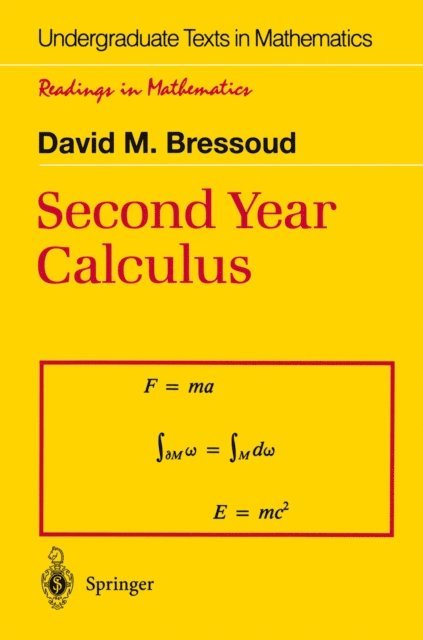
    Second Year Calculus

    From Celestial Mechanics to Special Relativity

    AvDavid M. Bressoud

    Häftad, Engelska, 1991

    Del i serien Undergraduate Texts in Mathematics

    611 kr

    Beställningsvara. Skickas inom 10-15 vardagar. Fri frakt över 249 kr.

    Fler format och utgåvor

    E-bok

    805 kr

    Beskrivning

    Second Year Calculus: From Celestial Mechanics to Special Relativity covers multi-variable and vector calculus, emphasizing the historical physical problems which gave rise to the concepts of calculus. The book carries us from the birth of the mechanized view of the world in Isaac Newton's Mathematical Principles of Natural Philosophy in which mathematics becomes the ultimate tool for modelling physical reality, to the dawn of a radically new and often counter-intuitive age in Albert Einstein's Special Theory of Relativity in which it is the mathematical model which suggests new aspects of that reality. The development of this process is discussed from the modern viewpoint of differential forms. Using this concept, the student learns to compute orbits and rocket trajectories, model flows and force fields, and derive the laws of electricity and magnetism. These exercises and observations of mathematical symmetry enable the student to better understand the interaction of physics and mathematics.

    Produktinformation

    • Utgivningsdatum:1991-08-08
    • Mått:155 x 235 x 22 mm
    • Vikt:610 g
    • Format:Häftad
    • Språk:Engelska
    • Serie:Undergraduate Texts in Mathematics
    • Antal sidor:404
    • Upplaga:1991
    • Förlag:Springer-Verlag New York Inc.
    • ISBN:9780387976068

    Utforska kategorier

    • Beräkning och matematisk analys inom Naturvetenskap och teknik

    Recensioner i media

    The subtitle of this book, "From celestial mechanics to special relativity" is correctly indicative of its content, and in the preface, the author enthusiastically pleads guilty to blurring the line between mathematics and physics. One of the book's merits is the substantive historical material given. Among other purposes this serves to show the physics setting in which many calculus concepts have their origin. The book eventually gets around to a fairly honest mathematical treatment of the traditional material of advanced calculus via differential forms, but before arriving at this in Chapter 5, mathematics students are likely to have some frustrating experiences. In Chapter 4 one encounters "we define $\int\sp{bar b}\sb{bar a}f\sb 1(x,y,z)dx+f\sb 2(x,y,z)dy+f\sb 3(x,y,z)dz$ to be the work done by this force field as it moves a particle along the directed line segment from $bar a$ to $bar b$". Exercise 8 at the end of this section states "Prove that in an arbitrary force field the amount of work done in moving from $bar a$ to $bar b$ may be dependent on the path". So, one asks oneself, how is {\it work} defined? Nothing more is to be found than the statement in Chapter 2 that work is force times distance, and the resulting representation as a dot product of vectors. The book has much to recommend it. If the first four chapters are primarily to serve as providing some intuitive foundation, it might be better to more explicitly acknowledge this, and to find a more appropriate formulation for whatever is intended in exercises such as the one cited above. ZENTRALBLATT MATH

    Innehållsförteckning

    • 1 F=ma.- 1.1 Prelude to Newton’s Principia.- 1.2 Equal Area in Equal Time.- 1.3 The Law of Gravity.- 1.4 Exercises.- 1.5 Reprise with Calculus.- 1.6 Exercises.- 2 Vector Algebra.- 2.1 Basic Notions.- 2.2 The Dot Product.- 2.3 The Cross Product.- 2.4 Using Vector Algebra.- 2.5 Exercises.- 3 Celestial Mechanics.- 3.1 The Calculus of Curves.- 3.2 Exercises.- 3.3 Orbital Mechanics.- 3.4 Exercises.- 4 Differential Forms.- 4.1 Some History.- 4.2 Differential 1-Forms.- 4.3 Exercises.- 4.4 Constant Differential 2-Forms.- 4.5 Exercises.- 4.6 Constant Differential k-Forms.- 4.7 Prospects.- 4.8 Exercises.- 5 Line Integrals, Multiple Integrals.- 5.1 The Riemann Integral.- 5.2 Line Integrals.- 5.3 Exercises.- 5.4 Multiple Integrals.- 5.5 Using Multiple Integrals.- 5.6 Exercises.- 6 Linear Transformations.- 6.1 Basic Notions.- 6.2 Determinants.- 6.3 History and Comments.- 6.4 Exercises.- 6.5 Invertibility.- 6.6 Exercises.- 7 Differential Calculus.- 7.1 Limits.- 7.2 Exercises.- 7.3 Directional Derivatives.- 7.4 The Derivative.- 7.5 Exercises.- 7.6 The Chain Rule.- 7.7 Using the Gradient.- 7.8 Exercises.- 8 Integration by Pullback.- 8.1 Change of Variables.- 8.2 Interlude with Lagrange.- 8.3 Exercises.- 8.4 The Surface Integral.- 8.5 Heat Flow.- 8.6 Exercises.- 9 Techniques of Differential Calculus.- 9.1 Implicit Differentiation.- 9.2 Invertibility.- 9.3 Exercises.- 9.4 Locating Extrema.- 9.5 Taylor’s Formula in Several Variables.- 9.6 Exercises.- 9.7 Lagrange Multipliers.- 9.8 Exercises.- 10 The Fundamental Theorem of Calculus.- 10.1 Overview.- 10.2 Independence of Path.- 10.3 Exercises.- 10.4 The Divergence Theorems.- 10.5 Exercises.- 10.6 Stokes’ Theorem.- 10.7 Summary for R3.- 10.8 Exercises.- 10.9 Potential Theory.- 11 E = mc2.- 11.1 Prelude to Maxwell’s Dynamical Theory.-11.2 Flow in Space-Time.- 11.3 Electromagnetic Potential.- 11.4 Exercises.- 11.5 Special Relativity.- 11.6 Exercises.- Appendices.- A An Opportunity Missed 361.- B Bibliography 365.- C Clues and Solutions 367.- Index 382.