• Fri frakt över 249 kr
  • •
  • Snabba leveranser
  • •
  • Billiga böcker
Kundservice

Du är på sajten för privatpersoner.

Företag, bibliotek eller offentlig verksamhet?

Du handlar på classic.bokus.com, där alla dina funktioner finns intakta.
Till classic.bokus.com
Bokus logotyp. Gå till startsidan.
  • Erbjudanden
  • Nyheter
  • Student
  • Topplistor
  • Barn & ungdom
  • Bokus Play
  • E-böcker
  • Pocketböcker
  • Spel & pussel

10% rabatt på allt med kod NYSTART10 →

Sidfot

Mina sidor

    Hjälp

    • Kundservice
    • Vanliga frågor och svar
    • Frakt och leverans
    • Retur vid ångerrätt
    • Reklamera vara
    • Betalning
    • Köpvillkor
    • Allmänna villkor
    • Information om webbplatsens tillgänglighet

    Om Bokus

    • Om oss
    • Pressrum
    • För studenter
    • För företag
    • För bibliotek och offentlig verksamhet
    • För leverantörer
    • Hållbarhet

    Populärt

    • Aktuella erbjudanden
    • Presentkort
    • Studentlitteratur
    • Nya böcker
    • Topplistor
    • Signerade böcker
    • Engelska böcker

    Inspiration

    • Boktips
    • BookTok
    • Populära bokserier
    • Barnbokskaraktärer
    • Populära författare
    Logotyp för Bokus
    Följ oss på Facebook (extern länk)Följ oss på Instagram (extern länk)Följ oss på YouTube (extern länk)Följ oss på TikTok (extern länk)
    bokus @ CookiesAnpassa cookiesIntegritetspolicyKöpvillkor
    Till Citymail hemsida (extern länk)Till Budbee hemsida (extern länk)Till Postnord hemsida (extern länk)Till Schenker hemsida (extern länk)Till Early Bird hemsida (extern länk)Till Walleys hemsida (extern länk)
    1. Medicin
    2. Andra medicinska specialiteter
    3. Psykiatri

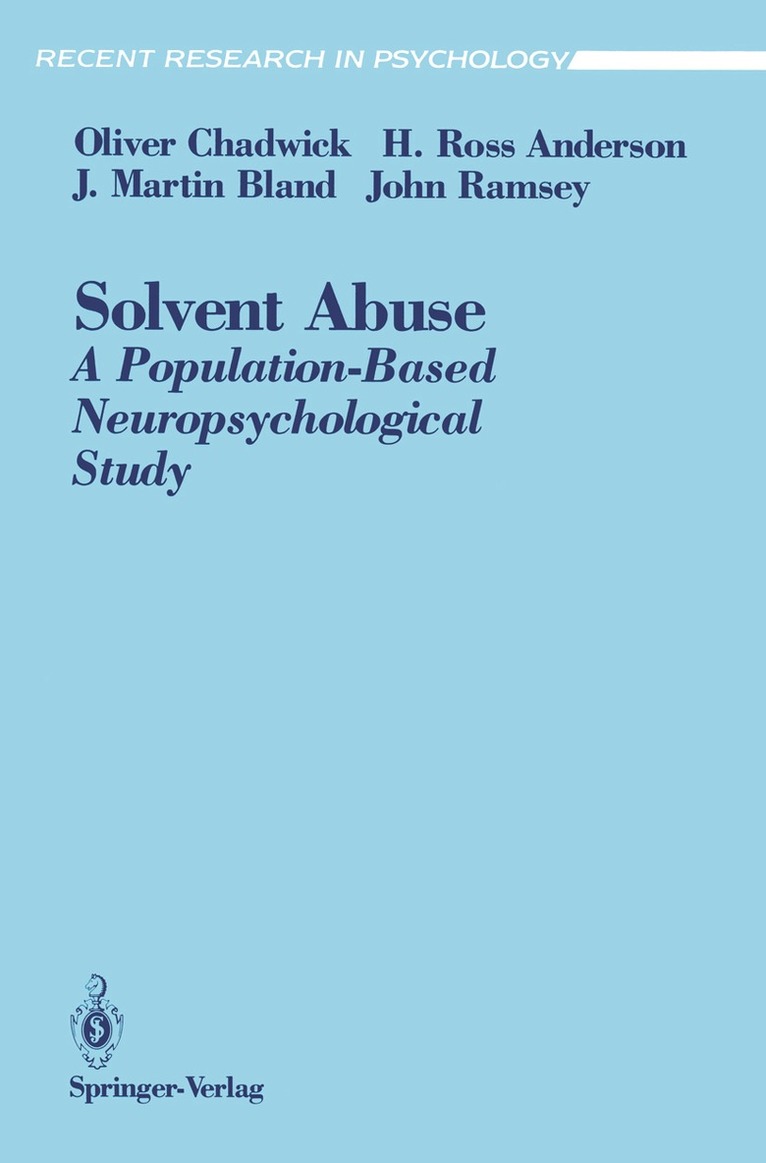
    Solvent Abuse

    A Population-Based Neuropsychological Study

    AvOliver Chadwick,H. Ross Anderson

    Häftad, Engelska, 1991

    Del i serien Recent Research in Psychology

    1 118 kr

    Beställningsvara. Skickas inom 10-15 vardagar. Fri frakt över 249 kr.

    Beskrivning

    1. 1 History of Solvent Abuse The practice of deliberately inhaling various gases or vapors in order to induce an altered state of mood or sensibility is not new. As noted repeatedly in other reviews (eg, Cohen, 1973; Novak, 1980), it was recognized in early Greek civilization as an adjunct to divination; indeed, it has now become customary, if not obligatory, to refer to the Oracle at Delphi before considering the more recent history of the subject. According to legend, the priestess at the Temple at Delphi would achieve communion with the Gods by inhaling the naturally-occurring gas that emanated from a fissure in a rock. Inhalation would induce a trance-like state. Her mystical observations and utterances while in this state were interpreted by the Temple Prophet and issued as divine pronouncements to those seeking guidance. Incenses, perfumes and spices have probably always been used in ceremonial worship and religious ritual. However, in sofar as it is possible to make the distinction, these substances have been used primarily for their aromatic qualities rather than for their intoxicating effects. The recreational use of gases and vapors dates from the end of the eighteenth century and may be seen as a concomitant of the scientific advances that preceded the industrial revolution. Following the synthesis of nitrous oxide by Sir Joseph Priestley in 1776, the potential uses of the gas were explored in depth by Sir Humphrey Davy.

    Produktinformation

    • Utgivningsdatum:1991-10-22
    • Mått:155 x 235 x 10 mm
    • Vikt:260 g
    • Format:Häftad
    • Språk:Engelska
    • Serie:Recent Research in Psychology
    • Antal sidor:150
    • Upplaga:1991
    • Förlag:Springer-Verlag New York Inc.
    • ISBN:9780387976075

    Utforska kategorier

    • Psykiatri inom Medicin

    Innehållsförteckning

    • 1 Introduction.- 1.1 History of Solvent Abuse.- 1.2 The Abused Substances.- 1.3 Neurological and Neuropsychological Consequences of Abuse.- 1.4 Additional Issues to Be Adressed in the Study.- 1.5 Rationale of the Design of the Present Investigation.- 2 Method.- 2.1 Summary.- 2.2 The Target Population.- 2.3 Parental Permission and Absentees.- 2.4 The Screening Questionnaire.- 2.5 The Individual Assessments.- 2.6 Information Obtained from the Schools.- 2.7 Definition and Composition of the Case and Control Groups.- 2.8 The Follow-up Assessment.- 2.9 Statistical Methods.- 3 Results.- 3.1 Epidemiological Aspects of Solvent Abuse.- 3.2 Comparison Between the Questionnaire, Interview and Toxicological Findings.- 3.3 The History and Pattern of Solvent Abuse in Cases Confirmed at Interview.- 3.4 Background Characteristics of the Solvent Abusers.- 3.5 Psychological Test Results.- 3.6 Educational Test Results Antecedent to Solvent Abuse.- 3.7 Follow-up.- 4 Discussion.- 4.1 Epidemiological Aspects of Solvent Abuse.- 4.2 The Practice of Solvent Abuse.- 4.3 Characteristics of Children Who Abused Solvents.- 4.4 Neuropsychological Consequences of Solvent Abuse.- 5 Summary of Main Findings.- Appendix A: Self-completed Screening Questionnaire.- Appendix B: Psychological Test Battery (Initial Assessment).- Appendix C: Psychological Test Introduced for Follow-up Assessment.- References.- Tables.- Figures.