• Fri frakt över 249 kr
  • •
  • Snabba leveranser
  • •
  • Billiga böcker
Kundservice

Du är på sajten för privatpersoner.

Företag, bibliotek eller offentlig verksamhet?

Du handlar på classic.bokus.com, där alla dina funktioner finns intakta.
Till classic.bokus.com
Bokus logotyp. Gå till startsidan.
  • Erbjudanden
  • Nyheter
  • Student
  • Topplistor
  • Barn & ungdom
  • Bokus Play
  • E-böcker
  • Pocketböcker
  • Spel & pussel

10% rabatt på allt med kod NYSTART10 →

Sidfot

Mina sidor

    Hjälp

    • Kundservice
    • Vanliga frågor och svar
    • Frakt och leverans
    • Retur vid ångerrätt
    • Reklamera vara
    • Betalning
    • Köpvillkor
    • Allmänna villkor
    • Information om webbplatsens tillgänglighet

    Om Bokus

    • Om oss
    • Pressrum
    • För studenter
    • För företag
    • För bibliotek och offentlig verksamhet
    • För leverantörer
    • Hållbarhet

    Populärt

    • Aktuella erbjudanden
    • Presentkort
    • Studentlitteratur
    • Nya böcker
    • Topplistor
    • Signerade böcker
    • Engelska böcker

    Inspiration

    • Boktips
    • BookTok
    • Populära bokserier
    • Barnbokskaraktärer
    • Populära författare
    Logotyp för Bokus
    Följ oss på Facebook (extern länk)Följ oss på Instagram (extern länk)Följ oss på YouTube (extern länk)Följ oss på TikTok (extern länk)
    bokus @ CookiesAnpassa cookiesIntegritetspolicyKöpvillkor
    Till Citymail hemsida (extern länk)Till Budbee hemsida (extern länk)Till Postnord hemsida (extern länk)Till Schenker hemsida (extern länk)Till Early Bird hemsida (extern länk)Till Walleys hemsida (extern länk)
    1. Naturvetenskap och teknik
    2. Matematik och naturvetenskap
    3. Matematik
    4. Algebra

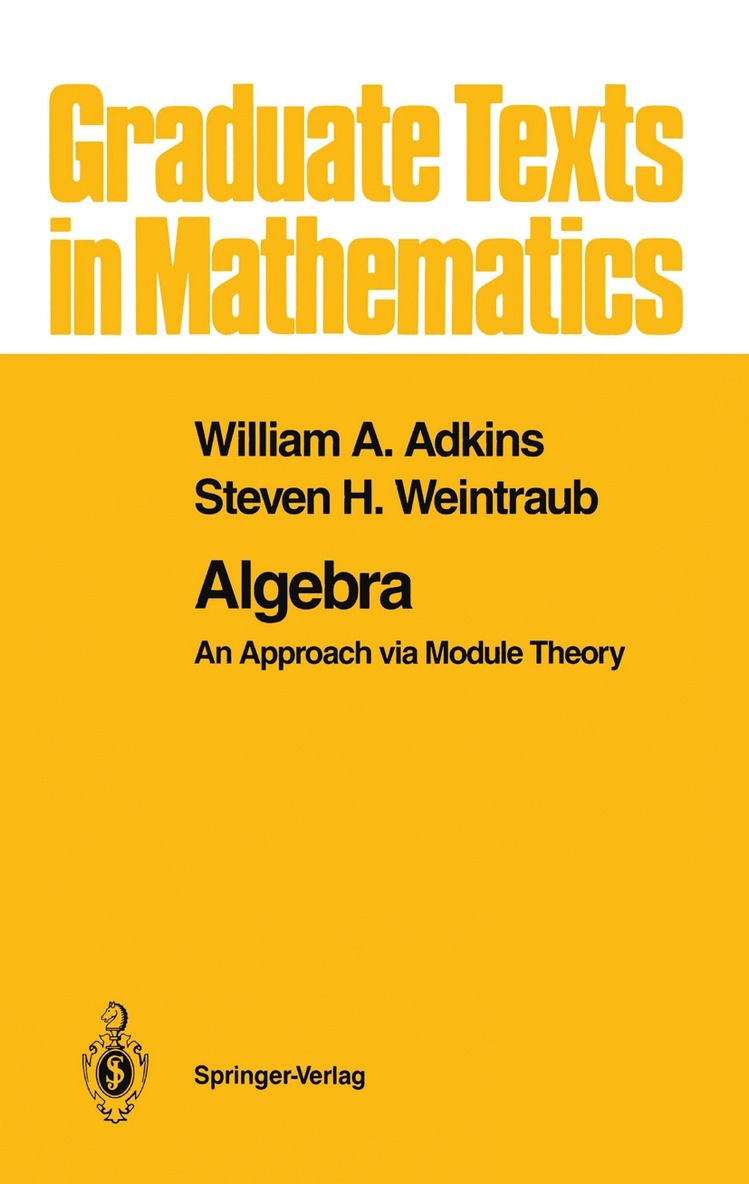
    Algebra

    An Approach via Module Theory

    AvWilliam A. Adkins,Steven H. Weintraub

    Inbunden, Engelska, 1992

    Del 136 i serien Graduate Texts in Mathematics

    1 085 kr

    Beställningsvara. Skickas inom 10-15 vardagar. Fri frakt över 249 kr.

    Fler format och utgåvor

    Häftad

    761 kr

    Beskrivning

    This book is designed as a text for a first-year graduate algebra course. As necessary background we would consider a good undergraduate linear algebra course. An undergraduate abstract algebra course, while helpful, is not necessary (and so an adventurous undergraduate might learn some algebra from this book). Perhaps the principal distinguishing feature of this book is its point of view. Many textbooks tend to be encyclopedic. We have tried to write one that is thematic, with a consistent point of view. The theme, as indicated by our title, is that of modules (though our intention has not been to write a textbook purely on module theory). We begin with some group and ring theory, to set the stage, and then, in the heart of the book, develop module theory. Having developed it, we present some of its applications: canonical forms for linear transformations, bilinear forms, and group representations. Why modules? The answer is that they are a basic unifying concept in mathematics. The reader is probably already familiar with the basic role that vector spaces play in mathematics, and modules are a generaliza­ tion of vector spaces. (To be precise, modules are to rings as vector spaces are to fields.

    Produktinformation

    • Utgivningsdatum:1992-09-03
    • Mått:155 x 235 x 35 mm
    • Vikt:975 g
    • Format:Inbunden
    • Språk:Engelska
    • Serie:Graduate Texts in Mathematics
    • Antal sidor:526
    • Upplaga:2
    • Förlag:Springer-Verlag New York Inc.
    • ISBN:9780387978390

    Utforska kategorier

    • Algebra inom Naturvetenskap och teknik

    Innehållsförteckning

    • 1 Groups.- 1.1 Definitions and Examples.- 1.2 Subgroups and Cosets.- 1.3 Normal Subgroups, Isomorphism Theorems, and Automorphism Groups.- 1.4 Permutation Representations and the Sylow Theorems.- 1.5 The Symmetric Group and Symmetry Groups.- 1.6 Direct and Semidirect Products.- 1.7 Groups of Low Order.- 1.8 Exercises.- 2 Rings.- 2.1 Definitions and Examples.- 2.2 Ideals, Quotient Rings, and Isomorphism Theorems.- 2.3 Quotient Fields and Localization.- 2.4 Polynomial Rings.- 2.5 Principal Ideal Domains and Euclidean Domains.- 2.6 Unique Factorization Domains.- 2.7 Exercises.- 3 Modules and Vector Spaces.- 3.1 Definitions and Examples.- 3.2 Submodules and Quotient Modules.- 3.3 Direct Sums, Exact Sequences, and Horn.- 3.4 Free Modules.- 3.5 Projective Modules.- 3.6 Free Modules over a PID.- 3.7 Finitely Generated Modules over PIDs.- 3.8 Complemented Submodules.- 3.9 Exercises.- 4 Linear Algebra.- 4.1 Matrix Algebra.- 4.2 Determinants and Linear Equations.- 4.3 Matrix Representation of Homomorphisms.- 4.4 Canonical Form Theory.- 4.5 Computational Examples.- 4.6 Inner Product Spaces and Normal Linear Transformations.- 4.7 Exercises.- 5 Matrices over PIDs.- 5.1 Equivalence and Similarity.- 5.2 Hermite Normal Form.- 5.3 Smith Normal Form.- 5.4 Computational Examples.- 5.5 A Rank Criterion for Similarity.- 5.6 Exercises.- 6 Bilinear and Quadratic Forms.- 6.1 Duality.- 6.2 Bilinear and Sesquilinear Forms.- 6.3 Quadratic Forms.- 6.4 Exercises.- 7 Topics in Module Theory.- 7.1 Simple and Semisimple Rings and Modules.- 7.2 Multilinear Algebra.- 7.3 Exercises.- 8 Group Representations.- 8.1 Examples and General Results.- 8.2 Representations of Abelian Groups.- 8.3 Decomposition of the Regular Representation.- 8.4 Characters.- 8.5 Induced Representations.- 8.6 Permutation Representations.- 8.7 Concluding Remarks.- 8.8 Exercises.- Index of Notation.- Index of Terminology.