• Fri frakt över 249 kr
  • •
  • Snabba leveranser
  • •
  • Billiga böcker
Kundservice

Du är på sajten för privatpersoner.

Företag, bibliotek eller offentlig verksamhet?

Du handlar på classic.bokus.com, där alla dina funktioner finns intakta.
Till classic.bokus.com
Bokus logotyp. Gå till startsidan.
  • Erbjudanden
  • Nyheter
  • Student
  • Topplistor
  • Barn & ungdom
  • Bokus Play
  • E-böcker
  • Pocketböcker
  • Spel & pussel

10% rabatt på allt med kod NYSTART10 →

Sidfot

Mina sidor

    Hjälp

    • Kundservice
    • Vanliga frågor och svar
    • Frakt och leverans
    • Retur vid ångerrätt
    • Reklamera vara
    • Betalning
    • Köpvillkor
    • Allmänna villkor
    • Information om webbplatsens tillgänglighet

    Om Bokus

    • Om oss
    • Pressrum
    • För studenter
    • För företag
    • För bibliotek och offentlig verksamhet
    • För leverantörer
    • Hållbarhet

    Populärt

    • Aktuella erbjudanden
    • Presentkort
    • Studentlitteratur
    • Nya böcker
    • Topplistor
    • Signerade böcker
    • Engelska böcker

    Inspiration

    • Boktips
    • BookTok
    • Populära bokserier
    • Barnbokskaraktärer
    • Populära författare
    Logotyp för Bokus
    Följ oss på Facebook (extern länk)Följ oss på Instagram (extern länk)Följ oss på YouTube (extern länk)Följ oss på TikTok (extern länk)
    bokus @ CookiesAnpassa cookiesIntegritetspolicyKöpvillkor
    Till Citymail hemsida (extern länk)Till Budbee hemsida (extern länk)Till Postnord hemsida (extern länk)Till Schenker hemsida (extern länk)Till Early Bird hemsida (extern länk)Till Walleys hemsida (extern länk)
    1. Naturvetenskap och teknik
    2. Teknik och industri
    3. Teknik: allmänt

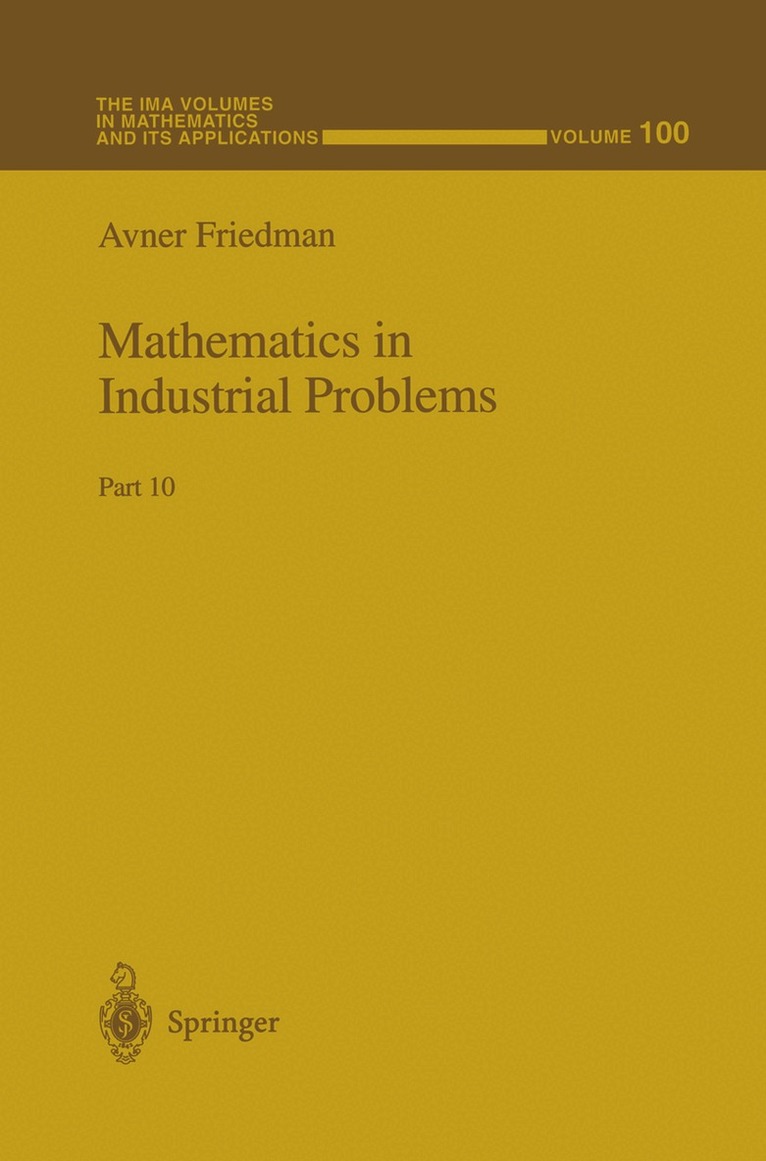
    Mathematics in Industrial Problems

    Part 10

    AvAvner Friedman

    Inbunden, Engelska, 1998

    Del i serien IMA Volumes in Mathematics and its Applications

    1 085 kr

    Beställningsvara. Skickas inom 10-15 vardagar. Fri frakt över 249 kr.

    Beskrivning

    This is the tenth volume in Avner Friedman's collection of Mathematics in Industrial Problems. These books aim to foster interaction between industry and mathematics at the "grass roots" level of specific problems. The problems presented in this book arise from models developed by industrial scientists engaged in research and development of new or improved products. The author's sources are affiliated with a variety of industrial enterprises including Motorola, IBM, Ford Motor Company, Eastman Kodak, 3M, AT&T Labs, Honeywell, and Schlumberger-Doll Research. The topics explored in this volume include semiconductor devices and microaccelerometers, computational aeroacoustics, coating flows, coalescence, electrorheological fluids, mass transport in particle- loaded beds, metal cutting processes, network traffic analysis, risk management, micromagnetics, and cooling systems. Open problems and references to mathematical literature are incorporated into most of the chapters. The final chapter contains solutions to problems raised in previous parts of the series, Mathematics in Industrial Problems, published in the IMA Volumes in Mathematics and its Applications.

    Produktinformation

    • Utgivningsdatum:1998-06-12
    • Mått:155 x 235 x undefined mm
    • Format:Inbunden
    • Språk:Engelska
    • Serie:IMA Volumes in Mathematics and its Applications
    • Antal sidor:189
    • Förlag:Springer-Verlag New York Inc.
    • ISBN:9780387985183

    Utforska kategorier

    • Teknik: allmänt inom Naturvetenskap och teknik
    • Naturvetenskap:allmänt inom Naturvetenskap och teknik

    Innehållsförteckning

    • 1 Simulation and modeling of updrain TMOS devices.- 1.1 Applications.- 1.2 Structure of a smart power device.- 1.3 Mathematical models.- 1.4 Solution to problem (1).- 1.5 Partial solution to problem (3).- 1.6 References.- 2 Strategic risk management using stochastic programming.- 2.1 Dynamic programming.- 2.2 Stochastic programming.- 2.3 Bundling.- 2.4 Epiconsistency.- 2.5 Future directions.- 2.6 References.- 3 Discrete fluids using lattice gas methods.- 3.1 Computational aeroacoustics.- 3.2 Lattice gas methods.- 3.3 Hypercubic lattice.- 3.3.1 Aerodynamic studies.- 3.3.2 Acoustic study.- 3.4 Open opportunities.- 3.5 References.- 4 Computer-aided design of developable surfaces.- 4.1 Developable surfaces.- 4.2 Properties of developable surfaces.- 4.3 Developable Bézier surfaces.- 4.4 Open problems.- 4.5 References.- 5 Modeling techniques for computation of coating flows.- 5.1 Coating configuration.- 5.2 The governing equations.- 5.3 Fluid flow in a slot.- 5.4 Inclined boundary.- 5.5 References.- 6 Measuring coalescence rates.- 6.1 The coalescence problem.- 6.2 Introducing chemiluminescent species.- 6.3 Results and open problems.- 6.4 Partial solutions.- 6.5 References.- 7 The light field for diffusely scattering media.- 7.1 The problem.- 7.2 Radiation transfer.- 7.3 Modulation transfer function.- 7.4 Solving for I.- 7.5 Further questions.- 7.6 References.- 8 The changing nature of network traffic analysis and modeling.- 8.1 Motivation.- 8.2 Changes and challenges.- 8.3 Self-similar processes.- 8.4 An example.- 8.5 Open problems.- 8.6 References.- 9 Stress-induced warpage in micro-accelerometers.- 9.1 Micro-accelerometers.- 9.2 Warping in micro-accelerometers.- 9.3 Buckling of micromachined structure.- 9.4 Solution to problem (1).- 9.5 References.- 10 Exchange energyrepresentations in computational micromagnetics.- 10.1 Micromagnetic structure.- 10.2 The Landau-Lifshitz-Gilbert equation.- 10.3 Numerical methods.- 10.4 Open problem.- 10.5 References.- 11 Nonlinear effects in electrorheological fluids.- 11.1 Elect rorheological fluids.- 11.2 An integral equation approach.- 11.3 A time dependent model.- 11.4 Open problems.- 11.5 Solution to problems (1)(2).- 11.6 References.- 12 Modeling of a building cooling system.- 12.1 Cooling systems terminology.- 12.2 A cooling system diagram.- 12.3 Statement of the problem.- 12.4 Dynamic equations.- 12.5 Open problems.- 12.6 References.- 13 Mass transport and adsorption in particle-loaded beds.- 13.1 Adsorption measurements.- 13.2 A mathematical model.- 13.3 A simplified model.- 13.4 Numerical and experimental results.- 13.5 References.- 14 Growth instability in metal electrodeposition.- 14.1 The Hull cell.- 14.2 Model equations.- 14.3 Open problems.- 14.4 References.- 15 Simulation of production metal cutting processes.- 15.1 Metal cutting process.- 15.2 Model equations.- 15.3 Numerical results.- 15.4 References.- 16 Application of inverse scattering to oil field evaluation problems.- 16.1 Extended Born approximation.- 16.2 An inversion approach.- 16.3 Imaging pits in corroded steel casings.- 16.4 References.- 17 Solutions to problems from previous parts.- 17.1 Part 5.- 17.2 Part 7.- 17.3 Part 9.- 17.4 References.