• Fri frakt över 249 kr
  • •
  • Snabba leveranser
  • •
  • Billiga böcker
Kundservice

Du är på sajten för privatpersoner.

Företag, bibliotek eller offentlig verksamhet?

Du handlar på classic.bokus.com, där alla dina funktioner finns intakta.
Till classic.bokus.com
Bokus logotyp. Gå till startsidan.
  • Erbjudanden
  • Student
  • Topplistor
  • Barn & ungdom
  • Bokus Play
  • E-böcker
  • Ljudböcker
  • Pocketböcker
  • Spel & pussel

Upp till 25% på utvalda nyheter →

Sidfot

Mina sidor

    Hjälp

    • Kundservice
    • Vanliga frågor och svar
    • Frakt och leverans
    • Retur vid ångerrätt
    • Reklamera vara
    • Betalning
    • Köpvillkor
    • Allmänna villkor
    • Information om webbplatsens tillgänglighet

    Om Bokus

    • Om oss
    • Pressrum
    • För studenter
    • För företag
    • För bibliotek och offentlig verksamhet
    • För leverantörer
    • Hållbarhet

    Populärt

    • Aktuella erbjudanden
    • Presentkort
    • Studentlitteratur
    • Nya böcker
    • Topplistor
    • Signerade böcker
    • Engelska böcker

    Inspiration

    • Boktips
    • BookTok
    • Populära bokserier
    • Barnbokskaraktärer
    • Populära författare
    Logotyp för Bokus
    Följ oss på Facebook (extern länk)Följ oss på Instagram (extern länk)Följ oss på YouTube (extern länk)Följ oss på TikTok (extern länk)
    bokus @ CookiesAnpassa cookiesIntegritetspolicyKöpvillkor
    Till Citymail hemsida (extern länk)Till Budbee hemsida (extern länk)Till Postnord hemsida (extern länk)Till Schenker hemsida (extern länk)Till Early Bird hemsida (extern länk)Till Walleys hemsida (extern länk)
    1. Data och IT
    2. Programmeringsböcker
    3. Programspråk

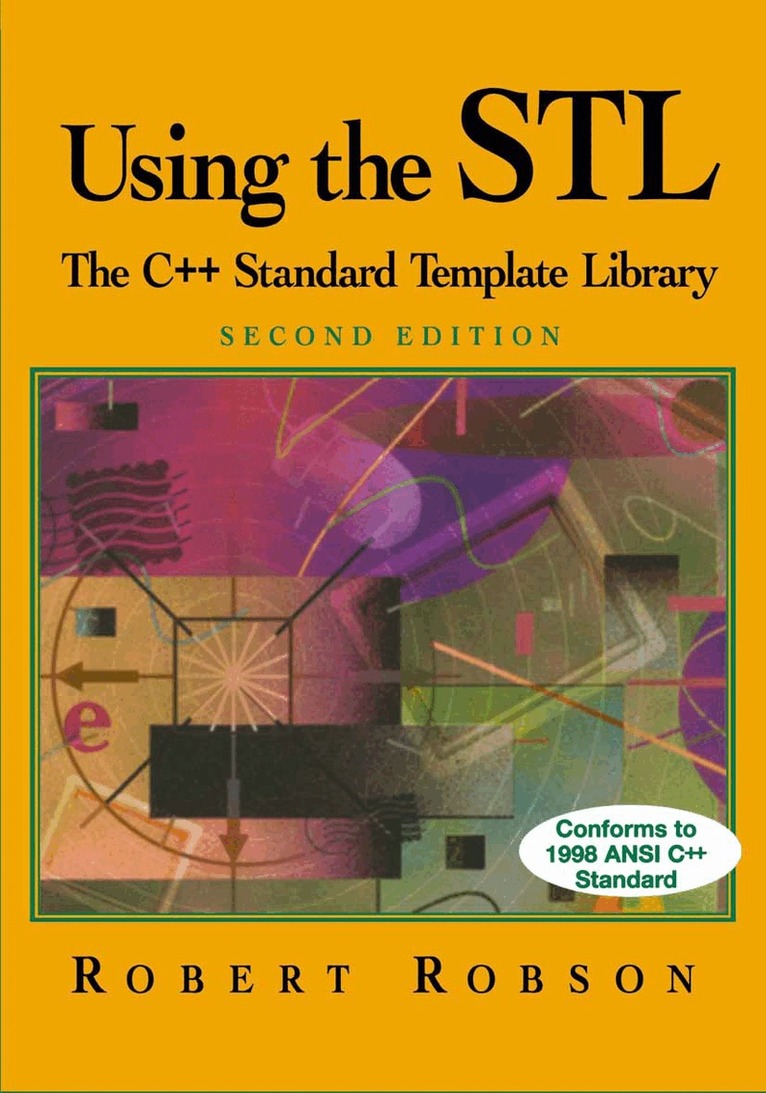
    Using the STL

    The C++ Standard Template Library

    AvRobert Robson

    Häftad, Engelska, 1999

    1 119 kr

    Beställningsvara. Skickas inom 10-15 vardagar. Fri frakt över 249 kr.

    Fler format och utgåvor

    E-bok

    1 170 kr

    E-bok

    1 455 kr

    Beskrivning

    A lot has happened since the first edition of this book was written. When the first edition was prepared, there was only one version of the Standard Template Library (STL) available-the Hewlett-Packard version. Since then, several other versions have appeared from major compiler and library vendors. This is in an effort to conform to the recent International Standards Organization/International Electrotechnical Commission (ISO/IEC) C++ standards, which define the STL as part of the Standard C++ Library. As expected, the STL is becoming widely available and an accepted part of C++ program development. This is good. Unfortunately, the proliferation of implementations makes it difficult to exactly define the STL. We now have mul­ tiple implementations, many of which are slightly incompatible with one another. The reasons for this are largely due to different capabilities of the compilers on which they are implemented. Many compilers do not implement the most recent features of the language since production of standards often precedes conform­ ing implementations by many months. This will improve over time as the com­ pilers add the necessary capabilities to support the full STL.

    Produktinformation

    • Utgivningsdatum:1999-12-03
    • Mått:178 x 254 x 33 mm
    • Vikt:1 134 g
    • Format:Häftad
    • Språk:Engelska
    • Antal sidor:594
    • Upplaga:2
    • Förlag:Springer-Verlag New York Inc.
    • ISBN:9780387988573

    Utforska kategorier

    • Programspråk inom Data och IT

    Innehållsförteckning

    • 1 Introduction.- 1.1 What Is the STL?.- 1.2 History.- 1.3 STL Components.- 1.4 Generic Algorithms.- 1.5 Iterators.- 1.6 Standard Exceptions.- 1.7 Complexity.- 1.8 Thread Safety.- 1.9 Namespaces.- 1.10 Overview of This Book.- 2 Iterators.- 2.1 Introduction.- 2.2 Pointers as Iterators.- 2.3 Iterator Classes.- 2.4 Using Iterators.- 2.5 Iterator Functions.- 2.6 Iterator Tags.- 2.7 Iterator Traits.- 3 The STL Algorithms.- 3.1 Introduction.- 3.2 Operators.- 3.3 Function Objects.- 3.4 The STL Algorithms.- 4 Sequence Algorithms.- 4.1 Introduction.- 4.2 Preliminaries.- 4.3 Nonmutating Sequence Algorithms.- 4.4 Mutating Sequence Algorithms.- 5 Sorting and Related Algorithms.- 5.1 Introduction.- 5.2 Preliminaries.- 5.3 Sorting.- 5.4 Searching Algorithms.- 5.5 Set Algorithms.- 5.6 Heap Algorithms.- 5.7 Miscellaneous Algorithms.- 6 Generalized Numeric Algorithms.- 6.1 Introduction.- 6.2 Accumulation.- 6.3 Inner Product.- 6.4 Partial Sum.- 6.5 Adjacent Difference.- 6.6 Numeric Arrays.- 7 Sequence Containers.- 7.1 Introduction.- 7.2 Container Operations.- 7.3 Vectors.- 7.4 Lists.- 7.5 Deques.- 7.6 Choosing a Sequence Container.- 7.7 Strings.- 8 Associative Containers.- 8.1 Introduction.- 8.2 Associative Container Operations.- 8.3 Sets.- 8.4 Multisets.- 8.5 Maps.- 8.6 Associative Container Implementation.- 8.7 Hash Table Implementations.- 8.8 Container Selection.- 9 Adaptors.- 9.1 Introduction.- 9.2 Container Adaptors.- 9.3 The Stack.- 9.4 Queues.- 9.5 Priority Queues.- 9.6 Iterator Adaptors.- 9.7 Function Adaptors.- 10 Memory Management.- 10.1 Introduction.- 10.2 Allocators.- 10.3 Uninitialized Memory Operations.- 10.4 Temporary Buffers.- 10.5 auto_ptr.- 11 Putting the STL to Work.- 11.1 Introduction.- 11.2 A Banking Problem.- 11.3 Symbol Tables.- 12 The Story Continues.- 12.1 Introduction.- 12.2 The Future.- 12.3 Summary.- Appendix A STL Header Files.- Appendix B The STL Reference.- References.