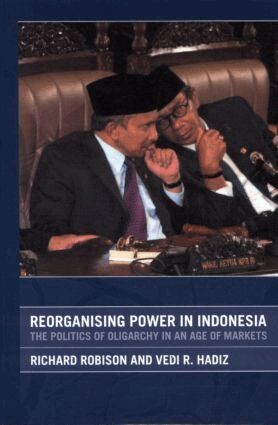
Reorganising Power in Indonesia
The Politics of Oligarchy in an Age of Markets
574 kr
Tillfälligt slut
Du är på sajten för privatpersoner.
574 kr
Tillfälligt slut
Richard Robison is Professor of Political economy at the Institute of Social Studies in the Hague, The Netherlands and was formerly Director of the Australian Research Council's Special Centre for the Study of Political and Economic Change in Asia at Murdoch University, Australia.Vedi Hadiz is Assistant Professor in the Department of Sociology at the National University of Singapore and was previously Research Fellow at the Asia Research Center, Murdoch University, Australia.
'[This] is the first study to spell out the nature of the relationship between a national oligarchy and the global market place. As such it is not only an important empirical study, it also represents a major critique of the neo-classical understanding of development that prevailed throughout the late 20th century.'- Richard Higgott, The Pacific Review'Richard Robison and Vedi Hadiz have delivered the most comprehensive and analytically sound book on the politics of post-New Order Indonesia written so far.' - The Jakarta Post'In this information-packed and theoretically sophisticated analysis, Robison and Hadiz brilliantly argue that, in spite of Indonesia's economic successes and the collapse of Suharto's regime, power arrangements in the country still operate to keep an oligarchy in command.' - Lucien W. Pye, Foreign Affairs'This is a superb book that should remain the definitive account of Indonesia's political-economic elite during the years preceeding and following the New Order's collapse. The book gives us a clearly stated benchmark against which to mark the progress of meaningful reform. Well worth the read.' - Pacific Affairs'In this exciting book, two well-known scholars of Indonesian political economy address questions about the nature of institutional change and the prospects for neoliberal convergence toward democracy and free markets. In the process, they provide one of the most novel, detailed, coherent, and analytically grounded accounts of Indonesian politics in recent years...by shifting the analytic focus away from well-worn political actors and cleavages, this book gives a remarkably fresh account of the New Order, and brings forward many figures and conflicts that had previously been obscured...the authors have provided a book that uses a single analytic framework to rethink the New Order, to provide a promising interpretation of the democratic era, and to link politics past and present in a tightly coherent and highly detailed narrative...It will continue to do what good books do--generate debate and new lines of research--and will significantly advance our understanding of Indonesian politcs.' -Indonesia, 82 (October 2006)
Du är på sajten för privatpersoner.
574 kr
Tillfälligt slut
Richard Robison is Professor of Political economy at the Institute of Social Studies in the Hague, The Netherlands and was formerly Director of the Australian Research Council's Special Centre for the Study of Political and Economic Change in Asia at Murdoch University, Australia.Vedi Hadiz is Assistant Professor in the Department of Sociology at the National University of Singapore and was previously Research Fellow at the Asia Research Center, Murdoch University, Australia.
'[This] is the first study to spell out the nature of the relationship between a national oligarchy and the global market place. As such it is not only an important empirical study, it also represents a major critique of the neo-classical understanding of development that prevailed throughout the late 20th century.'- Richard Higgott, The Pacific Review'Richard Robison and Vedi Hadiz have delivered the most comprehensive and analytically sound book on the politics of post-New Order Indonesia written so far.' - The Jakarta Post'In this information-packed and theoretically sophisticated analysis, Robison and Hadiz brilliantly argue that, in spite of Indonesia's economic successes and the collapse of Suharto's regime, power arrangements in the country still operate to keep an oligarchy in command.' - Lucien W. Pye, Foreign Affairs'This is a superb book that should remain the definitive account of Indonesia's political-economic elite during the years preceeding and following the New Order's collapse. The book gives us a clearly stated benchmark against which to mark the progress of meaningful reform. Well worth the read.' - Pacific Affairs'In this exciting book, two well-known scholars of Indonesian political economy address questions about the nature of institutional change and the prospects for neoliberal convergence toward democracy and free markets. In the process, they provide one of the most novel, detailed, coherent, and analytically grounded accounts of Indonesian politics in recent years...by shifting the analytic focus away from well-worn political actors and cleavages, this book gives a remarkably fresh account of the New Order, and brings forward many figures and conflicts that had previously been obscured...the authors have provided a book that uses a single analytic framework to rethink the New Order, to provide a promising interpretation of the democratic era, and to link politics past and present in a tightly coherent and highly detailed narrative...It will continue to do what good books do--generate debate and new lines of research--and will significantly advance our understanding of Indonesian politcs.' -Indonesia, 82 (October 2006)