• Fri frakt över 249 kr
  • •
  • Snabba leveranser
  • •
  • Billiga böcker
Kundservice

Du är på sajten för privatpersoner.

Företag, bibliotek eller offentlig verksamhet?

Du handlar på classic.bokus.com, där alla dina funktioner finns intakta.
Till classic.bokus.com
Bokus logotyp. Gå till startsidan.
  • Erbjudanden
  • Nyheter
  • Student
  • Topplistor
  • Barn & ungdom
  • Bokus Play
  • E-böcker
  • Pocketböcker
  • Spel & pussel

10% rabatt på allt med kod NYSTART10 →

Sidfot

Mina sidor

    Hjälp

    • Kundservice
    • Vanliga frågor och svar
    • Frakt och leverans
    • Retur vid ångerrätt
    • Reklamera vara
    • Betalning
    • Köpvillkor
    • Allmänna villkor
    • Information om webbplatsens tillgänglighet

    Om Bokus

    • Om oss
    • Pressrum
    • För studenter
    • För företag
    • För bibliotek och offentlig verksamhet
    • För leverantörer
    • Hållbarhet

    Populärt

    • Aktuella erbjudanden
    • Presentkort
    • Studentlitteratur
    • Nya böcker
    • Topplistor
    • Signerade böcker
    • Engelska böcker

    Inspiration

    • Boktips
    • BookTok
    • Populära bokserier
    • Barnbokskaraktärer
    • Populära författare
    Logotyp för Bokus
    Följ oss på Facebook (extern länk)Följ oss på Instagram (extern länk)Följ oss på YouTube (extern länk)Följ oss på TikTok (extern länk)
    bokus @ CookiesAnpassa cookiesIntegritetspolicyKöpvillkor
    Till Citymail hemsida (extern länk)Till Budbee hemsida (extern länk)Till Postnord hemsida (extern länk)Till Schenker hemsida (extern länk)Till Early Bird hemsida (extern länk)Till Walleys hemsida (extern länk)
    1. Samhälle och politik
    2. Politik och statsskick

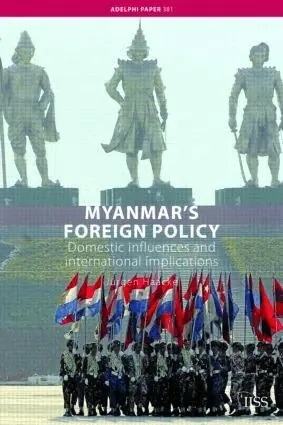
    Myanmar's Foreign Policy

    Domestic Influences and International Implications

    AvJurgen Haacke

    Häftad, Engelska, 2006

    Del i serien Adelphi series

    456 kr

    Beställningsvara. Skickas inom 10-15 vardagar. Fri frakt över 249 kr.

    Fler format och utgåvor

    Inbunden

    2 727 kr

    Beskrivning

    Against the background of its problematic human-rights record and the military regime's continued extra-constitutional rule, Myanmar has faced mounting diplomatic pressure from the international community since the renewed detention of Daw Aung San Suu Kyi in May 2003. This Adelphi Paper examines Myanmar's foreign policy, which is predicated on state-building and development, as well as defending the regime's decision to give priority to establishing an enduring constitution over immediate national reconciliation and democratisation. It discusses how the regime has been able to take advantage of the economic, security and geostrategic interests of both China and India in the country to achieve developmental and security goals, and how its relations with Beijing in particular have assumed ever greater significance as Western capitals have sought to place Myanmar under the scrutiny of the UN Security Council on the grounds that its domestic circumstances have regional security implications. It discusses the regime's objectives, concerns and challenges in its relations with the US, Japan and Europe; details the difficult decisions of the leadership as ASEAN has started to relax its application of the non-interference norm when dealing with Myanmar; and examines its interaction with the UN, particularly the secretary-general and his special envoys. The paper concludes by analysing the likely regional and international implications of intensified political pressure on the military regime.

    Produktinformation

    • Utgivningsdatum:2006-06-30
    • Mått:156 x 234 x undefined mm
    • Vikt:240 g
    • Format:Häftad
    • Språk:Engelska
    • Serie:Adelphi series
    • Antal sidor:128
    • Förlag:Taylor & Francis Ltd
    • ISBN:9780415407267

    Utforska kategorier

    • Politik och statsskick inom Samhälle och politik

    Innehållsförteckning

    • Introduction 1. The Political-Security Imperative and Foreign Policy Goals 2. Myanmar’s Foreign Policy towards China and India 3. Myanmar and ASEAN 4. Relations with the West and Japan 5. Myanmar and the United Nations Conclusion