• Fri frakt över 249 kr
  • •
  • Snabba leveranser
  • •
  • Billiga böcker
Kundservice

Du är på sajten för privatpersoner.

Företag, bibliotek eller offentlig verksamhet?

Du handlar på classic.bokus.com, där alla dina funktioner finns intakta.
Till classic.bokus.com
Bokus logotyp. Gå till startsidan.
  • Erbjudanden
  • Student
  • Topplistor
  • Barn & ungdom
  • Bokus Play
  • E-böcker
  • Ljudböcker
  • Pocketböcker
  • Spel och pussel

5% studentrabatt – använd koden KURSBOK27 →

Sidfot

Mina sidor

    Hjälp

    • Kundservice
    • Vanliga frågor och svar
    • Frakt och leverans
    • Retur vid ångerrätt
    • Reklamera vara
    • Betalning
    • Köpvillkor
    • Allmänna villkor
    • Information om webbplatsens tillgänglighet

    Om Bokus

    • Om oss
    • Pressrum
    • För studenter
    • För företag
    • För bibliotek och offentlig verksamhet
    • För leverantörer
    • Hållbarhet

    Populärt

    • Aktuella erbjudanden
    • Presentkort
    • Studentlitteratur
    • Nya böcker
    • Topplistor
    • Signerade böcker
    • Engelska böcker

    Inspiration

    • Boktips
    • BookTok
    • Barnbokskaraktärer
    • Populära författare
    Logotyp för Bokus
    Följ oss på Facebook (extern länk)Följ oss på Instagram (extern länk)Följ oss på YouTube (extern länk)Följ oss på TikTok (extern länk)
    bokus @ CookiesAnpassa cookiesIntegritetspolicyKöpvillkor
    Till Citymail hemsida (extern länk)Till Budbee hemsida (extern länk)Till Postnord hemsida (extern länk)Till Schenker hemsida (extern länk)Till Early Bird hemsida (extern länk)Till Walleys hemsida (extern länk)
    1. Samhälle och politik
    2. Samhälle och kultur
    3. Kultur och medier
    4. Referensverk och tvärvetenskap

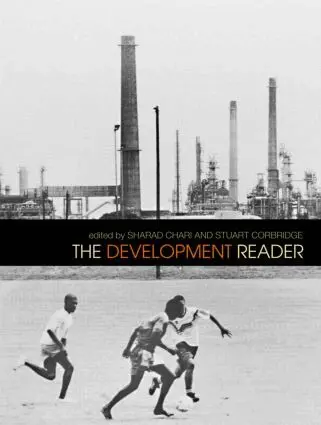
    Development Reader

    AvSharad Chari,Stuart Corbridge

    Häftad, Engelska, 2008

    874 kr

    Beställningsvara. Skickas inom 10-15 vardagar. Fri frakt över 249 kr.

    Beskrivning

    The Development Reader brings together fifty-four key readings on development history, theory and policy: Adam Smith and Karl Marx meet, among others, Robert Wade, Amartya Sen and Jeffrey Sachs. It shows how debates around development have been structured by different readings of the roles played by markets, empire, nature and difference in the organization of world affairs. For example, present-day concerns about economic liberalization echo long-standing debates around free-trade, extended divisions of labour and national economic policy. Likewise, old debates about empire are re-appearing in critical perspectives on US policy in the Middle East. While there is little room today for old-fashioned environmental or cultural determinism, the attention now being given to climate change and a clash of civilisations shows that questions of nature and difference remain at the centre of development politics. Section and individual extract introductions guide students through the material and bind the readings into a coherent whole. Organized chronologically as well as thematically, it offers an intellectual history of the debates and political struggles that swirl around development. By bringing together intellectual history and contemporary development issues in this way, The Development Reader breaks fresh ground. It will have broad appeal across the humanities and social sciences, and is essential reading for students of contemporary development issues, practitioners and campaigners.

    Produktinformation

    • Utgivningsdatum:2008-06-17
    • Mått:188 x 239 x 28 mm
    • Vikt:1 248 g
    • Format:Häftad
    • Språk:Engelska
    • Antal sidor:592
    • Förlag:Taylor & Francis Ltd
    • ISBN:9780415415057

    Utforska kategorier

    • Referensverk och tvärvetenskap inom Samhälle och politik

    Mer om författaren

    Sharad Chari is Lecturer in Human Geography at the London School of Economics. He works on the historical ethnography of labour, work, activism, gender, state-sanctioned racism, and development in India and South Africa. He is the author of Fraternal Capital: Peasant-workers, self-made men, and globalization in provincial India (Stanford University Press, 2004), and is working on a monograph on space, race and activism in twentieth-century South Africa.Stuart Corbridge is Professor of Development Studies at the London School of Economics. He has written widely on economic and political change in India and the history of development thought. His most recent book (with Williams, Srivastava and Veron) is Seeing the State: Governance and Governmentality in India (CUP, 2005).

    Innehållsförteckning

    • Part I The Object of Development The geography of poverty and wealth, by J.Sachs, A.Mellinger and J.Gallup, Late Victorian Holocausts, by M.Davis, Imperial Leather: Race, Gender and Sexuality in the Colonial Contest, by A.McClintock Part II Markets, Empire, Nature, Difference Economic development: a semantic history by H.Arndt, The Wealth of Nations, Book IV, by A.Smith, British Rule in India, by K.Marx , On Social Evolution: Selected Writings, by H. Spencer, Hind Swaraj by M.K.Gandhi Part III Reform, Revolution, Resistance Economic possibilities for our grandchildren by J.M.Keynes, The Great Transformation: The Political and Economic Origins of Our Time, by K.Polanyi Colonial Policy and Practice: A Comparative Study of Burma and Netherlands India, by J.S.Furnivall, Bread and Democracy in Germany, by A. Gerschenkron, This is the Voice of Algeria By F.Fanon Part IV Promethean Visions Encountering Development: The Making and Unmaking of the Third World by A.Escobar, The Stages of Economic Growth by W.W.Rostow The Population of India and Pakistan, by K.Davis, Economic development with unlimited supplies of labour, by W.A.Lewis, The distribution of gains between investing and borrowing countries, by H.Singer, The Economics of Feasible Socialism Revisited by A. Nove, Man and nature in China by R.Murphey Part V Challenges to the Mainstream The Political Economy of Growth, by P.Baran Capitalism and cheap labour power in South Africa: from segregation to apartheid by H.Wolpe, Women’s Role in Economic Development by E.Boserup, Silent Spring by R.Carson, Why Poor People Stay Poor: A Study of Urban Bias in World Development by M.Lipton Latin American squatter settlements: a problem and a solution by W.Mangin Part VI The Hubris of Development Foreign aid forever? by P.Bauer The Poverty of ‘Development Economics’ by D.Lal Democracy and the ‘Washington Consensus by J.Williamson , Seeing Like a State by J.Scott, The irrelevance of development studies, by M.Edwards, Male bias in the development process: an overview by D.Elson, The anti-politics machine: 'development' and bureaucratic power in Lesotho by J. Ferguson with L.Lohmann Part VII Institutions, Governance and Participation Goodbye Washington Consensus, hello Washington confusion? by D.Rodrik, Was Latin America too rich to prosper? Structural and political obstacles to export-led economic growth by J.Mahon, Fiscal reform and the economic foundations of local state corporatism in China by J.Oi Moving the state: the politics of democratic decentralization in Kerala, South Africa and Porto Allegre by P.Heller, Citizen and Subject: Contemporary Africa and the Legacy of Late Colonialism by M. Mamdani People’s knowledge’, participation and patronage by D.Mosse Part VIII Globalization, Security and Well-Being Why Globalization Works by M.Wolf Is globalization reducing poverty and inequality? by R.Wade Human Well-Being and the Natural Environment by P.Dasgupta More than 100 million women are missing by A.K.Sen Conceptualising environmental collective action: why gender matters by B.Agarwal AIDS, gender and sexuality during Africa’s economic crisis by B.Schoepf, Feminism, the Taliban and the Politics of Counter-Insurgency by C. Hirschkind and S. Mahmood Part IX Development in the 21st Century Asia’s re-emergence by S. Radelet and J. Sachs , On missing the boat: the marginalization of the bottom billion in the world economy by P.Collier, The New Imperialism by D.Harvey, From the Spectre of Marx to the Spirit of the Law: Labor Insurgency in China by C.K. Lee, The recurrent crises of the gatekeeper state by F. Cooper Beyond Occidentalism: toward non-imperial geohistorical categories by F.Coronil, Globalization and violence by A.Appadurai On development, demography and climate change: the end of the Third World as we know it? by T.Dyson