• Fri frakt över 249 kr
  • •
  • Snabba leveranser
  • •
  • Billiga böcker
Kundservice

Du är på sajten för privatpersoner.

Företag, bibliotek eller offentlig verksamhet?

Du handlar på classic.bokus.com, där alla dina funktioner finns intakta.
Till classic.bokus.com
Bokus logotyp. Gå till startsidan.
  • Erbjudanden
  • Nyheter
  • Student
  • Topplistor
  • Barn & ungdom
  • Bokus Play
  • E-böcker
  • Pocketböcker
  • Spel & pussel

10% rabatt på allt med kod: NYSTART10 →

Sidfot

Mina sidor

    Hjälp

    • Kundservice
    • Vanliga frågor och svar
    • Frakt och leverans
    • Retur vid ångerrätt
    • Reklamera vara
    • Betalning
    • Köpvillkor
    • Allmänna villkor
    • Information om webbplatsens tillgänglighet

    Om Bokus

    • Om oss
    • Pressrum
    • För studenter
    • För företag
    • För bibliotek och offentlig verksamhet
    • För leverantörer
    • Hållbarhet

    Populärt

    • Aktuella erbjudanden
    • Presentkort
    • Studentlitteratur
    • Nya böcker
    • Topplistor
    • Signerade böcker
    • Engelska böcker

    Inspiration

    • Boktips
    • BookTok
    • Populära bokserier
    • Barnbokskaraktärer
    • Populära författare
    Logotyp för Bokus
    Följ oss på Facebook (extern länk)Följ oss på Instagram (extern länk)Följ oss på YouTube (extern länk)Följ oss på TikTok (extern länk)
    bokus @ CookiesAnpassa cookiesIntegritetspolicyKöpvillkor
    Till Citymail hemsida (extern länk)Till Budbee hemsida (extern länk)Till Postnord hemsida (extern länk)Till Schenker hemsida (extern länk)Till Early Bird hemsida (extern länk)Till Walleys hemsida (extern länk)
    1. Samhälle och politik
    2. Politik och statsskick
    3. Internationella relationer

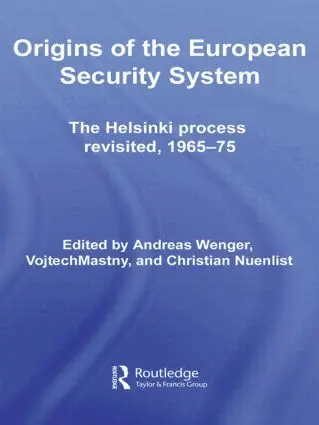
    Origins of the European Security System

    The Helsinki Process Revisited, 1965-75

    AvAndreas Wenger,Vojtech Mastny

    Inbunden, Engelska, 2008

    Del i serien CSS Studies in Security and International Relations

    2 493 kr

    Beställningsvara. Skickas inom 10-15 vardagar. Fri frakt över 249 kr.

    Beskrivning

    This edited volume explores the significance of the early ‘Helsinki process’ as a means of redefining and broadening the concept of security during the latter half of the Cold War. The early Helsinki process introduced innovative confidence-building measures, and made human rights a requirement of a legitimate and well-functioning international system, thus providing the framework for disarmament in Europe in the mid-1980s, as well as the inspiration for the later demise of Communism in Europe. Using newly declassified archives, the book explores the positions of the two superpowers and the crucial impact of European Community member states, which introduced European values into the Cold War debate on security. It also shows how Eastern and Central European nations, such as Poland, did not restrict themselves to providing support to Moscow but, rather, pursued interests of their own. The volume sheds light on the complementary role of the neutrals as mediators and special negotiators in the multilateral negotiations; on the interdependence of politics and economics; and on the link between military security and the CSCE process.

    Produktinformation

    • Utgivningsdatum:2008-04-29
    • Mått:156 x 234 x 19 mm
    • Vikt:690 g
    • Format:Inbunden
    • Språk:Engelska
    • Serie:CSS Studies in Security and International Relations
    • Antal sidor:276
    • Förlag:Taylor & Francis Ltd
    • ISBN:9780415433877

    Utforska kategorier

    • Internationella relationer inom Samhälle och politik
    • Europas historia inom Historia och arkeologi

    Mer om författaren

    Andreas Wenger, Vojtech Mastny, Christian Nuenlist

    Innehållsförteckning

    • Part 1: Introduction 1. New Perspectives on the Origins of the CSCE Process Andreas Wenger and Vojtech Mastny Part 2: The Superpowers and European Détente 2. North America, Atlanticism, and the Making of the Helsinki Final Act Michael Cotey Morgan 3. Henry Kissinger and the Reconceptualization of European Security, 1969–75 Jeremi Suri 4. The USSR and the Helsinki Process, 1969–75: Optimism, Doubt, or Defiance? Marie-Pierre Rey Part 3: Eastern Strategies in the CSCE 5. The Warsaw Pact and the European Security Conference, 1964–69: Sovereignty, Hegemony, and the German Question Douglas Selvage 6. The GDR’s Targets in the Early CSCE Process: Another Missed Opportunity to Freeze the Division of Germany, 1969–73 Federica Caciagli 7. ‘Europe Must Not Become Greater Finland’: Opponents of the CSCE: The German CDU/CSU and China Bernd Schaefer Part 4: Western Strategies in the CSCE 8. The EC-Nine, the CSCE, and the Changing Pattern of European Security Daniel Möckli 9. From Linkage to Freer Movement: The Federal Republic of Germany and the Nexus between Western CSCE Preparations and Deutschlandpolitik, 1969–72 Petri Hakkarainen 10. ‘It Was Cold War and We Wanted to Win’: Human Rights, ‘Détente’, and the CSCE Floribert Baudet Part 5: The Neutrals – Economics – Military Security 11. Expanding the East-West Dialogue beyond the Bloc Division: The Neutrals as Negotiators and Mediators, 1969–75 Christian Nuenlist 12. Helsinki and Rambouillet: US Attitudes towards Trade and Security during the Early CSCE Process, 1972–75 Duccio Basosi 13. The Link between CSCE and MBFR: Two Sprouts from One Bulb Helga Haftendorn