• Fri frakt över 249 kr
  • •
  • Snabba leveranser
  • •
  • Billiga böcker
Kundservice

Du är på sajten för privatpersoner.

Företag, bibliotek eller offentlig verksamhet?

Du handlar på classic.bokus.com, där alla dina funktioner finns intakta.
Till classic.bokus.com
Bokus logotyp. Gå till startsidan.
  • Erbjudanden
  • Student
  • Topplistor
  • Barn & ungdom
  • Bokus Play
  • E-böcker
  • Ljudböcker
  • Pocketböcker
  • Spel och pussel

Pocketfynda! Hundratals böcker för 49 kr/st →

Sidfot

Mina sidor

    Hjälp

    • Kundservice
    • Vanliga frågor och svar
    • Frakt och leverans
    • Retur vid ångerrätt
    • Reklamera vara
    • Betalning
    • Köpvillkor
    • Allmänna villkor
    • Information om webbplatsens tillgänglighet

    Om Bokus

    • Om oss
    • Pressrum
    • För studenter
    • För företag
    • För bibliotek och offentlig verksamhet
    • För leverantörer
    • Hållbarhet

    Populärt

    • Aktuella erbjudanden
    • Presentkort
    • Studentlitteratur
    • Nya böcker
    • Topplistor
    • Signerade böcker
    • Engelska böcker

    Inspiration

    • Boktips
    • BookTok
    • Barnbokskaraktärer
    • Populära författare
    Logotyp för Bokus
    Följ oss på Facebook (extern länk)Följ oss på Instagram (extern länk)Följ oss på YouTube (extern länk)Följ oss på TikTok (extern länk)
    bokus @ CookiesAnpassa cookiesIntegritetspolicyKöpvillkor
    Till Citymail hemsida (extern länk)Till Budbee hemsida (extern länk)Till Postnord hemsida (extern länk)Till Schenker hemsida (extern länk)Till Early Bird hemsida (extern länk)Till Walleys hemsida (extern länk)
    1. Ekonomi och Ledarskap
    2. Nationalekonomi
    3. Mikroekonomi

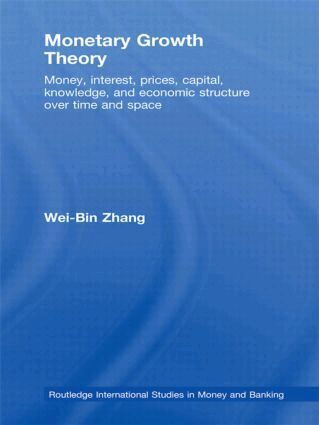
    Monetary Growth Theory

    Money, Interest, Prices, Capital, Knowledge and Economic Structure over Time and Space

    AvWei-Bin Zhang

    Inbunden, Engelska, 2008

    Del i serien Routledge International Studies in Money and Banking

    2 713 kr

    Beställningsvara. Skickas inom 10-15 vardagar. Fri frakt över 249 kr.

    Fler format och utgåvor

    Häftad

    741 kr

    E-bok

    881 kr

    Beskrivning

    This book answers some challenging questions in monetary growth theory within a compact theoretical framework. The author succeeds in integrating the theory of money, the theory of value and the theory of growth. The book re-examines many important ideas in modern monetary economics within a single analytical framework. It is concerned not only with traditional one-sector growth models of a homogeneous population with endogenous capital and knowledge, but also with multi-sector models, economies with heterogeneous households, and economies with urban structures, interregional interactions and international trade.Zhang’s book will appeal to those studying monetary economics, neoclassical growth theory, development economics and international economics. It is also useful more generally, for researchers in social sciences with an interest in the role of money in modern societies.

    Produktinformation

    • Utgivningsdatum:2008-07-23
    • Mått:156 x 234 x 26 mm
    • Vikt:900 g
    • Format:Inbunden
    • Språk:Engelska
    • Serie:Routledge International Studies in Money and Banking
    • Antal sidor:400
    • Förlag:Taylor & Francis Ltd
    • ISBN:9780415461627

    Utforska kategorier

    • Mikroekonomi inom Ekonomi och Ledarskap
    • Finansiering inom Ekonomi och Ledarskap
    • Makroekonomi inom Ekonomi och Ledarskap

    Mer om författaren

    Wei-Bin Zhang is Professor at Ritsumeikan Asia Pacific University, Japan.

    Innehållsförteckning

    • 1. Money and Growth Theory, 1.1 Money in Economic Growth Theory, 1.2 The One-Sector Growth (OSG) Model, 1.3 The OSG Model with the Cobb-Douglas Functions, 1.4 Theoretical Foundations of the Utility Function, 1.5 The Keynesian Consumption Function and the OSG Approach, 1.6 The Solow Growth Model and the OSG Approach, 1.7 The Ramsey Growth Model and the OSG Approach, 1.8 The Structure of the Book, 2 Money as a Store of Value, 2.1 The Tobin Monetary Growth Model, 2.2 Growth with Inflationary Finance, 2.3 A Portfolio Balance Growth Mode, 2.4 Monetary Growth with Two Types of Households, 2.5 A Two-Sector Monetary Growth Model, 2.6 Money as a Store of Value, 3 Money in Utility and Production Functions, 3.1 The Levhari and Patinkin Approach, 3.2 The Sidrauski Model and Its Variations, 3.3 The One-Sector MIUF-OSG Model, 3.4 A Growth Economy with Two Types of Households, 3.5 A Portfolio Balance MIUF-OSG Growth Model, 3.6 Growth with Capital Accumulation and Education, 3.7 The MIPF Approach, 3.8 Further Issues, 4 Money-in-Advance Growth Models, 4.1 A CIA-OSG Growth Model, 4.2 A CIA Two-Sector Model, 4.3 Monetary Policy in a CIA Economy, 4.4 Home Production in the CIA-OSG Model, 4.5 Growth with Learning by Doing and Research, 4.6 Money, Public Goods and Returns to Scale, 4.7 A Shopping Cost Model in the Ramsey Approach, 4.8 Concluding Remarks, 5 Unemployment and Inflation, 5.1 A Traditional Model of Inflation and Unemployment, 5.2 The IS-LM Model for a National Economy, 5.3 A Monetary Growth Welfare Economy with MIUF Approach, 5.4 Money, the Efficiency Wage Theory and the MIUF Approach, 5.5 Other Causes of Unemployment, 6 Preference Change and Habit Formation, 6.1 Uzawa’s Preference Change in the Ramsey Approach, 6.2 The CIA-OSG Model with Preference Change, 6.3 The MIUF-OSG Model with Preference Change, 6.4 A Two-Sector Two-Group Monetary Growth Model with Consumer Durables, 6.5 Habit Formation in the Ramsey Approach, 7 Monetary Growth with Urban Structure, 7.1 The Monetary Urban Growth Model, 7.2 The Dynamics of the Non-monetary Economy, 7.3 The Dynamics of the Monetary Economy, 7.4 Concluding Remarks, 8 Money in Multi-Regional Growth Economies, 8.1 The Two-region Monetary Growth Model, 8.2 The Dynamics of the Non-monetary Economy, 8.3 The Dynamics of the Monetary Economy, 8.4 Conclusions, 9 Money, Growth and International Trade, 9.1 A Classical Monetary Trade Model, 9.2 Dornbush’s Exchange Rate Model for a Small Economy, 9.3 A Small Open-Country Economy with the CIA Approach, 9.4 A Small Open-Country Economy with the MIUF Approach, 9.5 A Multi-Country Economic Model, 9.6 Money, Capital, Knowledge, Trade, and Growth, 10 Money and Economic Complexity