• Fri frakt över 249 kr
  • •
  • Snabba leveranser
  • •
  • Billiga böcker
Kundservice

Du är på sajten för privatpersoner.

Företag, bibliotek eller offentlig verksamhet?

Du handlar på classic.bokus.com, där alla dina funktioner finns intakta.
Till classic.bokus.com
Bokus logotyp. Gå till startsidan.
  • Erbjudanden
  • Nyheter
  • Student
  • Topplistor
  • Barn & ungdom
  • Bokus Play
  • E-böcker
  • Pocketböcker
  • Spel & pussel

10% rabatt på allt med kod NYSTART10 →

Sidfot

Mina sidor

    Hjälp

    • Kundservice
    • Vanliga frågor och svar
    • Frakt och leverans
    • Retur vid ångerrätt
    • Reklamera vara
    • Betalning
    • Köpvillkor
    • Allmänna villkor
    • Information om webbplatsens tillgänglighet

    Om Bokus

    • Om oss
    • Pressrum
    • För studenter
    • För företag
    • För bibliotek och offentlig verksamhet
    • För leverantörer
    • Hållbarhet

    Populärt

    • Aktuella erbjudanden
    • Presentkort
    • Studentlitteratur
    • Nya böcker
    • Topplistor
    • Signerade böcker
    • Engelska böcker

    Inspiration

    • Boktips
    • BookTok
    • Populära bokserier
    • Barnbokskaraktärer
    • Populära författare
    Logotyp för Bokus
    Följ oss på Facebook (extern länk)Följ oss på Instagram (extern länk)Följ oss på YouTube (extern länk)Följ oss på TikTok (extern länk)
    bokus @ CookiesAnpassa cookiesIntegritetspolicyKöpvillkor
    Till Citymail hemsida (extern länk)Till Budbee hemsida (extern länk)Till Postnord hemsida (extern länk)Till Schenker hemsida (extern länk)Till Early Bird hemsida (extern länk)Till Walleys hemsida (extern länk)
    1. Skönlitteratur
    2. Litteraturvetenskap
    3. Litteraturvetenskap

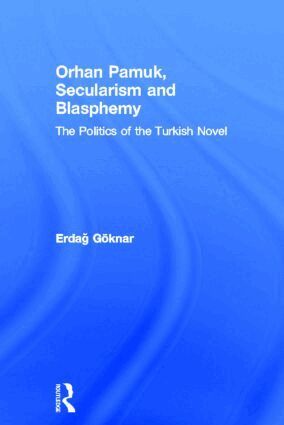
    Orhan Pamuk, Secularism and Blasphemy

    The Politics of the Turkish Novel

    AvErdag Göknar

    Häftad, Engelska, 2013

    832 kr

    Beställningsvara. Skickas inom 10-15 vardagar. Fri frakt över 249 kr.

    Fler format och utgåvor

    Inbunden

    2 786 kr

    Beskrivning

    Orhan Pamuk, Secularism and Blasphemy is the first critical study of all of Pamuk’s novels, including the early untranslated work. In 2005 Orhan Pamuk was charged with "insulting Turkishness" under Article 301 of the Turkish penal code. Eighteen months later he was awarded the Nobel Prize. After decades of criticism for wielding a depoliticized pen, Pamuk was cast as a dissident through his trial, an event that underscored his transformation from national literateur to global author. By contextualizing Pamuk’s fiction into the Turkish tradition and by defining the literary and political intersections of his work, Orhan Pamuk, Secularism and Blasphemy rereads Pamuk's dissidence as a factor of the form of his novels.This is not a traditional study of literature, but a book that turns to literature to ask larger questions about recent transformations in Turkish history, identity, modernity, and collective memory. As a corrective to common misreadings of Pamuk’s work in its international reception, Orhan Pamuk, Secularism and Blasphemy applies various analytical lenses to the politics of the Turkish novel, including gender studies, cultural translation, historiography, and Islam. The book argues that modern literature that confronts representations of the nation-state, or devlet, with those of Ottoman, Islamic, and Sufi contexts, or din, constitute "secular blasphemies" that redefine the politics of the Turkish novel.Concluding with a meditation on conditions of "untranslatability" in Turkish literature, this study provides a comprehensive and critical analysis of Pamuk’s novels to date.


    Produktinformation

    • Utgivningsdatum:2013-01-31
    • Mått:156 x 234 x 18 mm
    • Vikt:500 g
    • Format:Häftad
    • Språk:Engelska
    • Antal sidor:314
    • Förlag:Taylor & Francis Ltd
    • ISBN:9780415505383

    Utforska kategorier

    • Litteraturvetenskap inom Skönlitteratur

    Mer om författaren

    Erdağ Göknar is Assistant Professor of Turkish Studies at Duke University and the award-winning translator of Orhan Pamuk’s My Name is Red. He holds a Ph.D. in Near and Middle Eastern studies and has published various critical articles on Turkish literary culture. He is also the translator of A.H. Tanpınar’s novel of Turkish modernity A Mind at Peace and co-editor of Mediterranean Passages: Readings from Dido to Derrida (North Carolina, 2008).

    Recensioner i media

    "In what sense is Orhan Pamuk, under fire by his government for "insulting Turkishness," Turkey's most representative national author in the literary world system? Orhan Pamuk, Secularism and Blasphemy addresses this conundrum, focusing on Pamuk's literary technique as a mode of political engagement that confounds antinomies between secular state (devlet) and politically enfranchised Islam (din), regionalism and cosmopolitanism, Kemalism and Turkism. Drawing on writings not yet accessible to Anglophone readers, as well as on the masterworks - The Black Book, My Name is Red, Snow - Erdag Göknar traces Pamuk's adventures in "postsecular" fictional form. Whether Pamuk is seen transforming the Empire-to-Republic Bildungsroman, fusing the novel with the Sufi tale, or depicting Istanbul as an archive in which Ottoman and Islamic memories are entered into disruptive, anachronistic relation with present modernities, he emerges as a remarkable fabulist of new literary cartographies.Göknar argues persuasively that Pamuk's writings have become a political flashpoint the world over because they are spellbindingly 'blasphemous' in truly unpredictable ways, which is to say, as volatile, translational spaces of the "secular-sacred." This lucidly written and comprehensive study of Pamuk's oeuvre is essential reading for all those interested in the politics of the novel, Turkish literary history, and the stakes of critical secularism in comparative literature today."Emily Apter, New York University (author of The Translation Zone. A New Comparative Literature)"Orhan Pamuk, Secularism and Blasphemy analyzes more than the Turkish Nobel laureate, more than the Turkish novel, and more than Turkish politics.It makes sense of the contradictory interactions among Pamuk, his writing, his homeland’s Ottoman past and present anxieties about the role of Islam in a secular state.Göknar helps us better understand Pamuk and Turkey by highlighting the politics of literary life in a globalizing age."Walter Andrews, University of Washington (author of The Age of Beloveds: Love and the Beloved in Early Modern Ottoman Culture and Society) "The greatest strength of Göknar’s study is the insight he provides into Pamuk’s position within the tradition of Turkish literary and cultural modernity. Göknar’s vast knowledge of Turkish literature and Ottoman culture provides a crucial context for reading Pamuk’s novels. To be sure, there are other paths to exploring Pamuk and his literary influences—his essays and memoirs are full of references to and reverence for European literature and modernity, so to ignore them would be a disservice to any scholarly reading. However, Göknar has provided a much needed corrective to those who seek to read Pamuk primarily from a Western perspective, as well as to those in Turkey who argue that he has betrayed his own literary and cultural heritage. As such, Orhan Pamuk, Secularism and Blasphemy should be required reading for anyone who wishes to understand one of contemporary literature’s most important voices."David N. Coury, University of Wisconsin-Green BayCritCom, Council for European Studies

    Innehållsförteckning

    • Part I: Tropes of "Turkishness" from Islam to State 1. Literary Revisions of the Secular Modern 2. The Untranslated Novels of a Nobel Laureate Part II: The Archive of Ottoman Istanbul 3. A Voice from the Ottoman Archive 4. Reimagining the Ottoman Legacy Part III: The Literary Politics of the Secular-Sacred 5. Political Parody from Coups to Conspiracy 6. Novelizing Secular Sufism Conclusion The Blasphemies of 'turning Turk'