• Fri frakt över 249 kr
  • •
  • Snabba leveranser
  • •
  • Billiga böcker
Kundservice

Du är på sajten för privatpersoner.

Företag, bibliotek eller offentlig verksamhet?

Du handlar på classic.bokus.com, där alla dina funktioner finns intakta.
Till classic.bokus.com
Bokus logotyp. Gå till startsidan.
  • Erbjudanden
  • Nyheter
  • Student
  • Topplistor
  • Barn & ungdom
  • Bokus Play
  • E-böcker
  • Pocketböcker
  • Spel & pussel

Må bättre, för mindre! Upp till 50% rabatt på hälsoböcker

Sidfot

Mina sidor

    Hjälp

    • Kundservice
    • Vanliga frågor och svar
    • Frakt och leverans
    • Retur vid ångerrätt
    • Reklamera vara
    • Betalning
    • Köpvillkor
    • Allmänna villkor
    • Information om webbplatsens tillgänglighet

    Om Bokus

    • Om oss
    • Pressrum
    • För studenter
    • För företag
    • För bibliotek och offentlig verksamhet
    • För leverantörer
    • Hållbarhet

    Populärt

    • Aktuella erbjudanden
    • Presentkort
    • Studentlitteratur
    • Nya böcker
    • Topplistor
    • Signerade böcker
    • Engelska böcker

    Inspiration

    • Boktips
    • BookTok
    • Populära bokserier
    • Barnbokskaraktärer
    • Populära författare
    Logotyp för Bokus
    Följ oss på Facebook (extern länk)Följ oss på Instagram (extern länk)Följ oss på YouTube (extern länk)Följ oss på TikTok (extern länk)
    bokus @ CookiesAnpassa cookiesIntegritetspolicyKöpvillkor
    Till Citymail hemsida (extern länk)Till Budbee hemsida (extern länk)Till Postnord hemsida (extern länk)Till Schenker hemsida (extern länk)Till Early Bird hemsida (extern länk)Till Walleys hemsida (extern länk)
    1. Ekonomi och Ledarskap
    2. Nationalekonomi
    3. Ekonomisk historia

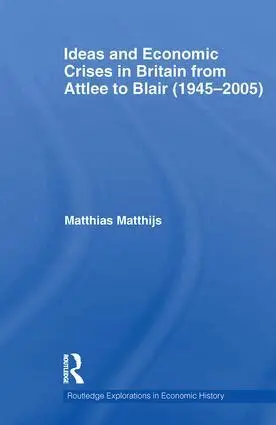
    Ideas and Economic Crises in Britain from Attlee to Blair (1945-2005)

    AvMatthias Matthijs

    Häftad, Engelska, 2012

    Del i serien Routledge Explorations in Economic History

    903 kr

    Beställningsvara. Skickas inom 10-15 vardagar. Fri frakt över 249 kr.

    Fler format och utgåvor

    Inbunden

    2 493 kr

    E-bok

    1 071 kr

    E-bok

    1 071 kr

    Beskrivning

    During the period from 1945 to 2005, Britain underwent two deep-seated institutional transformations when political elites successfully challenged the prevailing wisdom on how to govern the economy. Attlee and Thatcher were able to effectively implement most of their political platforms. During this period there were also two opportunities to challenge existing institutional arrangements. Heath's 'U-turn' in 1972 signalled his failure to implement the radical agenda promised upon election in 1970, whilst Tony Blair’s New Labour similarly failed to instigate a major break with the 'Thatcherite' settlement. Rather than simply retell the story of British economic policymaking since World War II, this book offers a theoretically informed version of events, which draws upon the literatures on institutional path dependence, economic constructivism and political economy to explain this puzzle. It will be of great interest to both researchers and postgraduates with an interest in British economic history and the fields of political economy and economic crisis more widely.

    Produktinformation

    • Utgivningsdatum:2012-02-15
    • Mått:156 x 234 x 19 mm
    • Vikt:500 g
    • Format:Häftad
    • Språk:Engelska
    • Serie:Routledge Explorations in Economic History
    • Antal sidor:272
    • Förlag:Taylor & Francis Ltd
    • ISBN:9780415533430

    Utforska kategorier

    • Ekonomisk historia inom Ekonomi och Ledarskap

    Mer om författaren

    Matthias Matthijs is Assistant Professor of International Political Economy at American University’s School of International Service and Professorial Lecturer of International Economics and International Relations at Johns Hopkins University’s School of Advanced International Studies, Washington, DC

    Recensioner i media

    "The publication of this lively and meticulously researched book is especially timely, appearing as it does at a moment when the whole legacy of Thatcherism, to which Blair and New Labour were heirs, has been thrown in doubt by the Great Recession of 2007-09. A must-read for all who are keen to discern the future of British politics. " --Robert Skidelsky; a member of the House of Lords, Professor Emeritus of the University of Warwick, and the chief biographer of John Maynard Keynes."Every now and then, one book stands out for both content and timing. This is such a book. Its content is truly stellar, being simultaneously a definitive telling of the post-war UK story and a guide to its key moments of fundamental change. The timing of its publication could not be better, given that the UK faces just such a moment again now. The Matthijs thesis on how to turn crises into new economic settlements deserves the widest possible academic and popular readership. Anyone keen to leave both Thatcherism and New Labour behind needs to read Ideas and Economic Crises, and learn from it. I certainly have!" -- David Coates, Worrell Professor of Anglo-American Studies, Wake Forest University, USA"In this absorbing study Matthias Matthijs reviews the complex interweaving of ideas and economic policies in Britain since 1945, and provides new insights into the Keynesian consensus, into Heath and Thatcher, and Blair and Brown. It is the perfect book for understanding the political and ideological context in which the Coalition Government is seeking to reduce the deficit and lay the foundations for economic recovery." -- Andrew Gamble, University of Cambridge"In order to understand continuity and change in economic policy-making, argues Matthijs (international politics, American U. in Washington), it is necessary to analyze both the impact and the narration of economic crises in the shaping of policy because sometimes how the facts are explained is more important than the objective facts themselves for changing ideas about the role of the state in the economy and what the main goals of economic policy ought to be. This argument underlies his analysis of change and continuity in British economic policy-making, which focuses on four key moments of potential policy realignment -- the successful realignments under Clement Attlee (1945-1951) and Margaret Thatcher (1979-1990) and the failed realignments under Edward Heath (1970-1974) and Tony Blair (1997-2005) -- and the role of economic ideas within institutions." -- ©Feb 2011 Book News Inc.

    Innehållsförteckning

    • 1. Continuity and Change in British Economic Policymaking 2. Crisis, Ideas and Path Dependence: Theoretical Framework and Postware Britain's Changing Political Economy 3. Clement Attlee’s Postwar 'Settlement' (1945-1970): Depression, War, Keynes, Beveridge and a New Consensus 4. Relative Decline and the Unravelling of Consensus (1959-1979): From 'Having it so Good' to the 'Winter of Discontent' 5. Margaret Thatcher’s Triumph (1975-1990): Inflation, Hayek, and the Overhaul of the British State 6. Thatcherism’s Flaws and Tony Blair’s Consolidation (1987-2005): From the Lawson Boom to New Labour’s 'New Britain' 7. Conclusion: Made in Britain Postscript Bibliography