• Fri frakt över 249 kr
  • •
  • Snabba leveranser
  • •
  • Billiga böcker
Kundservice

Du är på sajten för privatpersoner.

Företag, bibliotek eller offentlig verksamhet?

Du handlar på classic.bokus.com, där alla dina funktioner finns intakta.
Till classic.bokus.com
Bokus logotyp. Gå till startsidan.
  • Erbjudanden
  • Nyheter
  • Student
  • Topplistor
  • Barn & ungdom
  • Bokus Play
  • E-böcker
  • Pocketböcker
  • Spel & pussel

10% rabatt på allt med kod NYSTART10 →

Sidfot

Mina sidor

    Hjälp

    • Kundservice
    • Vanliga frågor och svar
    • Frakt och leverans
    • Retur vid ångerrätt
    • Reklamera vara
    • Betalning
    • Köpvillkor
    • Allmänna villkor
    • Information om webbplatsens tillgänglighet

    Om Bokus

    • Om oss
    • Pressrum
    • För studenter
    • För företag
    • För bibliotek och offentlig verksamhet
    • För leverantörer
    • Hållbarhet

    Populärt

    • Aktuella erbjudanden
    • Presentkort
    • Studentlitteratur
    • Nya böcker
    • Topplistor
    • Signerade böcker
    • Engelska böcker

    Inspiration

    • Boktips
    • BookTok
    • Populära bokserier
    • Barnbokskaraktärer
    • Populära författare
    Logotyp för Bokus
    Följ oss på Facebook (extern länk)Följ oss på Instagram (extern länk)Följ oss på YouTube (extern länk)Följ oss på TikTok (extern länk)
    bokus @ CookiesAnpassa cookiesIntegritetspolicyKöpvillkor
    Till Citymail hemsida (extern länk)Till Budbee hemsida (extern länk)Till Postnord hemsida (extern länk)Till Schenker hemsida (extern länk)Till Early Bird hemsida (extern länk)Till Walleys hemsida (extern länk)
    1. Samhälle och politik
    2. Samhälle och kultur
    3. Kultur och medier
    4. Referensverk och tvärvetenskap

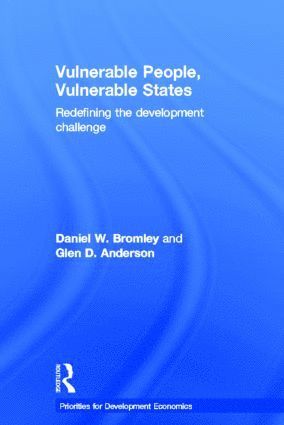
    Vulnerable People, Vulnerable States

    Redefining the Development Challenge

    AvDaniel Bromley,Glen Anderson

    Inbunden, Engelska, 2012

    Del i serien Priorities for Development Economics

    2 422 kr

    Beställningsvara. Skickas inom 10-15 vardagar. Fri frakt över 249 kr.

    Fler format och utgåvor

    Häftad

    878 kr

    Beskrivning

    Over five decades of economic and technical assistance to the countries of Africa and the Middle East have failed to improve the life prospects for over 1.4 billion people who remain vulnerable. Billions of dollars have been spent on such assistance and yet little progress has been made. Persistent hunger and hopelessness threaten more than individuals and families. These conditions foster political alienation that can easily metastasize into hostility and aggression. Recent uprisings in the Middle East are emblematic of this problem. Vulnerable people give rise to vulnerable states.This book challenges the dominant catechism of development assistance by arguing that the focus on economic growth (and fighting poverty) has failed to bring about the promised "convergence." Poor people and poor countries have clearly not closed the gap on the rich industrialized world. Pursuing convergence has been a failure. Here we argue that development assistance must be reconstituted to focus on creating economic coherence. People are vulnerable because the economies in which they are embedded do not cohere. The absence of economic coherence means that economic processes do not work as they must if individual initiative is to result in improved livelihoods. Weak and vulnerable states must be strengthened so that they can become partners in the process of creating economic coherence. When economies do not cohere, countries become breeding grounds for localized civil conflicts that often spill across national borders.

    Produktinformation

    • Utgivningsdatum:2012-06-22
    • Mått:156 x 234 x undefined mm
    • Vikt:470 g
    • Format:Inbunden
    • Språk:Engelska
    • Serie:Priorities for Development Economics
    • Antal sidor:168
    • Förlag:Taylor & Francis Ltd
    • ISBN:9780415534512

    Utforska kategorier

    • Referensverk och tvärvetenskap inom Samhälle och politik
    • Internationell ekonomi inom Ekonomi och Ledarskap
    • Miljöekonomi inom Ekonomi och Ledarskap

    Mer om författaren

    Daniel W. Bromley is Anderson-Bascom Professor (Emeritus) of applied economics at the University of Wisconsin-Madison, and Visiting Professor, Humboldt University-Berlin. Glen D. Anderson is Senior Manager at International Resources Group, Washington, D.C.

    Recensioner i media

    In the opening chapter of their new book, Daniel Bromley and Glen Anderson use the story of a Ghanaian farmer to vividly remind us that when the poor try to make a living, they face an insurmountable avalanche of barriers and costs. It is expensive being poor! And it makes them vulnerable. The reasons for their vulnerability? The rules that govern their economic lives are dysfunctional and incoherent. And because the poor cannot influence these many incoherent economic institutions, they become vulnerable.To reduce vulnerability, the authors argue, we need to diagnose and repair the incoherence of the economic institutions that create the vulnerability. Creating economic coherence is, in the authors' view, a new and better development paradigm than the current one of fighting poverty through economic convergence, or removing binding constraints to growth. True, the authors concede, vulnerability has many aspects, and is difficult to measure. But better measurement of outcomes is not what will make a difference to the lives of those who are chronically vulnerable. Take the Millennium Development Goals. Because the MDGs focus on symptoms of, rather than reasons for, vulnerability, they do not provide the basis for a clear and practical strategy. Focusing on vulnerability and coherence, by contrast, holds the promise of giving us clarity of purpose and forcing us to think about causality and connections. How to create more vulnerability-reducing coherence in an economy? Foster the enabling environment for markets to do their job, so that individuals can act, and transact, based on good information. Be clear about priorities and sequencing. Create the political space for innovation and adaptation. Etc. This book is not just about rethinking old concepts and suggesting powerful new ones. It is also a practical guide. Highly recommended!Rogier van den Brink, World Bank, USAThis is a very important book that should be read as a sequel to the classical writings in economic development by Sachs, Easterly, and Collier. It is a hopeful book, with a pragmatic vision of how development can be successfully achieved for the bottom 1.4 billion vulnerable people. It stresses the need for a country to have a vision of its future, carry out comprehensive diagnostics of the multiple constraints to development and their causal determinants, seek economic coherence in institutional reforms, establish actionable program priorities, and thus achieve sustainable economic development that will reduce vulnerability to repeated shocks. The approach restores the role of the state in making markets work, takes us beyond the microeconomics of fighting poverty, and opens the door for a creative role for development experts. It is indeed a welcome new departure in how to address the development challenge—it should be broadly noted and debated.Alain deJanvry, University of California-Berkeley, USAThe authors make the claim that the struggle for development ought to decisively focus on mitigating vulnerability of poor people and poor nations. This implies that instead of removing the symptoms of poverty, policies should aim at improving the coherence of the poor economies so that they become more responsive and adaptable to shocks. The idea is powerful and worthy of elaboration. The book forces us to think anew.Jean-Philippe Platteau, University Faculties of Notre-Dame de la Paix, Namur, BelgiumDevelopment assistance has not created significant results in Sub-Saharan Africa in the last 50 years. By redirecting our attention from income growth to the vulnerability of people and states, Daniel Bromley and Glen Anderson propose an agency-based approach for development assistance, that is, to increase the capabilities of people and states to create a coherent economic, social and political system. This is a paradigmatic change to the thinking of economic development.Yang Yao, Director, China Center for Economic Research, Peking University, China

    Innehållsförteckning

    • 1. From Convergence to Coherence: The New Development Opportunity 2. On Economic Coherence 3. Contending With Economic Incoherence: The Notional State 4. Creating Coherence: The Role of Institutions 5. Policy Reform as Institutional Innovation 6. The Diagnostic Imperative 7. From Diagnosis to Policy Reform 8. Working with the Policy-Reform Process 9. Toward Economic Coherence: A Practical Guide