• Fri frakt över 249 kr
  • •
  • Snabba leveranser
  • •
  • Billiga böcker
Kundservice

Du är på sajten för privatpersoner.

Företag, bibliotek eller offentlig verksamhet?

Du handlar på classic.bokus.com, där alla dina funktioner finns intakta.
Till classic.bokus.com
Bokus logotyp. Gå till startsidan.
  • Erbjudanden
  • Nyheter
  • Student
  • Topplistor
  • Barn & ungdom
  • Bokus Play
  • E-böcker
  • Pocketböcker
  • Spel & pussel

10% rabatt på allt med kod: NYSTART10 →

Sidfot

Mina sidor

    Hjälp

    • Kundservice
    • Vanliga frågor och svar
    • Frakt och leverans
    • Retur vid ångerrätt
    • Reklamera vara
    • Betalning
    • Köpvillkor
    • Allmänna villkor
    • Information om webbplatsens tillgänglighet

    Om Bokus

    • Om oss
    • Pressrum
    • För studenter
    • För företag
    • För bibliotek och offentlig verksamhet
    • För leverantörer
    • Hållbarhet

    Populärt

    • Aktuella erbjudanden
    • Presentkort
    • Studentlitteratur
    • Nya böcker
    • Topplistor
    • Signerade böcker
    • Engelska böcker

    Inspiration

    • Boktips
    • BookTok
    • Populära bokserier
    • Barnbokskaraktärer
    • Populära författare
    Logotyp för Bokus
    Följ oss på Facebook (extern länk)Följ oss på Instagram (extern länk)Följ oss på YouTube (extern länk)Följ oss på TikTok (extern länk)
    bokus @ CookiesAnpassa cookiesIntegritetspolicyKöpvillkor
    Till Citymail hemsida (extern länk)Till Budbee hemsida (extern länk)Till Postnord hemsida (extern länk)Till Schenker hemsida (extern länk)Till Early Bird hemsida (extern länk)Till Walleys hemsida (extern länk)
    1. Naturvetenskap och teknik
    2. Geovetenskap
    3. Miljövetenskap och miljöpolitik

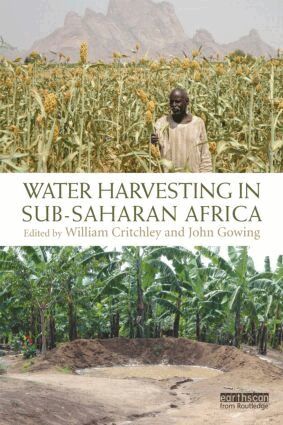
    Water Harvesting in Sub-Saharan Africa

    AvWilliam Critchley,John Gowing

    Häftad, Engelska, 2012

    793 kr

    Beställningsvara. Skickas inom 10-15 vardagar. Fri frakt över 249 kr.

    Beskrivning

    Agriculture in Sub-Saharan Africa is constrained by highly variable rainfall, frequent drought and low water productivity. There is an urgent need, heightened by climate change, for appropriate technologies to address this problem through managing and increasing the quantity of water on farmers’ fields – water harvesting. This book defines water harvesting as a set of approaches which occupy an intermediate position along the water-management spectrum extending from in situ moisture conservation to irrigated agriculture. They generally comprise small-scale systems that induce, collect, store and make use of local surface runoff for agriculture. The authors review development experience and set out the state of the art of water harvesting for crop production and other benefits in Sub-Saharan Africa. This includes an assessment of water harvesting schemes that were initiated two or three decades ago when interest was stimulated by the droughts of the 1970s and 1980s. These provide lessons to promote sustainable development of dryland agriculture in the face of changing environmental conditions. Case studies from eight countries across Sub-Saharan Africa provide the evidence base. Each follows a similar format and is based on assessments conducted in collaboration with in-country partners, with a focus on attempts to promote adoption of water harvesting, both horizontally (spread) and vertically (institutionalization). Introductory cross-cutting chapters as well as an analytical conclusion are also included.

    Produktinformation

    • Utgivningsdatum:2012-11-30
    • Mått:156 x 234 x 13 mm
    • Vikt:362 g
    • Format:Häftad
    • Språk:Engelska
    • Antal sidor:224
    • Förlag:Taylor & Francis Ltd
    • ISBN:9780415537865

    Utforska kategorier

    • Miljövetenskap och miljöpolitik inom Naturvetenskap och teknik

    Mer om författaren

    William Critchley is a Senior Sustainable Land Management Specialist at the Centre for International Cooperation, VU University Amsterdam, the Netherlands. John Gowing is a Reader in Agricultural Water Management, School of Agriculture, Food and Rural Development, Newcastle University, Newcastle upon Tyne, UK.Contributors: Adane Abebe, Ermias Alemu, M. Balima, Jennie Barron, Jetske Bouma, Martin Bwalya, Kipruto Cherogony, Asha Mohamed Deen, Sabina Di Prima, Abdalla Osman Eissa, Abdelaziz Gaiballa, Douglas Gumbo, Abdou Hassane, Seraphine Kabore-Sawadogo, F.C. Kahimba, Ralph Lasage, H.F. Mahoo, Maimbo Malesu, B.P. Mbilinyi, Eefke Mollee, K.D. Mutabazi, Isaiah Nyagumbo, Alex Oduor, Korodjouma Ouattara, I. Ouédraogo, Chris Reij, P.Reuben, F.B. Rwehumbiza, Hilmy Sally, M. Savadogo, Susanne M. Scheierling, Denyse Snelder, S. Traoré, S.D. Tumbo, Kifle Woldearegay and Menas Wuta.

    Recensioner i media

    "This important and timely book addresses one of the most critical issues related to water and food security – enhancing the role of rainfed agriculture... The book addresses the vital question of how to make this happen, and thus provides critical information to practitioners and researchers. The authors argue that there is little time to waste; and while more research is certainly valuable, enough is known to go forward with confidence. That surely is an important message" – from the foreword by David Molden, Director General of the International Centre for Integrated Mountain Development, Nepal, former Deputy Director General of the International Water Management Institute and Leader of the Comprehensive Assessment of Water Management in Agriculture

    Innehållsförteckning

    • Foreword 1. Introduction 2. Water Harvesting for Crop Production in Sub-Saharan Africa: Challenges, Concepts and Practices 3. A Review of the Recent Literature on Water Harvesting in Sub-Saharan Africa 4. Burkina Faso: Cradle of Farm Scale Technologies 5. Ethiopia: Opportunities for Building on Tradition – Time for Action 6. Kenya: From Drought Relief to Business Model 7. Niger: Small-Scale and Simple for Sustainability 8. Tanzania: Bright Spots and Barriers to Adoption 9. Sudan: Ancient Traditions Receiving a New Impetus 10. Zimbabwe: Keeping Runoff on the Land 11. Investing in water for agriculture in the Drylands of Sub-Saharan Africa: Considerations for a Conducive Policy Environment 12. Conclusions, Lessons and an Agenda for Action Index