• Fri frakt över 249 kr
  • •
  • Snabba leveranser
  • •
  • Billiga böcker
Kundservice

Du är på sajten för privatpersoner.

Företag, bibliotek eller offentlig verksamhet?

Du handlar på classic.bokus.com, där alla dina funktioner finns intakta.
Till classic.bokus.com
Bokus logotyp. Gå till startsidan.
  • Erbjudanden
  • Student
  • Topplistor
  • Barn & ungdom
  • Bokus Play
  • E-böcker
  • Ljudböcker
  • Pocketböcker
  • Spel & pussel

Upp till 25% på utvalda nyheter →

Sidfot

Mina sidor

    Hjälp

    • Kundservice
    • Vanliga frågor och svar
    • Frakt och leverans
    • Retur vid ångerrätt
    • Reklamera vara
    • Betalning
    • Köpvillkor
    • Allmänna villkor
    • Information om webbplatsens tillgänglighet

    Om Bokus

    • Om oss
    • Pressrum
    • För studenter
    • För företag
    • För bibliotek och offentlig verksamhet
    • För leverantörer
    • Hållbarhet

    Populärt

    • Aktuella erbjudanden
    • Presentkort
    • Studentlitteratur
    • Nya böcker
    • Topplistor
    • Signerade böcker
    • Engelska böcker

    Inspiration

    • Boktips
    • BookTok
    • Populära bokserier
    • Barnbokskaraktärer
    • Populära författare
    Logotyp för Bokus
    Följ oss på Facebook (extern länk)Följ oss på Instagram (extern länk)Följ oss på YouTube (extern länk)Följ oss på TikTok (extern länk)
    bokus @ CookiesAnpassa cookiesIntegritetspolicyKöpvillkor
    Till Citymail hemsida (extern länk)Till Budbee hemsida (extern länk)Till Postnord hemsida (extern länk)Till Schenker hemsida (extern länk)Till Early Bird hemsida (extern länk)Till Walleys hemsida (extern länk)
    1. Psykologi och pedagogik
    2. Pedagogik
    3. Pedagogisk metodik

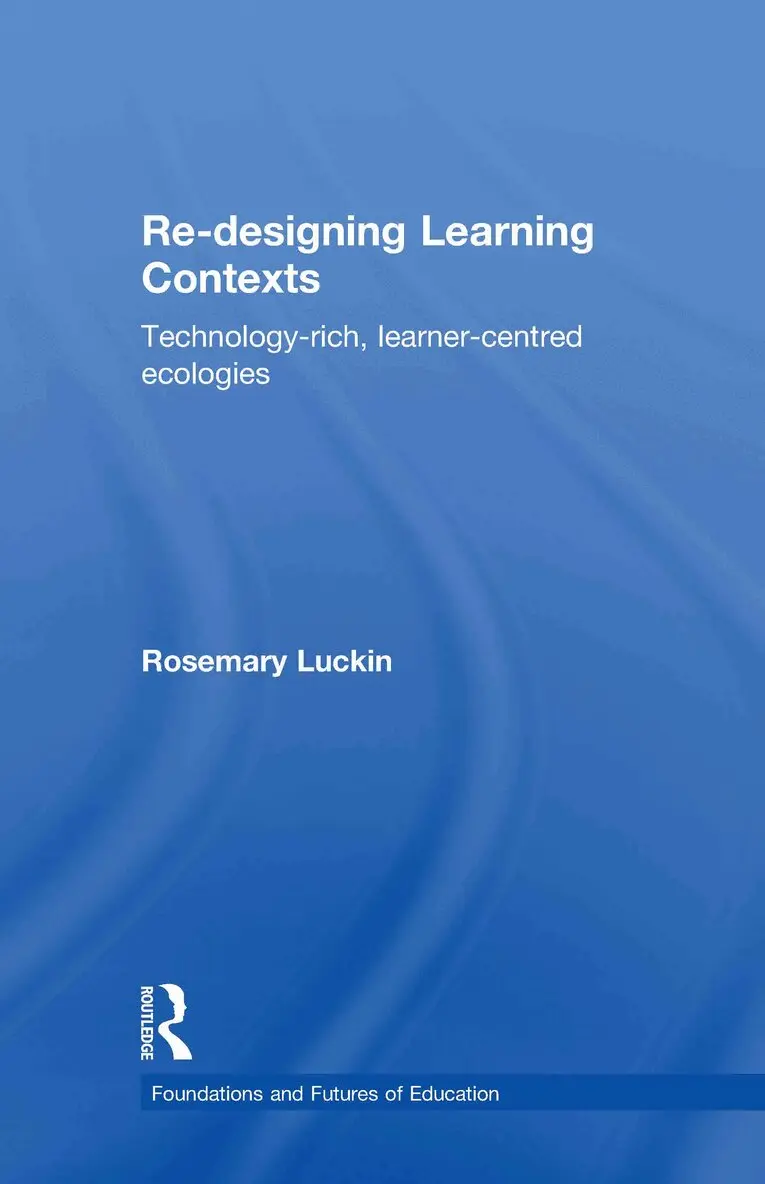
    Re-Designing Learning Contexts

    Technology-Rich, Learner-Centred Ecologies

    AvRosemary Luckin

    Inbunden, Engelska, 2011

    Del i serien Foundations and Futures of Education

    2 354 kr

    Beställningsvara. Skickas inom 10-15 vardagar. Fri frakt över 249 kr.

    Fler format och utgåvor

    Häftad

    648 kr

    E-bok

    766 kr

    E-bok

    766 kr

    Beskrivning

    What do we mean by the word ‘context’ in education and how does our context influence the way that we learn?What role can technology play in enhancing learning and what is the future of technology within learning?Re-Designing Learning Contexts seeks to re-dress the lack of attention that has traditionally been paid to a learner’s wider context and proposes a model to help educators and technologists develop more productive learning contexts. It defines context as the interactions between the learner and a set of inter-related resource elements that are not tied to a physical or virtual location. Context is something that belongs to an individual and that is created through their interactions in the world. Based on original, empirical research, the book considers the intersection between learning, context and technology, and explores:the meaning of the concept of context and it’s relationship to learningthe ways in which different types of technology can scaffold learning in contextthe Learner-Centric ‘Ecology of Resources’ model of context as a framework for designing technology-rich learning environmentsthe importance of matching available resources to each learner’s particular needs the ways in which the learner’s environment and the technologies available might change over the coming yearsthe potential impact of recent technological developments within computer science and artificial intelligence.This interdisciplinary study draws on a range of disciplines, including geography, anthropology, psychology, education and computing, to investigate the dynamics and potential of teacher-learner interaction within a learning continuum, and across a variety of locations. It will be of interest to those teaching, researching and thinking about the use of technology in learning and pedagogy, as well as those involved in developing technology for education and those who use it in their own teaching.For practical examples of the way the Ecology of Resources framework has been used visit: http://eorframework.pbworks.com.

    Produktinformation

    • Utgivningsdatum:2011-06-14
    • Mått:156 x 234 x 16 mm
    • Vikt:460 g
    • Format:Inbunden
    • Språk:Engelska
    • Serie:Foundations and Futures of Education
    • Antal sidor:208
    • Förlag:Taylor & Francis Ltd
    • ISBN:9780415554411

    Utforska kategorier

    • Pedagogisk metodik inom Psykologi och pedagogik

    Mer om författaren

    Rosemary Luckin is Professor of Learner-Centred Design at the London Knowledge Lab, Institute of Education, University of London, UK. She has graduate and postgraduate qualifications in Artificial Intelligence and Cognitive Science and has taught learners in schools, colleges and universities.

    Recensioner i media

    'One of the most important contributions on the whole TEL field.' – Richard Noss, Director of ESRC/EPSRC TEL Research Program'As new technologies, tools and online resources continue to proliferate, teachers, children and parents are increasingly confronted with 'learning support' overload. From smartphones to multitouch, apps to augmented reality, and interactive books to YouTube – how do they decide which to use and also how best to integrate with existing learning practices? Luckin's seminal and timely text covers the wider 'context of learning' spanning across time, space, home and school, while also crossing local and global and virtual and physical. A must read for those who want to learn more about how best to systematically choose, combine and constrain in an increasingly unwieldy world of instant knowledge and pervasive technology.' – Prof. Yvonne Rogers, Professor of Human-Computer Interaction, Oxford University

    Innehållsförteckning

    • Part One: Background 1. Contexts for Learning 2. Learners and Learning 3. The Role of Technology Part Two: The Ecology of Resources Model and Design Framework 4. Software Design and the Zone of Proximal Adjustment 5. Modelling a Learner's Context 6. The Ecology of Resources Method: Models and Participatory Design 7. The Ecology of Resources Design Framework Part Three: The Future of Technology Rich Learning 8. New Technologies, New Interactions? 9. New Interactions, New Opportunities for Learning