• Fri frakt över 249 kr
  • •
  • Snabba leveranser
  • •
  • Billiga böcker
Kundservice

Du är på sajten för privatpersoner.

Företag, bibliotek eller offentlig verksamhet?

Du handlar på classic.bokus.com, där alla dina funktioner finns intakta.
Till classic.bokus.com
Bokus logotyp. Gå till startsidan.
  • Erbjudanden
  • Nyheter
  • Student
  • Topplistor
  • Barn & ungdom
  • Bokus Play
  • E-böcker
  • Pocketböcker
  • Spel & pussel

10% rabatt på allt med kod: NYSTART10 →

Sidfot

Mina sidor

    Hjälp

    • Kundservice
    • Vanliga frågor och svar
    • Frakt och leverans
    • Retur vid ångerrätt
    • Reklamera vara
    • Betalning
    • Köpvillkor
    • Allmänna villkor
    • Information om webbplatsens tillgänglighet

    Om Bokus

    • Om oss
    • Pressrum
    • För studenter
    • För företag
    • För bibliotek och offentlig verksamhet
    • För leverantörer
    • Hållbarhet

    Populärt

    • Aktuella erbjudanden
    • Presentkort
    • Studentlitteratur
    • Nya böcker
    • Topplistor
    • Signerade böcker
    • Engelska böcker

    Inspiration

    • Boktips
    • BookTok
    • Populära bokserier
    • Barnbokskaraktärer
    • Populära författare
    Logotyp för Bokus
    Följ oss på Facebook (extern länk)Följ oss på Instagram (extern länk)Följ oss på YouTube (extern länk)Följ oss på TikTok (extern länk)
    bokus @ CookiesAnpassa cookiesIntegritetspolicyKöpvillkor
    Till Citymail hemsida (extern länk)Till Budbee hemsida (extern länk)Till Postnord hemsida (extern länk)Till Schenker hemsida (extern länk)Till Early Bird hemsida (extern länk)Till Walleys hemsida (extern länk)
    1. Juridik
    2. Särskilda rättsområden
    3. IT-rätt och kommunikationsrätt

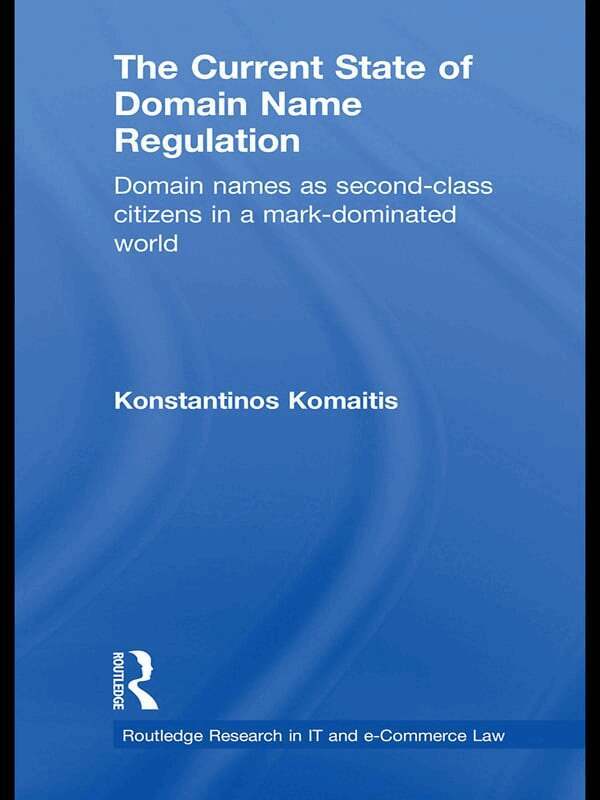
    Current State of Domain Name Regulation

    Domain Names as Second Class Citizens in a Mark-Dominated World

    AvKonstantinos Komaitis

    Häftad, Engelska, 2012

    Del i serien Routledge Research in Information Technology and E-Commerce Law

    574 kr

    Beställningsvara. Skickas inom 10-15 vardagar. Fri frakt över 249 kr.

    Fler format och utgåvor

    Inbunden

    2 434 kr

    E-bok

    679 kr

    E-bok

    679 kr

    Beskrivning

    In this book Konstantinos Komaitis identifies a tripartite problem – intellectual, institutional and ethical – inherent in the domain name regulation culture. Using the theory of property, Komaitis discusses domain names as sui generis ‘e-property’ rights and analyses the experience of the past ten years, through the Uniform Domain Name Dispute Resolution Policy (UDRP) and the Anticybersquatting Consumer Protection Act (ACPA). The institutional deficit he identifies, generates a further discussion on the ethical dimensions in the regulation of domain names and prompts Komaitis to suggest the creation of an environment based on justice. The relationship between trademarks and domain names has always been contentious and the existing institutions of the UDRP and ACPA have not assisted in alleviating the tension between the two identifiers. Over the past ten years, the trademark community has been systematic in encouraging and promoting a culture that indiscriminately considers domain names as secondclass citizens, suggesting that trademark rights should have priority over the registration in the domain name space. Komaitis disputes this assertion and brings to light the injustices and the trademark-oriented nature of the UDRP and ACPA. He queries what the appropriate legal source to protect registrants when not seeking to promote trademark interests is. He also delineates a legal hypothesis on their nature as well as the steps of their institutionalisation process that we need to reverse, seeking to create a just framework for the regulation of domain names. Finally he explores how the current policies contribute to the philosophy of domain names as second-class citizens. With these questions in mind, Komaitis suggests some recommendations concerning the reconfiguration of the regulation of domain names.

    Produktinformation

    • Utgivningsdatum:2012-05-01
    • Mått:156 x 234 x 17 mm
    • Vikt:550 g
    • Format:Häftad
    • Språk:Engelska
    • Serie:Routledge Research in Information Technology and E-Commerce Law
    • Antal sidor:292
    • Förlag:Taylor & Francis Ltd
    • ISBN:9780415631587

    Utforska kategorier

    • IT-rätt och kommunikationsrätt inom Juridik
    • Varumärkesskydd inom Juridik

    Mer om författaren

    Konstantinos Komaitis (Ph.D, LLM (Strathclyde University) and LLM (University of Sheffield)) is a lecturer at the University of Strathclyde, UK. He was also a member of ICANN's Special Trademark Issues (STI) team and a drafter of the Uniform Rapid Suspension (URS) system.

    Recensioner i media

    '[This book] provides a passionate yet legalistic and well-researched overview of the legal, institutional and ethical problems caused by the clash between domain names and trademarks. This is really the first decent book-length treatment of what is now a decade and a half of legal and political conflict between domain name registrants and trademark holders. But this is more than a static compilation and description of the subject: Komaitis has an original and fundamentally important argument to make.' - Milton Mueller, Internet Governance Project, 2010"... the content of the book is excellent and it gives a thorough and comprehensive study on the subject. It is a valuable contribution on the subject of domain names and should be on the top of the list for researchers seeking answers to questions on the state of domain names."Anan Shawqi Younes, University of Leicester; SCRIPTed 2010 (7:3)

    Innehållsförteckning

    • 1. Introduction: Taking on the Sins of ICANN and the UDRP Part 1: Intellectual Problem 2. Contextualising Property 3. Introducing Trademarks 4. Domain Names: Their Technological, Socio-Economic and Legal Status Part 2: Institutional Problem 5. History of Domain Name Institutionalization 6. "Lex Domainia" – The New Lex Mercatoria? 7. The UDRP and Arbitration 8. Issues of Procedural Unfairness 9. Free Speech in the Context of the UDRP 10. Regulating Domain Names Nationally: The Case of the Anticybersquatting Consumer Protection Act (ACPA) 11. Applying the UDRP and ACPA in the Right Context Part 3: Ethical Problem 12. ‘Haves’ and ‘Have-Nots’ Part 4: Themes and Issues 13. Forwards and Backwards 14. Repeating the Same Mistakes: New GTLDs and the IRT Recommendation Report