• Fri frakt över 249 kr
  • •
  • Snabba leveranser
  • •
  • Billiga böcker
Kundservice

Du är på sajten för privatpersoner.

Företag, bibliotek eller offentlig verksamhet?

Du handlar på classic.bokus.com, där alla dina funktioner finns intakta.
Till classic.bokus.com
Bokus logotyp. Gå till startsidan.
  • Erbjudanden
  • Nyheter
  • Student
  • Topplistor
  • Barn & ungdom
  • Bokus Play
  • E-böcker
  • Pocketböcker
  • Spel & pussel

10% rabatt på allt med kod NYSTART10 →

Sidfot

Mina sidor

    Hjälp

    • Kundservice
    • Vanliga frågor och svar
    • Frakt och leverans
    • Retur vid ångerrätt
    • Reklamera vara
    • Betalning
    • Köpvillkor
    • Allmänna villkor
    • Information om webbplatsens tillgänglighet

    Om Bokus

    • Om oss
    • Pressrum
    • För studenter
    • För företag
    • För bibliotek och offentlig verksamhet
    • För leverantörer
    • Hållbarhet

    Populärt

    • Aktuella erbjudanden
    • Presentkort
    • Studentlitteratur
    • Nya böcker
    • Topplistor
    • Signerade böcker
    • Engelska böcker

    Inspiration

    • Boktips
    • BookTok
    • Populära bokserier
    • Barnbokskaraktärer
    • Populära författare
    Logotyp för Bokus
    Följ oss på Facebook (extern länk)Följ oss på Instagram (extern länk)Följ oss på YouTube (extern länk)Följ oss på TikTok (extern länk)
    bokus @ CookiesAnpassa cookiesIntegritetspolicyKöpvillkor
    Till Citymail hemsida (extern länk)Till Budbee hemsida (extern länk)Till Postnord hemsida (extern länk)Till Schenker hemsida (extern länk)Till Early Bird hemsida (extern länk)Till Walleys hemsida (extern länk)
    1. Ekonomi och Ledarskap
    2. Företagsekonomi
    3. Affärsutveckling

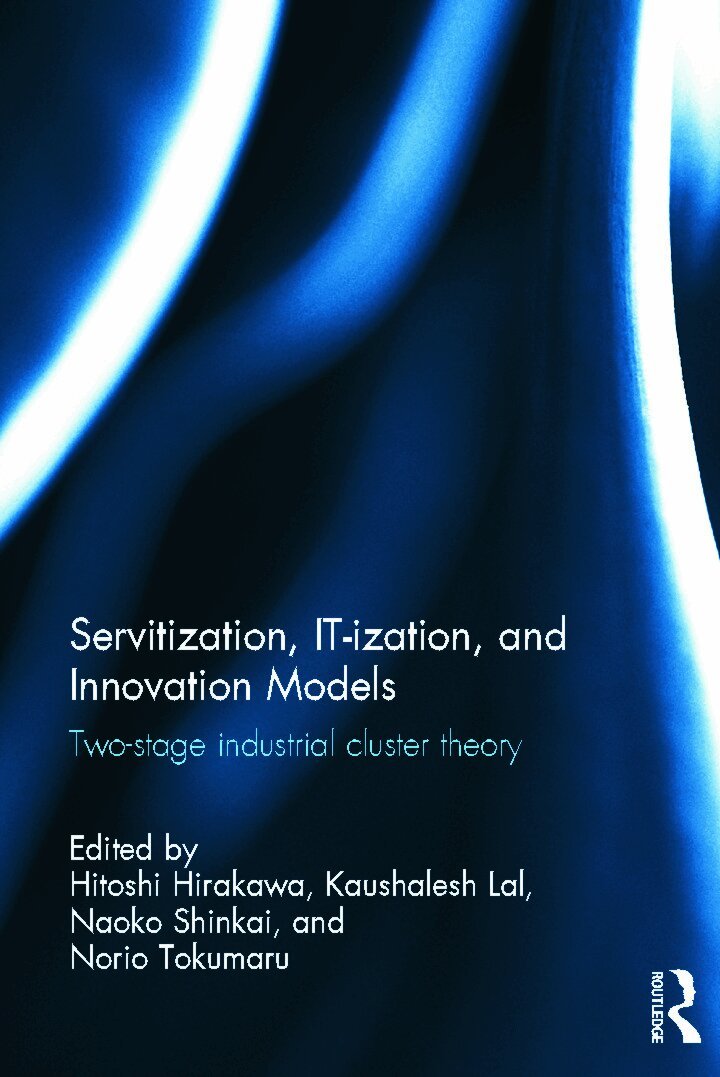
    Servitization, IT-ization and Innovation Models

    Two-Stage Industrial Cluster Theory

    AvHitoshi Hirakawa,Kaushalesh Lal

    Inbunden, Engelska, 2013

    2 495 kr

    Beställningsvara. Skickas inom 10-15 vardagar. Fri frakt över 249 kr.

    Beskrivning

    This book looks at two-stage industrial cluster theory and new innovation models in view of IT-ization and servitization of products. The formation of industrial clusters such as export processing zones and special economic zones has been the preferred mechanism for developing countries to boost their industrial development and export performance for the last several decades. Existing literature related to Development Economics cited numerous benefits of industrial clusters and several countries have reaped such benefits. The book goes beyond formation of traditional industrial clusters. It promotes the idea of formation of two-stage clusters. The book further stresses on new innovation models. The ideas are promoted based on the empirical evidence of Chinese and Taiwanese firms in consumer electronics and automobile sectors. Finally, the book looks at firm strategies in new business environment which is dominated by servitization of industrial products. It argues for firms to integrate manufacturing and services to a great extent. To substantiate the arguments, empirical evidence comes from India, Taiwan, and Bangladesh. The study further finds evidence, perhaps for the first time that innovation and knowledge acquisition strategies are influenced not only by size of firms but also vary with market preferences.

    Produktinformation

    • Utgivningsdatum:2013-01-18
    • Mått:156 x 234 x 15 mm
    • Vikt:520 g
    • Format:Inbunden
    • Språk:Engelska
    • Antal sidor:190
    • Förlag:Taylor & Francis Ltd
    • ISBN:9780415639453

    Utforska kategorier

    • Affärsutveckling inom Ekonomi och Ledarskap
    • Industrier och branscher inom Ekonomi och Ledarskap

    Mer om författaren

    Hitoshi Hirakawa is Professor of Asian Economies specializing in Asian Economies at the Economic Research Center, Graduate School of Economics, Nagoya University, and Visiting Professor at Nankai University, Tianjin, China. He had been teaching at Tokyo Keizai University, Ibaraki University, and others in Japan. Professor Hirakawa obtained his Ph.D. degree in Economics from Kyoto University, Kyoto, Japan. He holds Master Degree in Business Administration from Meiji University, Tokyo, Japan. Kaushalesh Lal earned his Ph.D. degree from Erasmus University Rotterdam, Netherlands. He holds Masters Degrees in Physics from Kanpur University and Operations Research from University of Delhi, India. Prior to joining United Nations University-MERIT in 2003, he has been teaching at Institute of Economic Growth, University of Delhi for about 21 years. He completed full six-year term at UNU-MERIT. Presently he is affiliated faculty to UNU-MERIT. Norio Tokumaru is Associate Professor at Nagoya Institute of Technology, Nagoya, Japan. His research interest is in changing innovation systems in the ICT-related industries in South and East Asia including India, China and Korea from the institutional and evolutionary perspectives.Naoko Shinkai has many years of experiences in research and development work on Development Economics and International Economics issues, including trade policy, labor and productivity, growth and income distribution, financial sector management, industrial development and poverty reduction strategy. She is currently interested in the areas of socio-economic impact assessment of policy reform, evaluation of development projects, and the effectiveness of development assistance and industrial development.

    Innehållsförteckning

    • Chapter 1 Introduction; Chapter 2 East Asia's economic development and new industrial cluster, HitoshiHirakawa; Chapter 3 The change of the development model and its impact on innovative activity, SongLei, GeDongsheng; Chapter 4 The servitization of Taiwan's ICT manufacturing and its industrial upgrading, Shin-HorngChen, Pam Pei-ChangWen, Pei-JuYu, Chih-KaiYang; Chapter 5 The ICT services industry in Bangalore, India, BalajiParthasarathy; Chapter 6 Innovation in the Indian IT industry, PavanSoni; Chapter 7 Perspectives of the IT sector in South Asia, NaokoShinkai; Chapter 8 Varieties of clustering and capability development in the Indian IT industry, NorioTokumaru; Chapter 9 Export orientation and corporate policy during global economic slowdown, KaushaleshLal, ShampaPaulIndex;