• Fri frakt över 249 kr
  • •
  • Snabba leveranser
  • •
  • Billiga böcker
Kundservice

Du är på sajten för privatpersoner.

Företag, bibliotek eller offentlig verksamhet?

Du handlar på classic.bokus.com, där alla dina funktioner finns intakta.
Till classic.bokus.com
Bokus logotyp. Gå till startsidan.
  • Erbjudanden
  • Nyheter
  • Student
  • Topplistor
  • Barn & ungdom
  • Bokus Play
  • E-böcker
  • Pocketböcker
  • Spel & pussel

10% rabatt på allt med kod: NYSTART10 →

Sidfot

Mina sidor

    Hjälp

    • Kundservice
    • Vanliga frågor och svar
    • Frakt och leverans
    • Retur vid ångerrätt
    • Reklamera vara
    • Betalning
    • Köpvillkor
    • Allmänna villkor
    • Information om webbplatsens tillgänglighet

    Om Bokus

    • Om oss
    • Pressrum
    • För studenter
    • För företag
    • För bibliotek och offentlig verksamhet
    • För leverantörer
    • Hållbarhet

    Populärt

    • Aktuella erbjudanden
    • Presentkort
    • Studentlitteratur
    • Nya böcker
    • Topplistor
    • Signerade böcker
    • Engelska böcker

    Inspiration

    • Boktips
    • BookTok
    • Populära bokserier
    • Barnbokskaraktärer
    • Populära författare
    Logotyp för Bokus
    Följ oss på Facebook (extern länk)Följ oss på Instagram (extern länk)Följ oss på YouTube (extern länk)Följ oss på TikTok (extern länk)
    bokus @ CookiesAnpassa cookiesIntegritetspolicyKöpvillkor
    Till Citymail hemsida (extern länk)Till Budbee hemsida (extern länk)Till Postnord hemsida (extern länk)Till Schenker hemsida (extern länk)Till Early Bird hemsida (extern länk)Till Walleys hemsida (extern länk)
    1. Samhälle och politik
    2. Samhälle och kultur
    3. Kultur och medier
    4. Referensverk och tvärvetenskap

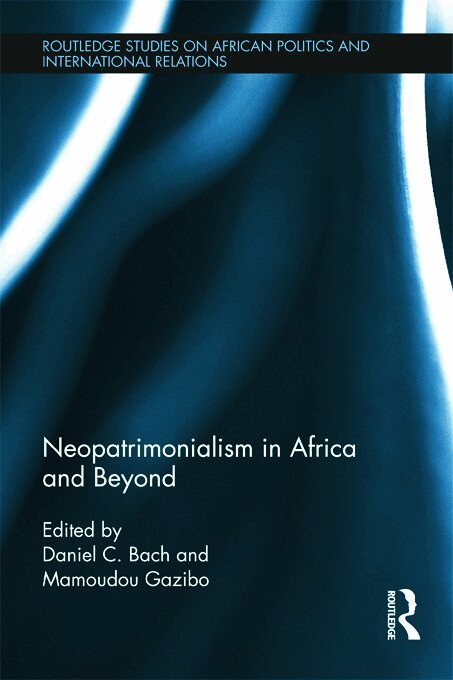
    Neopatrimonialism in Africa and Beyond

    AvDaniel Bach,Mamoudou Gazibo

    Häftad, Engelska, 2012

    Del i serien Routledge Studies in African Politics and International Relations

    712 kr

    Beställningsvara. Skickas inom 10-15 vardagar. Fri frakt över 249 kr.

    Beskrivning

    Neopatrimonialism, a system whereby rulers use state resources for personal benefit and to secure the loyalty of clients in the general population, is central to any teaching or conceptualisation of contemporary African politics. This book is a theoretical and comparative study of neopatrimonialism in Africa and across world regions.Although such practices are widespread in other parts of the world, the African neopatrimonial state has also become a global prototype of the anti-developmental state. This volume calls for a reappraisal of the genesis and interpretations of the concepts of patrimonialism and neopatrimonialism. Expert contributors consider recent debates in Africa through the study of democracy, clientelism, the ‘big man’ syndrome (Kenya), the rise of ‘godfatherism’ (Nigeria), ‘warlordism’ (Liberia) and the neopatrimonial state on a day to day basis (Niger). They discuss patrimonialism and neopatrimonialism from Latin America to Europe, Central Asia and Asia-Pacific, to weave a comparative analysis of the interplay between public policies and private interest.Neopatrimonialism in Africa and Beyond is an important and timely volume that will be of interest to students and scholars of international politics, African studies, sociology and international development.

    Produktinformation

    • Utgivningsdatum:2012-07-23
    • Mått:156 x 234 x 15 mm
    • Vikt:500 g
    • Format:Häftad
    • Språk:Engelska
    • Serie:Routledge Studies in African Politics and International Relations
    • Antal sidor:272
    • Förlag:Taylor & Francis Ltd
    • ISBN:9780415640107

    Utforska kategorier

    • Referensverk och tvärvetenskap inom Samhälle och politik

    Mer om författaren

    Daniel C. Bach is a CNRS Director of research at the Emile Durkheim Centre at the University of Bordeaux, France. He is also a professor at Sciences Po Bordeaux.Mamoudou Gazibo is Professor in the Department of Political Science of the University of Montreal, Canada.

    Recensioner i media

    'There is simply no other work of similar scope on this essential topic for comparative politics. This exhaustive volume simultaneously takes stock and pushes forward. It enlightens the reader on the origins of the concept and its past uses, while also offering new theoretical contributions, critical assessments of its usefulness within and beyond Africa, and original empirical applications.' - Pierre Englebert, Pomona College'A highly appropriate and masterly presentation of the conceptual and theoretical richness of neopatrimonialism that rightly corrects its traditional confinement to Africa and demonstrates its relevance to other political contexts including democratic Western polities.' - Helge Hveem, University of Oslo'This book without doubt elevates the theoretical and comparative study of neo patrimonialism in Africa to new heights and demonstrates that the concept is not unique to Africa. The comparativist approach which the book adopts enriches our understanding of the concept. After carefully spelling out what patrimonialism and neo patrimonialism mean in the diverse regions of the world from Africa to Asian, Latin America and Asian-Pacific, the authors examine the implications of the use of the term and show that even in parts of the world where the term has not been used similar practices exist. Anyone who reads, the book will be left with the clear understanding of meaning, application, and implications of the politics of patrimonialism and neo-patrimonialism in the world. It is a brilliant book that is must read for all those working to strengthen and consolidate democracy in new democracies throughout the world.' - Muna Ndulo, Professor of Law, Cornell University Law School and Director Cornell’s Institute for African Development.'This very welcome book reincorporates the study of ‘neopatrimonialism’ – in recent years heavily oriented towards the understanding of African politics – back into the conceptual and comparative framework of analysis from which it originated. In the process, it both helps to rectify the all too common perception of the uniqueness of Africa’s political trajectories, and illuminates the complex relationships between neopatrimonialism and recent pressures for political and economic transformation, both in Africa and elsewhere. In so doing, it provides a fitting tribute to, and reflection on, the work of Jean-François Médard, from which so much of our awareness of neopatrimonial politics derives.' - Christopher Clapham, University of Cambridge'The concept of neopatrimonialism has been widely accepted since the 1970s as a characterisation of the generality of African states, condemned by both history and culture to be anti-developmental. This volume is a welcome and timely critique of this approach, focusing on two major themes: the necessity to differentiate between positive and negative types of neopatrimonial states, some of which are quite capable of sustaining successful development, and the importance of taking the concept out of its Africanist ghetto and applying it comparatively across all regions of the globe including Europe. The contributors are a line-up of outstanding and well-known scholars writing on countries or regions they know well, and the whole enterprise is well-framed by Bach’s comparative typology of ‘regulated’ versus ‘predatory’ neopatrimonialism . This is an essential collection for all those concerned with the politics of development in its broadest sense.' - Richard Crook, Institute of Development Studies, Brighton."This is a useful addition to the canon of literature on neopatrimonialism. The theory section provides a useful reminder of how the term first emerged from Weber’s analysis, was subsequently adopted and refined for the specific regions subjected to that analysis, and the more recent ways in which research has reframed and asked new questions of neopatrimonialism... The editors have worked hard to ensure there is a logical flow throughout the collection rather than a set of disparate, loosely connected chapters... It seeks to widen the frame of reference [on neopatrimonialism], and raises interesting and important questions."- Dr Michael Jennings; e-International Relations (2012).

    Innehållsförteckning

    • 1. Introduction Mamoudou Gazibo Part 1: Concepts and Their Relevance 2. Weber’s patrimonial domination and its interpretations Hinnerk Bruhns 3. Patrimonialism and neopatrimonialism: comparative receptions and transcriptions Daniel Bach 4. The model of the political entrepreneur Daniel Compagnon 5. Charles Njonjo: the portrait of a 'big man' in Kenya Jean-François Médard 6. Can neopatrimonialism dissolve into democracy? Mamoudou Gazibo 7. Neopatrimonialism and its reinterpretations by development economics Alice Sindzingre Part 2: New Orientations and Debates in Africa 8. The path from neopatrimonialism: democracy and clientelism in Africa today Nicolas van de Walle 9. Rebellion and warlordism: the spectre of neopatrimonialism Morten Bøås and Kathleen M. Jennings 10. The origins and meaning of Nigeria’s "Godfatherism" Phenomenon Chris Albin-Lackey 11. Monitoring the neopatrimonial state on a day-to-day basis: politicians, customs officials and traders in Niger Mahaman Tijani Alou Part 3: Regional Transcriptions and Interpretations 12. Oligarchy and caciquismo in the Philippines Dominique Caouette 13. Jeitinho and other related phenomena in contemporary Brazil Yves-André Fauré 14. Neopatrimonialism, patronage and factionalism in post-soviet Uzbekistan Alisher Ikhamov 15. Berlusconismo as a case of "Hybrid neopatrimonialism" Mauro Barisione 16. Clientelism and patrimonialism in international relations: the case of France’s African policy Daniel Bourmaud 17. Conclusion, Neopatrimonial and developmental: the emerging states' syndrome Daniel C. Bach