• Fri frakt över 249 kr
  • •
  • Snabba leveranser
  • •
  • Billiga böcker
Kundservice

Du är på sajten för privatpersoner.

Företag, bibliotek eller offentlig verksamhet?

Du handlar på classic.bokus.com, där alla dina funktioner finns intakta.
Till classic.bokus.com
Bokus logotyp. Gå till startsidan.
  • Erbjudanden
  • Student
  • Topplistor
  • Barn & ungdom
  • Bokus Play
  • E-böcker
  • Ljudböcker
  • Pocketböcker
  • Spel & pussel

Upp till 25% på utvalda nyheter →

Sidfot

Mina sidor

    Hjälp

    • Kundservice
    • Vanliga frågor och svar
    • Frakt och leverans
    • Retur vid ångerrätt
    • Reklamera vara
    • Betalning
    • Köpvillkor
    • Allmänna villkor
    • Information om webbplatsens tillgänglighet

    Om Bokus

    • Om oss
    • Pressrum
    • För studenter
    • För företag
    • För bibliotek och offentlig verksamhet
    • För leverantörer
    • Hållbarhet

    Populärt

    • Aktuella erbjudanden
    • Presentkort
    • Studentlitteratur
    • Nya böcker
    • Topplistor
    • Signerade böcker
    • Engelska böcker

    Inspiration

    • Boktips
    • BookTok
    • Populära bokserier
    • Barnbokskaraktärer
    • Populära författare
    Logotyp för Bokus
    Följ oss på Facebook (extern länk)Följ oss på Instagram (extern länk)Följ oss på YouTube (extern länk)Följ oss på TikTok (extern länk)
    bokus @ CookiesAnpassa cookiesIntegritetspolicyKöpvillkor
    Till Citymail hemsida (extern länk)Till Budbee hemsida (extern länk)Till Postnord hemsida (extern länk)Till Schenker hemsida (extern länk)Till Early Bird hemsida (extern länk)Till Walleys hemsida (extern länk)
    1. Psykologi och pedagogik
    2. Psykologi
    3. Kognitiv psykologi

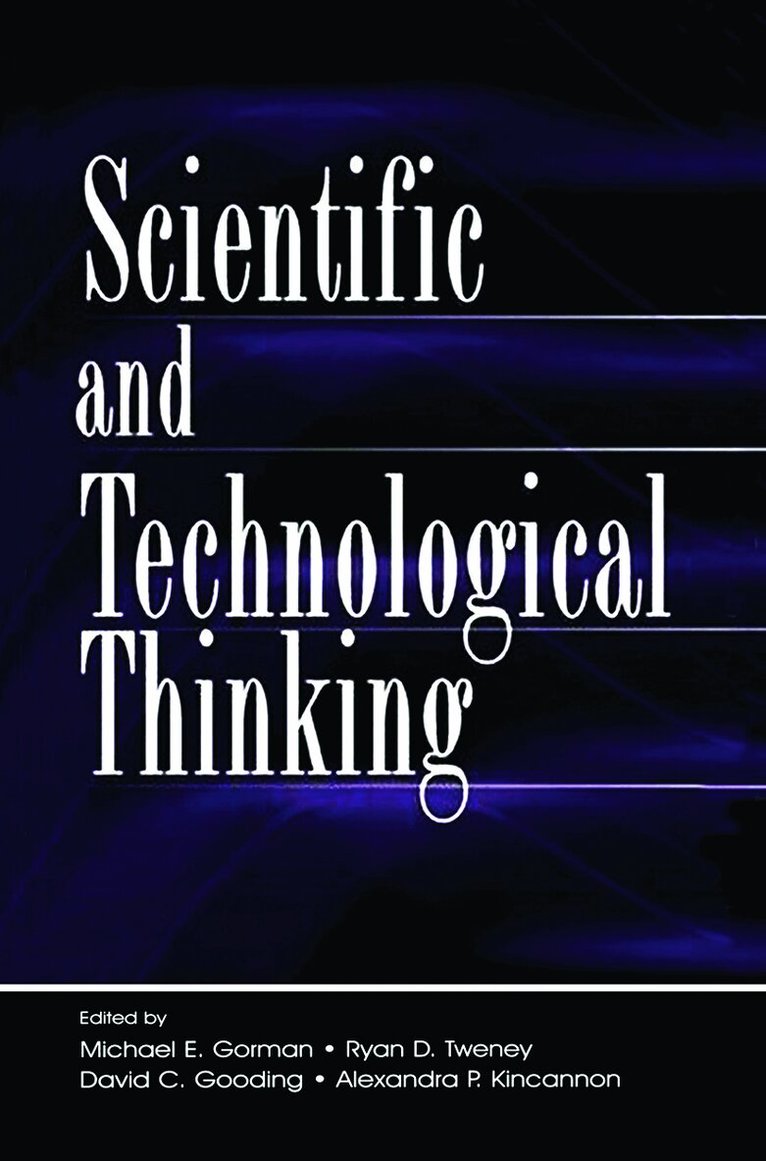
    Scientific and Technological Thinking

    AvMichael E. Gorman,Ryan D. Tweney

    Häftad, Engelska, 2013

    553 kr

    Beställningsvara. Skickas inom 10-15 vardagar. Fri frakt över 249 kr.

    Beskrivning

    At the turn of the 21st century, the most valuable commodity in society is knowledge--particularly new knowledge that may give a culture, company, or laboratory an adaptive advantage. Knowledge about the cognitive processes that lead to discovery and invention can enhance the probability of making valuable new discoveries and inventions. Such knowledge needs to be made widely available to ensure that no particular interest group "corners the market" on techno-scientific creativity. Knowledge can also facilitate the development of business strategies and social policies based on a genuine understanding of the creative process. Furthermore, through an understanding of principles underlying the cognitive processes related to discovery, educators can utilize these principles to teach students effective problem-solving strategies as part of their education as future scientists.This book takes the reader out onto the cutting edge of research in scientific and technological thinking. The editors advocate a multiple-method approach; chapters include detailed case studies of contemporary and historical practices, experiments, computational simulations, and innovative theoretical analyses. The editors attempt a provocative synthesis of this work at the end.In order to achieve true scientific and technological progress, an understanding of the process by which species are transforming the world is needed. This book makes an important step in that direction by leading to breakthroughs in the understanding of discovery and invention.

    Produktinformation

    • Utgivningsdatum:2013-07-09
    • Mått:152 x 229 x 20 mm
    • Vikt:521 g
    • Format:Häftad
    • Språk:Engelska
    • Antal sidor:472
    • Förlag:Taylor & Francis Ltd
    • ISBN:9780415654159

    Utforska kategorier

    • Kognitiv psykologi inom Psykologi och pedagogik

    Mer om författaren

    Michael E. Gorman, Ryan D. Tweney, David C. Gooding, Alexandra P. Kincannon

    Recensioner i media

    "...recommend this volume and hope that it indeed opens up greater discussion about scientific and technical thinking and where, how, and why it matters."—Science Education

    Innehållsförteckning

    • Contents: Preface. M.E. Gorman, R.D. Tweney, D.C. Gooding, A.P. Kincannon, Editors' Introduction. N.J. Nersessian, Interpreting Scientific and Engineering Practices: Integrating the Cognitive, Social, and Cultural Dimensions. K.N. Dunbar, J.A. Fugelsang, Casual Thinking in Science: How Scientists and Students Interpret the Unexpected. D. Klahr, A Framework for Cognitive Studies of Science and Technology. S.B. Trickett, C.D. Schunn, J.G. Trafton, Puzzles and Peculiarities: How Scientists Attend to and Process Anomalies During Data Analysis. J. Shrager, On Being and Becoming a Molecular Biologist: Notes From the Diary of an Insane Cell Mechanic. R.D. Tweney, R.P. Mears, C. Spitzmüller, Replicating the Practices of Discovery: Michael Faraday and the Interaction of Gold and Light. P. Thagard, How to Be a Successful Scientist. D.C. Gooding, Seeing the Forest for the Trees: Visualization, Cognition, and Scientific Inference. M.F. Ippolito, Problem Representation in Virginia Woolf's Invention of a Novelistic Form. G. Bradshaw, What's So Hard About Rocket Science? Secrets the Rocket Boys Knew. T.P. Hughes, A Systems Ordered World. M.E. Gorman, Levels of Expertise and Trading Zones: Combining Cognitive and Social Approaches to Technology Studies. B. Allenby, Technology at the Global Scale: Interactive Cognitivism and Earth Systems Engineering and Management. M.E. Gorman, R.D. Tweney, D.C. Gooding, A.P. Kincannon, The Future of Cognitive Studies of Science and Technology.