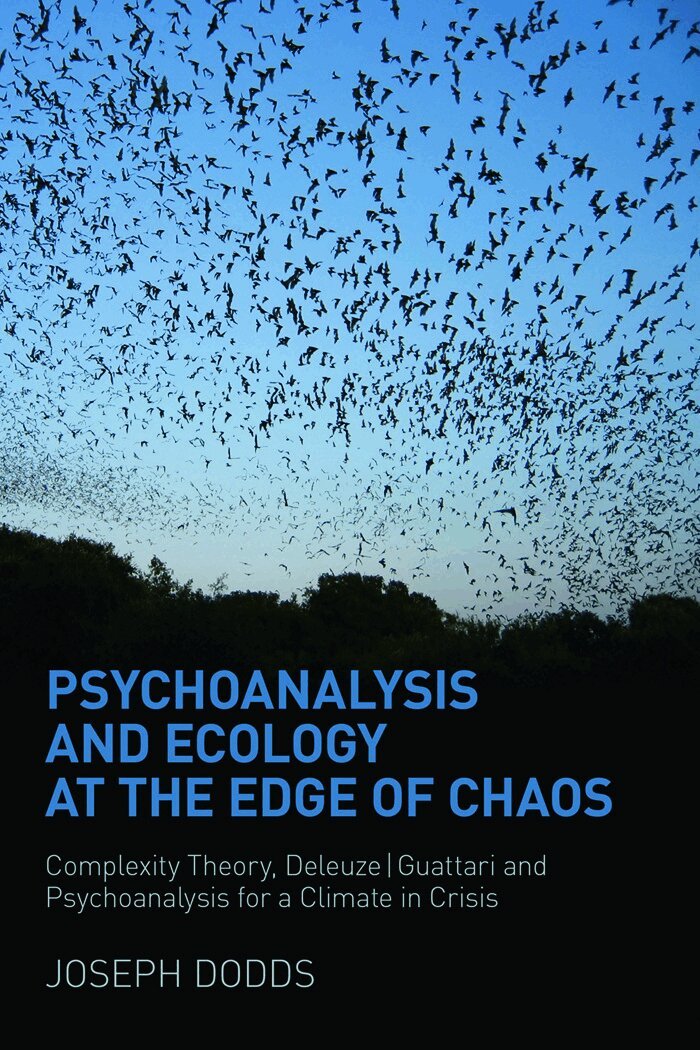
Häftad, Engelska, 2011
Psychoanalysis and Ecology at the Edge of Chaos
Complexity Theory, Deleuze,Guattari and Psychoanalysis for a Climate in Crisis
Av Joseph Dodds
584 kr
Beställningsvara. Skickas inom 10-15 vardagar. Fri frakt över 249 kr.
Beskrivning
Produktinformation
- Utgivningsdatum: 2011-07-25
- Mått: 156 x 234 x 19 mm
- Vikt: 470 g
- Format: Häftad
- Språk: Engelska
- Antal sidor: 256
- Förlag: Taylor & Francis Ltd
- ISBN: 9780415666121
Utforska kategorier
Mer om författaren
Joseph Dodds, PhD, is a psychoanalyst in private practice (Czech Psychoanalytical Society, International Psychoanalytical Association), a senior lecturer in psychoanalysis at the Anglo-American University, a psychology lecturer at the University of New York in Prague, and a Chartered Psychologist and Associate Fellow of the British Psychological Society.
Recensioner i media
"A brilliant integration of psychoanalytic theory with modern mathematics to explain the greatest challenge mankind has ever faced: its capacity to destroy the environment that sustains it. I cannot imagine psychoanalytic ideas to have a better application. The integration is truly original and scholarly, and provides an excellent background for further exploration." - Peter Fonagy, University College London, UK"Once in a while, a book enters the field of psychoanalysis that is so revolutionary that it turns everything upside down, causing us to question the very framework under which we operate... a seminal book that introduces a new area of focus that should be read by any psychoanalyst interested in preserving the world for their children and grandchildren." - Terry Marks-Tarlow, International Journal of Psychoanalytic Self-Psychology"This book is a real tour de force and an important addition to a currently relatively small body of writings on climate change from a psychoanalytic perspective. It is comprehensive and encyclopaedic, covering enormous ground between related and complex disciplines. Dodds navigates these ideas with clarity and conviction. Overall, he demonstrates the need to link the various different approaches in order to address the ecological crisis that we face. I think, the book is essential reading for all and will add specifically to their understanding for those studying psychoanalysis, psychotherapy and systemic thinking." - Jan Baker Psychodynamic Practice, 2013"Dodds shows us the interconnectedness between the ecology of mind, the ecology of society and the ecology of nature; each, worlds of infinite complexity, and locates psychoanalysis as part of a mind–society–nature continuum... He shows that complexity theory both illuminates psychoanalysis and helps to understand the crisis of man-made climate change… These ways of understanding the world are potentially revolutionary... Dodds’ enthusiasm for them is infectious, which encourages the reader to get to grips with this complicated but essential way of thinking." - Robert Tollemache Psychoanalytic Psychotherapy 2013 Vol.27, No.2"A tour de force of ecological, psychoanalytic and poststructural thought... essential reading for any scholar of ecopsychology who wishes to extend his or her thinking into new lines of flight and take some risks along the way." - Renee Lertzman, Ecopsychology"Occasionally a book is produced which meets the entirety of the mission of this journal... the known but little discussed nexus between psychology, the life sciences, and nonlinear dynamics... Mature students in fields ranging from psychology to ecology to complexity sciences will find this book of value." - Douglas Kiel, Nonlinear Dynamics, Psychology, and Life Sciences"Psychoanalysis and ecology at the edge of chaos makes a significant contribution to current discussions around the ecological crisis by suggesting that psychoanalysis offers important insights in the problem of climate change and its effects... This is a very useful and interesting book, carefully researched, well organized and clearly written, a very good case of truly interdisciplinary scholarship." - Maria Tamboukou, Psychology in Society"Showing himself to be a 'nomadic scholar' of the highest order Dodds both draws on relevant psychoanalytic ideas to explore the ecological terrain, and points out its limitations in remaining, in spite of all its advantages, fundamentally a psychology without ecology." - Martin Jordan, From the Foreword"Dodds' particular contribution is to show that psychoanalysis is not separate, but rooted in the natural world. He shows that complexity theory both illuminates psychoanalysis and helps to understand the crisis of man-made climate change. ... All in all, these ways of understanding the world are potentially revolutionary and can shed greater light on psychoanalytic thinking: Dodds' enthusiasm for them is infectious, which encourages the reader to get to grips with this complicated but essential way of thinking." - Robert Tollemache, Psychoanalytic Psychotherapy - Vol. 27, No. 2
Betyg & recensioner
0 recensioner
Inga recensioner tillgängliga.