• Fri frakt över 249 kr
  • •
  • Snabba leveranser
  • •
  • Billiga böcker
Kundservice

Du är på sajten för privatpersoner.

Företag, bibliotek eller offentlig verksamhet?

Du handlar på classic.bokus.com, där alla dina funktioner finns intakta.
Till classic.bokus.com
Bokus logotyp. Gå till startsidan.
  • Erbjudanden
  • Nyheter
  • Student
  • Topplistor
  • Barn & ungdom
  • Bokus Play
  • E-böcker
  • Pocketböcker
  • Spel & pussel

10% rabatt på allt med kod: NYSTART10 →

Sidfot

Mina sidor

    Hjälp

    • Kundservice
    • Vanliga frågor och svar
    • Frakt och leverans
    • Retur vid ångerrätt
    • Reklamera vara
    • Betalning
    • Köpvillkor
    • Allmänna villkor
    • Information om webbplatsens tillgänglighet

    Om Bokus

    • Om oss
    • Pressrum
    • För studenter
    • För företag
    • För bibliotek och offentlig verksamhet
    • För leverantörer
    • Hållbarhet

    Populärt

    • Aktuella erbjudanden
    • Presentkort
    • Studentlitteratur
    • Nya böcker
    • Topplistor
    • Signerade böcker
    • Engelska böcker

    Inspiration

    • Boktips
    • BookTok
    • Populära bokserier
    • Barnbokskaraktärer
    • Populära författare
    Logotyp för Bokus
    Följ oss på Facebook (extern länk)Följ oss på Instagram (extern länk)Följ oss på YouTube (extern länk)Följ oss på TikTok (extern länk)
    bokus @ CookiesAnpassa cookiesIntegritetspolicyKöpvillkor
    Till Citymail hemsida (extern länk)Till Budbee hemsida (extern länk)Till Postnord hemsida (extern länk)Till Schenker hemsida (extern länk)Till Early Bird hemsida (extern länk)Till Walleys hemsida (extern länk)
    1. Ekonomi och Ledarskap
    2. Nationalekonomi
    3. Miljöekonomi

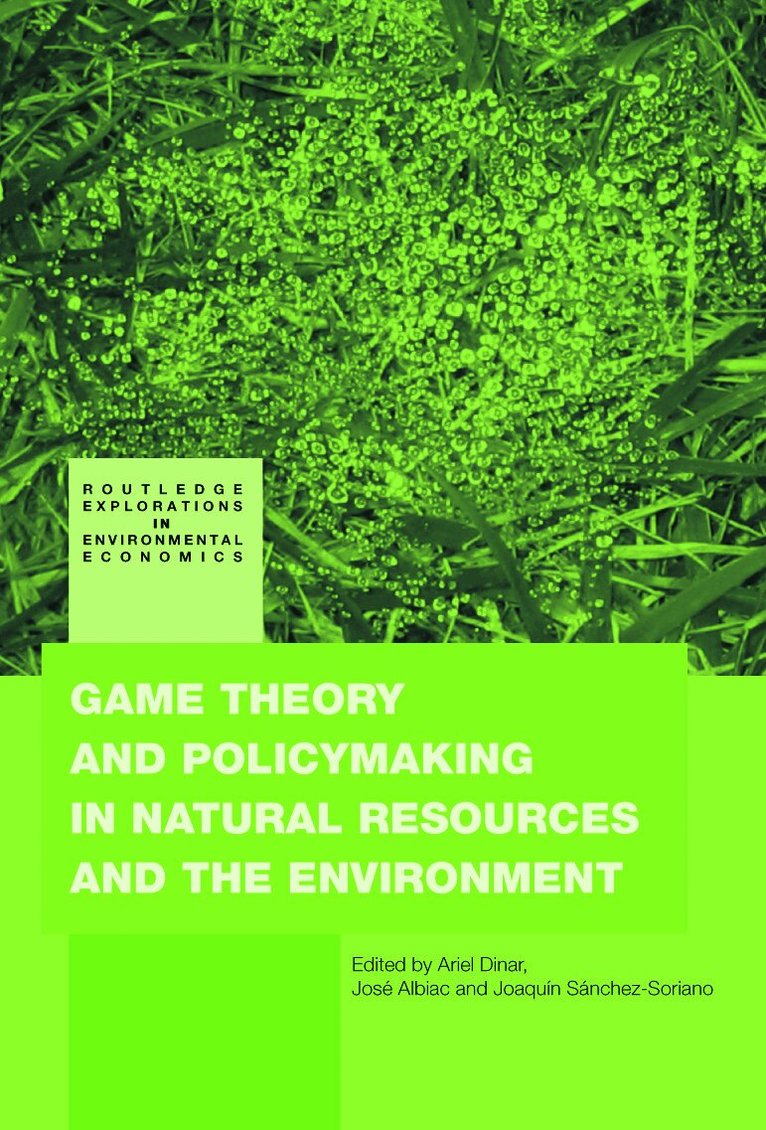
    Game Theory and Policy Making in Natural Resources and the Environment

    AvAriel Dinar,José Albiac

    Inbunden, Engelska, 2008

    Del i serien Routledge Explorations in Environmental Economics

    2 954 kr

    Beställningsvara. Skickas inom 10-15 vardagar. Fri frakt över 249 kr.

    Beskrivning

    Game Theory has become one of the main analytical tools for addressing strategic issues in the field of economics and is increasing its influence in other fields of social sciences. With the increased level of extraction of natural resources and pollution of environments, game theory gains its place in the literature and it is more and more seen as a tool for policy makers and not only for theoreticians. The book is structured into four parts dealing with the management of natural resources, the negotiation aspects of water management, water allocation through pricing and markets, and how conflicts and regulation shape the management of the environment. The first part explores game theory concepts applied to fisheries and grazing lands, which are two important natural resources. In the next two parts, several game theory methodologies are considered in the negotiation approach to water management and approaches to water pricing and markets. The last section looks at environmental protection as the end process of the interplay between conflict and regulation.This book includes chapters by experts from developing and developed countries that apply game theory to actual issues in natural resources and the environment. As such the book is extremely useful for graduate students and technical experts interested in the sustainable management of natural resource and the environment. It is also relevant to all Game Theory and Environmental Economics students.

    Produktinformation

    • Utgivningsdatum:2008-01-31
    • Mått:156 x 234 x 24 mm
    • Vikt:840 g
    • Format:Inbunden
    • Språk:Engelska
    • Serie:Routledge Explorations in Environmental Economics
    • Antal sidor:366
    • Förlag:Taylor & Francis Ltd
    • ISBN:9780415774222

    Utforska kategorier

    • Miljöekonomi inom Ekonomi och Ledarskap
    • Offentlig förvaltning inom Samhälle och politik
    • Hydrologi inom Naturvetenskap och teknik

    Mer om författaren

    Ariel Dinar is a Professor of Environmental Economics and Policy, and Director Water Science and Policy Center, University of California, Riverside, USA. He was formerly Lead Economist of the Development Research Group at the World Bank, USA. His research focuses on international water and cooperation, approaches to stable water allocation agreements, water and climate change, economics of water quantity/quality, and economic aspects of policy interventions and institutional reforms. His most recent undertaking is the RFF book series "Issues in Water Resource Policy" that aims to produce publications on contemporary water policy issues in various countries and states. Jose Albiac is a Research Fellow at CITA, an agricultural research centre of the Government of Aragón, Zaragoza, Spain.Joaquín Sánchez-Soriano is an Associate Professor at the Department of Statistics, Mathematics and Computer Science of the University Miguel Hernández, Elche, Spain.

    Innehållsförteckning

    • 1. Introduction: Game Theory - A Useful Approach for Policy Evaluation in Natural Resource and Environment?  2. Game Theory and the Development of Resource Management Policy: The Case of International Fisheries  3. Traditional Grazing Rights in Sub-Saharan Africa and the Role of Policy  4. Application of Partition Function Games to the Management of Straddling Fish Stocks  5. To Negotiate or to Game Theorize: Evaluating Water Allocation Mechanisms in the Kat Basin, South Africa  6. Cooperation and Equity in the River Sharing Problem  7. Negotiation over the Allocation of Water Resources: The Strategic Importance of Bargaining Structure  8. Rural-Urban Water Transfers with Applications to the U.S./Mexico Border Region  9. WAS-guided Cooperation in Water Management: Coalitions and Gains  10. Experimental Insights into the Efficiency of Alternative Water Management Institutions  11. A Fair Tariff System for Water Management  12. Game-Theoretic Modeling of Water Allocation Regimes Applied to the Yellow River Basin in China  13. Contributions of Game Theory to the Analysis of Consumer Boycotts  14. How does Environment Awareness Arise?: An Evolutionary Approach  15. Effects of Alternative CDM Baseline Schemes Under an Imperfectly Competitive Market Structure