• Fri frakt över 249 kr
  • •
  • Snabba leveranser
  • •
  • Billiga böcker
Kundservice

Du är på sajten för privatpersoner.

Företag, bibliotek eller offentlig verksamhet?

Du handlar på classic.bokus.com, där alla dina funktioner finns intakta.
Till classic.bokus.com
Bokus logotyp. Gå till startsidan.
  • Erbjudanden
  • Nyheter
  • Student
  • Topplistor
  • Barn & ungdom
  • Bokus Play
  • E-böcker
  • Pocketböcker
  • Spel & pussel

10% rabatt på allt med kod: NYSTART10 →

Sidfot

Mina sidor

    Hjälp

    • Kundservice
    • Vanliga frågor och svar
    • Frakt och leverans
    • Retur vid ångerrätt
    • Reklamera vara
    • Betalning
    • Köpvillkor
    • Allmänna villkor
    • Information om webbplatsens tillgänglighet

    Om Bokus

    • Om oss
    • Pressrum
    • För studenter
    • För företag
    • För bibliotek och offentlig verksamhet
    • För leverantörer
    • Hållbarhet

    Populärt

    • Aktuella erbjudanden
    • Presentkort
    • Studentlitteratur
    • Nya böcker
    • Topplistor
    • Signerade böcker
    • Engelska böcker

    Inspiration

    • Boktips
    • BookTok
    • Populära bokserier
    • Barnbokskaraktärer
    • Populära författare
    Logotyp för Bokus
    Följ oss på Facebook (extern länk)Följ oss på Instagram (extern länk)Följ oss på YouTube (extern länk)Följ oss på TikTok (extern länk)
    bokus @ CookiesAnpassa cookiesIntegritetspolicyKöpvillkor
    Till Citymail hemsida (extern länk)Till Budbee hemsida (extern länk)Till Postnord hemsida (extern länk)Till Schenker hemsida (extern länk)Till Early Bird hemsida (extern länk)Till Walleys hemsida (extern länk)
    1. Psykologi och pedagogik
    2. Psykologi
    3. Kognitiv psykologi

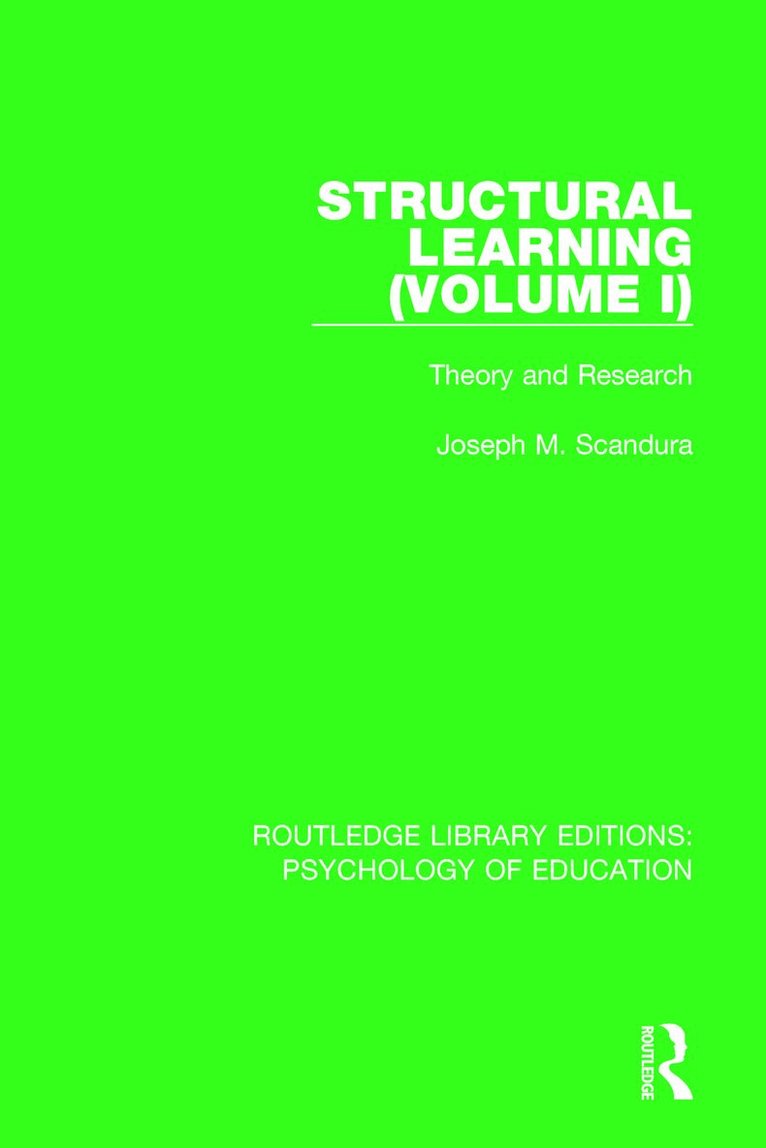
    Structural Learning (Volume 1)

    Theory and Research

    AvJoseph M. Scandura

    Häftad, Engelska, 2019

    Del i serien Routledge Library Editions: Psychology of Education

    607 kr

    Beställningsvara. Skickas inom 10-15 vardagar. Fri frakt över 249 kr.

    Fler format och utgåvor

    Inbunden

    1 998 kr

    E-bok

    717 kr

    E-bok

    717 kr

    Beskrivning

    Originally published in 1973, this book was published in two volumes. In the first volume, the author describes what he sees as the rudiments of three deterministic partial theories of structural learning. The first involves competence, partial theories which deal only with the problem of how to account for the various kinds of behavior of which people are typically capable. Special attention is given to mathematical competence. Nothing is said about learning or performance. The second partial theory is concerned with motivation, learning, and performance under idealized conditions, and is obtained from the first partial theory by imposing further structure on it. This theory says nothing about memory of the limited capacity of human subjects to process information. … The final theory is obtained from the second by making additional assumptions, which bring memory and finite information processing into the picture. The theory is still partial, however, since no attempt is made to deal with certain ultra-short-term behavioral phenomena which appear to depend directly on particular physiological characteristics.

    Produktinformation

    • Utgivningsdatum:2019-10-08
    • Mått:156 x 234 x 22 mm
    • Vikt:710 g
    • Format:Häftad
    • Språk:Engelska
    • Serie:Routledge Library Editions: Psychology of Education
    • Antal sidor:384
    • Förlag:Taylor & Francis Ltd
    • ISBN:9780415791458

    Utforska kategorier

    • Kognitiv psykologi inom Psykologi och pedagogik

    Innehållsförteckning

    • Preface. 1. Introduction and Overview 2. What is a Rule? 3. Mathematical Preliminaries 4. Rule-Based Theories of Structured Knowledge: General Nature and Relationships to Linguistics 5. Foundations of the Theory of Knowledge 6. A Theory of Mathematical Knowledge 7. Mechanisms of Learning and Performance – Memory-Free Theorizing in Structural Learning 8. Mechanisms of Motivation – Memory-Free Theorizing in Structural Learning 9. Foundations of the Idealized (Memory-Free) Theory 10. Memory Theory in Structural Learning. Epilogue. Bibliography. Author Index. Subject Index.