• Fri frakt över 249 kr
  • •
  • Snabba leveranser
  • •
  • Billiga böcker
Kundservice

Du är på sajten för privatpersoner.

Företag, bibliotek eller offentlig verksamhet?

Du handlar på classic.bokus.com, där alla dina funktioner finns intakta.
Till classic.bokus.com
Bokus logotyp. Gå till startsidan.
  • Erbjudanden
  • Nyheter
  • Student
  • Topplistor
  • Barn & ungdom
  • Bokus Play
  • E-böcker
  • Pocketböcker
  • Spel & pussel

10% rabatt på allt med kod NYSTART10 →

Sidfot

Mina sidor

    Hjälp

    • Kundservice
    • Vanliga frågor och svar
    • Frakt och leverans
    • Retur vid ångerrätt
    • Reklamera vara
    • Betalning
    • Köpvillkor
    • Allmänna villkor
    • Information om webbplatsens tillgänglighet

    Om Bokus

    • Om oss
    • Pressrum
    • För studenter
    • För företag
    • För bibliotek och offentlig verksamhet
    • För leverantörer
    • Hållbarhet

    Populärt

    • Aktuella erbjudanden
    • Presentkort
    • Studentlitteratur
    • Nya böcker
    • Topplistor
    • Signerade böcker
    • Engelska böcker

    Inspiration

    • Boktips
    • BookTok
    • Populära bokserier
    • Barnbokskaraktärer
    • Populära författare
    Logotyp för Bokus
    Följ oss på Facebook (extern länk)Följ oss på Instagram (extern länk)Följ oss på YouTube (extern länk)Följ oss på TikTok (extern länk)
    bokus @ CookiesAnpassa cookiesIntegritetspolicyKöpvillkor
    Till Citymail hemsida (extern länk)Till Budbee hemsida (extern länk)Till Postnord hemsida (extern länk)Till Schenker hemsida (extern länk)Till Early Bird hemsida (extern länk)Till Walleys hemsida (extern länk)
    1. Samhälle och politik
    2. Samhälle och kultur
    3. Kultur och medier
    4. Referensverk och tvärvetenskap

    World City Syndrome

    Neoliberalism and Inequality in Cape Town

    AvDavid A. McDonald

    Häftad, Engelska, 2009

    Del i serien Routledge Studies in Human Geography

    766 kr

    Beställningsvara. Skickas inom 10-15 vardagar. Fri frakt över 249 kr.

    Fler format och utgåvor

    Inbunden

    2 423 kr

    E-bok

    908 kr

    E-bok

    906 kr

    Beskrivning

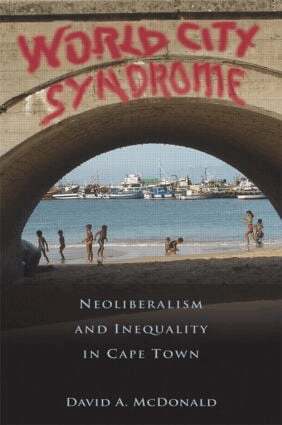
    The literature on ‘world cities’ has had an enormous influence on urban theory and planning alike. From Manila to London, academics and policy makers have attempted to understand, and to some extent strive for, world city status. This book is a study of Cape Town’s standing in this network of urban centres, and an investigation of the conceptual appropriateness of this world city hypothesis. Drawing on more than a dozen years of fieldwork in Cape Town, McDonald provides an historical overview of institutional and structural reforms, examining fiscal imbalances, political marginalization, (de)racialization, privatization and other neoliberal changes. By examining and analyzes these reforms and changes, McDonald contributes the first radical critique of the world city literature from a developing country perspective.

    Produktinformation

    • Utgivningsdatum:2009-09-24
    • Mått:152 x 229 x 20 mm
    • Vikt:710 g
    • Format:Häftad
    • Språk:Engelska
    • Serie:Routledge Studies in Human Geography
    • Antal sidor:384
    • Förlag:Taylor & Francis Ltd
    • ISBN:9780415875004

    Utforska kategorier

    • Referensverk och tvärvetenskap inom Samhälle och politik
    • Geografi inom Naturvetenskap och teknik

    Mer om författaren

    David McDonald is Director of Global Development Studies and Associate Professor of Geography at Queen’s University, Canada. He is the editor or co-editor of The Age of Commodity: Water Privatization in Southern Africa; Cost Recovery and the Crisis of Service Delivery in South Africa;  Environmental Justice in South Africa; Transnationalism and New African Immigration to South Africa; Destinations Unknown: Perspectives on the Brain Drain in Southern Africa; The Legacies of Julius Nyerere: Influences on Development Discourse and Practice in Africa; and On Borders: Perspectives on International Migration in Southern Africa.

    Innehållsförteckning

    • Introduction: World City Syndrome 1. Cape Town as World City 2. Cape Town as Capitalist City 3. Cape Town as Neoliberal City 4. Respatializing Cape Town (I): Local Government Restructuring 5. Respatializing Cape Town (II): Investments in the Built Environment 6. Privatizing Cape Town 7. Cost Recovering Cape Town 8. Disciplining Cape Town 9. (De)Africanizing Cape Town 10. Keep Left for Cape Town: Alternative Development Strategies