• Fri frakt över 249 kr
  • •
  • Snabba leveranser
  • •
  • Billiga böcker
Kundservice

Du är på sajten för privatpersoner.

Företag, bibliotek eller offentlig verksamhet?

Du handlar på classic.bokus.com, där alla dina funktioner finns intakta.
Till classic.bokus.com
Bokus logotyp. Gå till startsidan.
  • Erbjudanden
  • Nyheter
  • Student
  • Topplistor
  • Barn & ungdom
  • Bokus Play
  • E-böcker
  • Pocketböcker
  • Spel & pussel

10% rabatt på allt med kod NYSTART10 →

Sidfot

Mina sidor

    Hjälp

    • Kundservice
    • Vanliga frågor och svar
    • Frakt och leverans
    • Retur vid ångerrätt
    • Reklamera vara
    • Betalning
    • Köpvillkor
    • Allmänna villkor
    • Information om webbplatsens tillgänglighet

    Om Bokus

    • Om oss
    • Pressrum
    • För studenter
    • För företag
    • För bibliotek och offentlig verksamhet
    • För leverantörer
    • Hållbarhet

    Populärt

    • Aktuella erbjudanden
    • Presentkort
    • Studentlitteratur
    • Nya böcker
    • Topplistor
    • Signerade böcker
    • Engelska böcker

    Inspiration

    • Boktips
    • BookTok
    • Populära bokserier
    • Barnbokskaraktärer
    • Populära författare
    Logotyp för Bokus
    Följ oss på Facebook (extern länk)Följ oss på Instagram (extern länk)Följ oss på YouTube (extern länk)Följ oss på TikTok (extern länk)
    bokus @ CookiesAnpassa cookiesIntegritetspolicyKöpvillkor
    Till Citymail hemsida (extern länk)Till Budbee hemsida (extern länk)Till Postnord hemsida (extern länk)Till Schenker hemsida (extern länk)Till Early Bird hemsida (extern länk)Till Walleys hemsida (extern länk)
    1. Samhälle och politik
    2. Social välfärd och brottslighet
    3. Socialt arbete och välfärd

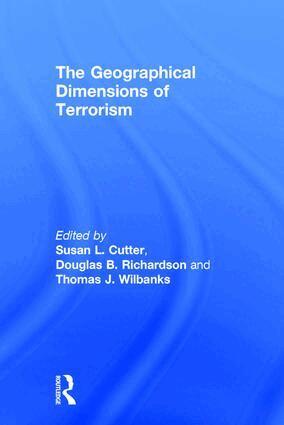
    Geographical Dimensions of Terrorism

    AvSusan L. Cutter,Douglas B. Richardson

    Häftad, Engelska, 2003

    793 kr

    Beställningsvara. Skickas inom 10-15 vardagar. Fri frakt över 249 kr.

    Beskrivning

    Undertaken as part of the National Science Foundation's call for research associated with the 9/11 terrorist attacks, this volume contains research that addresses the immediate role and utility of geographical information and technologies in emergency management. It also initiates an on-going process to help develop a focused national research agenda on the geographical dimensions of terrorism. Areas covered include: geospatial data and technologies infrastructure research, root causes of terrorism, and vulnerability science and hazard research.

    Produktinformation

    • Utgivningsdatum:2003-02-28
    • Mått:152 x 229 x 16 mm
    • Vikt:476 g
    • Format:Häftad
    • Språk:Engelska
    • Antal sidor:296
    • Förlag:Taylor & Francis Ltd
    • ISBN:9780415946421

    Utforska kategorier

    • Socialt arbete och välfärd inom Samhälle och politik

    Mer om författaren

    Susan L. Cutter, Douglas B. Richardson, Thomas J. Wilbanks

    Recensioner i media

    "This book is to be recommended, as it offers another toolbox to those of us concerned with terrorism and its impact on our lives. ." -- Stephane Lefebvre, formerly with the Department of National Defence, Canada, H-Net Reviews

    Innehållsförteckning

    • Figures Tables Acknowledgements Foreword, John H. Marburger Introduction, Philip Rubin Chapter 1: The Changing Landscape of Fear, Susan L. Cutter, Douglas B. Richardson and Thomas J. Wilbanks Chapter 2: Societal Responses to Threats Introduction 2.1 Public Health, Law Enforcement, and Hazards Management, Deborah S. K. Thomas 2.2 Urban Vulnerability to Terrorism as Hazard, James K. Mitchell 2.3 Emergency Preparedness and Response--Lessons Learned from 9/11, Gerald E. Galloway 2.4 Transborder Disaster Management, Richard Wright, Paul Ganster and David Dow Chapter 3: Understanding the Root Causes of Terrorism Introduction 3.1 The Space of Terror, Alexander B. Murphy 3.2 Geographies of Inclusion/Exclusion, Colin Flint 3.3 Drug Production, Commerce, and Terrorism, Kent Mathewson and Michael Steinberg 3.4 Insurrections, Marilyn Silberfein Chapter 4: Geospatial Data and Technologies in Times of Crises Introduction 4.1 The Need for a National Spatial Data Infrastructure, Mike Tait 4.2 Remote Sensing Imagery for Emergency Management, Andrew J. Bruzewicz 4.3 Geospatial Data in Emergencies, Michael F. Goodchild 4.4 Data Modeling for Emergencies, Michael F. Goodchild 4.5 Intelligent Emergency Response Systems, Mei-Po Kwan 4.6 Geographic Management Systems for Homeland Security, Frederick Abler and Douglas B. Richardson Chapter 5: Vulnerability of Lifelines, the Built Environment, and People Introduction 5.1 Critical Infrastructure, John A. Kelmelis and Scott A. Loomer 5.2 Energy Systems and Infrastructures, Thomas J. Wilbanks 5.3 Transportation and Communication Lifelines Disruption, Harvey J. Miller 5.4 Economic Assessment of Unexpected Events, Geoffrey J. D. Hewings and Yasuhide Okuyama 5.5 Estimating Populations at Risk, Jerome E. Dobson 5.6 Recreating Secure Spaces, Ray J. Dezzani and T. R. Lakshmanan Chapter 6: Bioterrorism Introduction 6.1 Understanding Biological Warfare, Arthur Getis 6.2 Bioweaponry and Agroterrorism, Lisa M. Butler Harrington 6.3 Spatial Surveillance of and Response to Biological Threats, Marilyn O. Ruiz Chapter 7: Building a Safer but Open Society Introduction 7.1 Openness versus Security of Geographic Information, Harlan Onsrud 7.2 GeoSecurity, William B. Wood Chapter 8: A Research and Action Agenda, Susan L. Cutter, Douglas B. Richardson and Thomas J. Wilbanks Epilogue, Jack Dangermond References Contributors