• Fri frakt över 249 kr
  • •
  • Snabba leveranser
  • •
  • Billiga böcker
Kundservice

Du är på sajten för privatpersoner.

Företag, bibliotek eller offentlig verksamhet?

Du handlar på classic.bokus.com, där alla dina funktioner finns intakta.
Till classic.bokus.com
Bokus logotyp. Gå till startsidan.
  • Erbjudanden
  • Nyheter
  • Student
  • Topplistor
  • Barn & ungdom
  • Bokus Play
  • E-böcker
  • Pocketböcker
  • Spel & pussel

10% rabatt på allt med kod: NYSTART10 →

Sidfot

Mina sidor

    Hjälp

    • Kundservice
    • Vanliga frågor och svar
    • Frakt och leverans
    • Retur vid ångerrätt
    • Reklamera vara
    • Betalning
    • Köpvillkor
    • Allmänna villkor
    • Information om webbplatsens tillgänglighet

    Om Bokus

    • Om oss
    • Pressrum
    • För studenter
    • För företag
    • För bibliotek och offentlig verksamhet
    • För leverantörer
    • Hållbarhet

    Populärt

    • Aktuella erbjudanden
    • Presentkort
    • Studentlitteratur
    • Nya böcker
    • Topplistor
    • Signerade böcker
    • Engelska böcker

    Inspiration

    • Boktips
    • BookTok
    • Populära bokserier
    • Barnbokskaraktärer
    • Populära författare
    Logotyp för Bokus
    Följ oss på Facebook (extern länk)Följ oss på Instagram (extern länk)Följ oss på YouTube (extern länk)Följ oss på TikTok (extern länk)
    bokus @ CookiesAnpassa cookiesIntegritetspolicyKöpvillkor
    Till Citymail hemsida (extern länk)Till Budbee hemsida (extern länk)Till Postnord hemsida (extern länk)Till Schenker hemsida (extern länk)Till Early Bird hemsida (extern länk)Till Walleys hemsida (extern länk)
    1. Naturvetenskap och teknik
    2. Matematik och naturvetenskap
    3. Biologi
    4. Biokemi

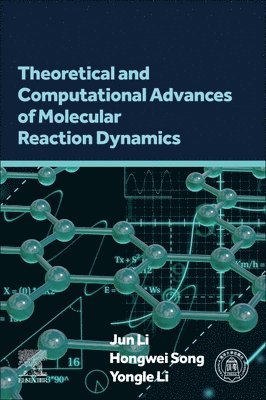
    Theoretical and Computational Advances of Molecular Reaction Dynamics

    AvJun Li,Hongwei Song

    Häftad, Engelska, 2025

    2 032 kr

    Kommande

    Beskrivning

    Theoretical and Computational Advances of Molecular Reaction Dynamics provides a strong foundation and comprehensive review of the principles, formulations, and methodology of MRD, with detailed tutorial guides and case studies for practical application, whilst demonstrating recent developments. It is designed to help improve understanding of the full-dimension accurate potential of the energy surface, chemical kinetics, reaction dynamics, collision energy transfer, and molecular spectra using MRD techniques. Details are given for calculating various molecular dynamic properties for various prototypical reactions/chemical species efficiently and accurately. Useful and timely tutorials for the practical implementations with tips and usable codes are included for research in this multidisciplinary field. The book also familiarizes readers with state-of-the-art research frontiers on theoretical and computational MRD, showing the new methods, theories, applications, and advances that have developed for the investigation of chemical kinetics, reaction dynamics, and molecular spectra—at the microscopic atomic or molecular level—in the era of machine learning and big data.

    Produktinformation

    • Utgivningsdatum:2025-08-01
    • Mått:152 x 229 x undefined mm
    • Format:Häftad
    • Språk:Engelska
    • Antal sidor:352
    • Förlag:Elsevier - Health Sciences Division
    • ISBN:9780443137990

    Utforska kategorier

    • Biokemi inom Naturvetenskap och teknik

    Mer om författaren

    Jun Li is Professor of Chemistry at the School of Chemistry and Chemical Engineering, Chongqing University, PR China. He received his Bachelor and Doctoral degrees from Sichuan University. He worked with Professor Sheng-Hsien Lin as a visiting student at National Chiao-Tung University, PR China on photochemistry for five months. After a three-year postdoctoral research role with Prof. Hua Guo at University of New Mexico, USA, he joined Chongqing University as an independent PI. With a Humboldt Fellowship for Experienced Researchers, he then worked with Professor Jörg Behler at Georg-August-Universität Göttingen, Germany. He has published more than 120 peer-reviewed articles and 2 book chapters “Data Quality, Data Sampling and Data Fitting: A Tutorial Guide for Constructing Full-dimensional Accurate Potential Energy Surfaces (PESs) of Small Molecular Systems” by Jun Li*, Yang Liu, in the book entitled Machine Learning in Molecular Sciences (Springer Nature, 2023) and “Tunneling in unimolecular and bimolecular reactions” by Hua Guo, Jianyi Ma, and Jun Li in Molecular Quantum Dynamics: From Theory to Applications (Physical Chemistry in Action), Edited by Fabien Gatti, Springer 2014. His research interests include potential energy surfaces, reaction kinetics, dynamics, and atomic-level mechanisms, mainly for gas phase systems, and machine learning. Hongwei Song received his PhD at Nanyang Technological University, PR China in 2012 under the supervision of Prof. Soo-Ying Lee. He then worked as a Postdoctoral Research Fellow with Professor Hua Guo at University of New Mexico, USA. In 2015, he joined the faculty of Innovation Academy for Precision Measurement Science and Technology of the Chinese Academy of Sciences (Wuhan Institute of Physics and Mathematics before 2019), PR China. His research interests involve ab initio potential energy surface, classical and quantum molecular reaction dynamics, and machine learning. Yongle Li received his B.S. degree from Tianjin University, PR China in 2006, and a Ph.D. degree from Nanjing University, PR China in 2011, under supervision of John Z. H. Zhang and Daiqian Xie. After working in East China Normal University, PR China for a short period, he worked as a Research Associate at the University of New Mexico, USA in 2012–2013 in Hua Guo’s group and New York University, USA in 2013–2015 in Yingkai Zhang’s group. In 2019-2021, he was a visiting associate at CalTech, USA in Tom Miller III’s group. Now he is an Associate Professor in Shanghai University, PR China as a Young Eastern Scholar. His group focuses on quantum/classical dynamics simulations, including reaction rates using RPMD and phase transition of molecular ferroelectrics.

    Innehållsförteckning

    • 1. IntroductionSection 1: Methodology2. Potential energy surface3. Quasi-Classical Trajectory4. Quantum Dynamics5. Ring Polymer Molecular Dynamics6. Machine learning in molecular reaction dynamicsSection 2: Case studies for bimolecular nonreactive dynamics7. Bimolecular nonreactive dynamicsSection 3: Case studies for prototypical reactions8. Featured Bimolecular reactive dynamics9. Photodetachment dynamicsSection 4: Case studies for Kinetics (RPMD, QCT, wave package, and others)10. RPMD kineticsSection 5: Conclusion, summary, and perspectives11. Conclusion, summary, and perspectives