• Fri frakt över 249 kr
  • •
  • Snabba leveranser
  • •
  • Billiga böcker
Kundservice

Du är på sajten för privatpersoner.

Företag, bibliotek eller offentlig verksamhet?

Du handlar på classic.bokus.com, där alla dina funktioner finns intakta.
Till classic.bokus.com
Bokus logotyp. Gå till startsidan.
  • Erbjudanden
  • Student
  • Topplistor
  • Barn & ungdom
  • Bokus Play
  • E-böcker
  • Ljudböcker
  • Pocketböcker
  • Spel & pussel

Upp till 25% på utvalda nyheter →

Sidfot

Mina sidor

    Hjälp

    • Kundservice
    • Vanliga frågor och svar
    • Frakt och leverans
    • Retur vid ångerrätt
    • Reklamera vara
    • Betalning
    • Köpvillkor
    • Allmänna villkor
    • Information om webbplatsens tillgänglighet

    Om Bokus

    • Om oss
    • Pressrum
    • För studenter
    • För företag
    • För bibliotek och offentlig verksamhet
    • För leverantörer
    • Hållbarhet

    Populärt

    • Aktuella erbjudanden
    • Presentkort
    • Studentlitteratur
    • Nya böcker
    • Topplistor
    • Signerade böcker
    • Engelska böcker

    Inspiration

    • Boktips
    • BookTok
    • Populära bokserier
    • Barnbokskaraktärer
    • Populära författare
    Logotyp för Bokus
    Följ oss på Facebook (extern länk)Följ oss på Instagram (extern länk)Följ oss på YouTube (extern länk)Följ oss på TikTok (extern länk)
    bokus @ CookiesAnpassa cookiesIntegritetspolicyKöpvillkor
    Till Citymail hemsida (extern länk)Till Budbee hemsida (extern länk)Till Postnord hemsida (extern länk)Till Schenker hemsida (extern länk)Till Early Bird hemsida (extern länk)Till Walleys hemsida (extern länk)
    1. Data och IT
    2. Systemvetenskap och AI
    3. Artificiell intelligens

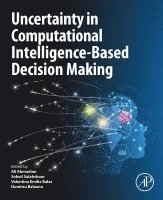
    Uncertainty in Computational Intelligence-Based Decision Making

    AvAli Ahmadian,Soheil Salahshour

    Häftad, Engelska, 2024

    Del i serien Advanced Studies in Complex Systems

    1 778 kr

    Beställningsvara. Skickas inom 10-15 vardagar. Fri frakt över 249 kr.

    Beskrivning

    Uncertainty in Computational Intelligence-Based Decision-Making focuses on techniques for reasoning and decision-making under uncertainty that are used to solve issues in artificial intelligence (AI). It covers a wide range of subjects, including knowledge acquisition and automated model construction, pattern recognition, machine learning, natural language processing, decision analysis, and decision support systems, among others.

    The first chapter of this book provides a thorough introduction to the topics of causation in Bayesian belief networks, applications of uncertainty, automated model construction and learning, graphic models for inference and decision making, and qualitative reasoning. The following chapters examine the fundamental models of computational techniques, computational modeling of biological and natural intelligent systems, including swarm intelligence, fuzzy systems, artificial neutral networks, artificial immune systems, and evolutionary computation. They also examine decision making and analysis, expert systems, and robotics in the context of artificial intelligence and computer science.


    • Provides readers a thorough understanding of the uncertainty that arises in artificial intelligence (AI), computational intelligence (CI) paradigms, and algorithms
    • Encourages readers to put concepts into practice and solve complex real-world problems using CI development frameworks like decision support systems and visual decision design
    • Provides a comprehensive overview of the techniques used in computational intelligence, uncertainty, and decision

    Produktinformation

    • Utgivningsdatum:2024-09-24
    • Mått:191 x 235 x 15 mm
    • Vikt:720 g
    • Format:Häftad
    • Språk:Engelska
    • Serie:Advanced Studies in Complex Systems
    • Antal sidor:338
    • Förlag:Elsevier Science
    • ISBN:9780443214752

    Utforska kategorier

    • Artificiell intelligens inom Data och IT

    Mer om författaren

    Dr. Ali Ahmadian is a senior research scientist the Mediterranea University of Reggio Calabria, Italy and an Associate Fellow Researcher at the Institute of IR 4.0, The National University of Malaysia. As an active researcher, he is dedicated to research in applied mathematics. He received his Ph.D. in early of 2014 as the best postgraduate student from Universiti Putra Malaysia (UPM). After his Ph.D. He took a postdoctoral fellowship at same university as part of the numerical analysis research group and at the same time joint to the University of Malaya as an Associate Researcher. He was promoted as a Fellow Researcher on December 2017 in UPM. In 2019, he joined the National University of Malaysia as a senior lecturer where he currently works in the Institute of IR 4.0. In general, his primary mathematical focus is the development of computational methods and models for problems arising in computer science, biology, physics, and engineering under fuzzy and fractional calculus (FC); in this context, he has worked on projects related to nano-communication networks, drug delivery systems, acid hydrolysis in palm oil frond, and carbon nanotubes dynamics, nanofluids, viscosity, AI and etc. He is a member of editorial board in Sustainable Computing: Informatics and Systems, Soft Computing, Journal of control and Decision, Progress in Fractional Differentiation and Applications (Natural Sciences Publishing) and Mathematical Problems in Engineering (Hindawi) and lead guest editor of special issues in more than 50 international journals from Elsevier, Springer, Wiley and so on. He is an author of more than 350 research papers published in as Nature, IEEE, Elsevier, Springer, Wiley and etc. He is an author and editor of four books published and in process in CRC Press and Elsevier, respectively. He also presented his research works in 38 international conferences held in Canada, Serbia, China, Turkey, Malaysia and UAE. He also received Premio Anassilaos Giovani Award for his achievement in art, culture, economics and science from Italy in November 2021. Soheil Salahshour has, since 2012, been a University Professor with the Department of Mathematics in different universities, and recently moved to the Istanbul Okan University. His research interests include fractional models and Calculus, Fuzzy expert systems, evolutionary algorithms, optical soliton solutions, data science and big data applications. Valentina E. Balas is a Professor in the Department of Automatics and Applied Software at the Faculty of Engineering, “Aurel Vlaicu” University of Arad, Romania. She holds a PhD Cum Laude, in Applied Electronics and Telecommunications from Polytechnic University of Timisoara. Dr. Balas is the author of more than 350 research papers. Her research interests are in intelligent systems, fuzzy control, soft computing, smart sensors, information fusion, modeling, and simulation. She is a member of the editorial boards of several national and international journals and evaluator expert for national, international projects, and PhD thesis. Dr. Balas is the Director of Intelligent Systems Research Centre and Director of the Department of International Relations, Programs, and Projects in Aurel Vlaicu University of Arad. She is the recipient of the "Tudor Tanasescu" Prize from the Romanian Academy for contributions in the field of soft computing methods (2019). Dumitru Baleanu is a full professor at the Institute of Space Sciences, Romania. Fractional dynamics and its applications, fractional differential equations, discrete mathematics, dynamic systems on time scales, the wavelet method and its applications, quantization of the systems with constraints, the Hamilton-Jacobi formalism, and geometries admitting generic and non-generic symmetries are among Dumitru's research interests. He has edited five books and published more than 1400 papers. He serves on several journals' editorial boards. With more than 30000 citations, Dumitru has served as a referee for more than 200 journals. He was included in the 2015–2020 Thompson Reuter list of the top 1% of highly cited researchers.

    Innehållsförteckning

    • 1. TOPSIS for the selection of the prediction model in forensic ink analysis2. EFFECTIVENESS OF ARTIFICIAL INTELLIGENCE IN DETERMINING FOOT PATHOLOGIES AND DESIGN INSOLES USING PLAIN RADIOGRAPH AND DIGITAL PHOTOGRAPH3. OUTBOUND LOGISTICS BUSINESS PROCESS MODELING: ANALYTIC PERSPECTIVE WITH BPMN 2.04. REVOLUTIONIZING DIABETIC FOOT ULCER TREATMENT: HARNESSING THE POWER OF ARTIFICIAL INTELLIGENCE AND TRANSFER LEARNING5. A Systematic Review on Personalized Hybrid Diet Recommendations6. Impact of Number and Type of Criteria on Ranking Abnormality in MCDM Techniques7. Comparison between some methods in fuzzy linear regression8. Artificial Intelligence and decision making in climate change studies: A review9. Computational Decision Intelligence approaches for drought prediction: A review10. A review of the Applications of Computational Decision Intelligence approaches in agrometeorology11. A Fuzzy Logic Design for Self-driving Vehicle to Avoid Obstacles12. K-Means Clustering Over Distributed Environment: A Review13. Advanced Frequent Itemsets Mining Algorithm (AFIM)14. TEAM: Trust Evaluation and Analysis of Misbehaviors in WSNs15. Computational Intelligence in Decision Support: Scope and Techniques16. Automatic Parallelization for Multicore Architectures: Role, Importance and Opportunities17. Using Tensor Processing Units to identify the relationship between hypothesis and premise: A case of natural language inference problem18. Secure and Cost-Effective Key Management Scheme for the Internet of Things supported WSN19. A deep learning-based integrated voice assistance system for partially disabled people