• Fri frakt över 249 kr
  • •
  • Snabba leveranser
  • •
  • Billiga böcker
Kundservice

Du är på sajten för privatpersoner.

Företag, bibliotek eller offentlig verksamhet?

Du handlar på classic.bokus.com, där alla dina funktioner finns intakta.
Till classic.bokus.com
Bokus logotyp. Gå till startsidan.
  • Erbjudanden
  • Nyheter
  • Student
  • Topplistor
  • Barn & ungdom
  • Bokus Play
  • E-böcker
  • Pocketböcker
  • Spel & pussel

Må bättre, för mindre! Upp till 50% rabatt på hälsoböcker

Sidfot

Mina sidor

    Hjälp

    • Kundservice
    • Vanliga frågor och svar
    • Frakt och leverans
    • Retur vid ångerrätt
    • Reklamera vara
    • Betalning
    • Köpvillkor
    • Allmänna villkor
    • Information om webbplatsens tillgänglighet

    Om Bokus

    • Om oss
    • Pressrum
    • För studenter
    • För företag
    • För bibliotek och offentlig verksamhet
    • För leverantörer
    • Hållbarhet

    Populärt

    • Aktuella erbjudanden
    • Presentkort
    • Studentlitteratur
    • Nya böcker
    • Topplistor
    • Signerade böcker
    • Engelska böcker

    Inspiration

    • Boktips
    • BookTok
    • Populära bokserier
    • Barnbokskaraktärer
    • Populära författare
    Logotyp för Bokus
    Följ oss på Facebook (extern länk)Följ oss på Instagram (extern länk)Följ oss på YouTube (extern länk)Följ oss på TikTok (extern länk)
    bokus @ CookiesAnpassa cookiesIntegritetspolicyKöpvillkor
    Till Citymail hemsida (extern länk)Till Budbee hemsida (extern länk)Till Postnord hemsida (extern länk)Till Schenker hemsida (extern länk)Till Early Bird hemsida (extern länk)Till Walleys hemsida (extern länk)
    1. Djur och Natur
    2. Naturböcker
    3. Växtböcker

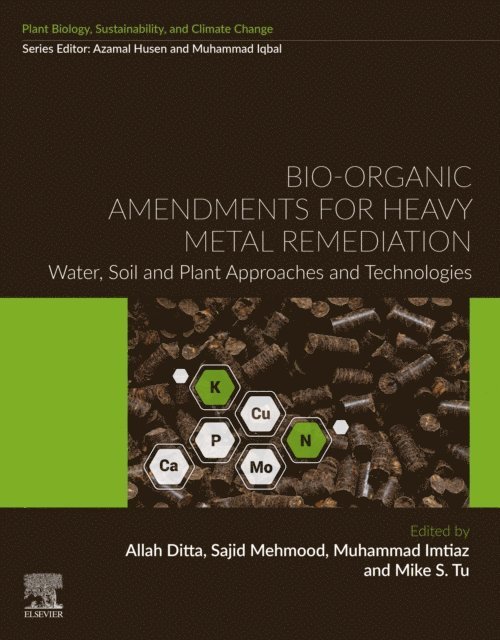
    Bio-organic Amendments for Heavy Metal Remediation

    Water, Soil and Plant Approaches and Technologies

    AvAllah Ditta,Sajid Mehmood

    Häftad, Engelska, 2024

    Del i serien Plant Biology, Sustainability, and Climate Change

    2 430 kr

    Beställningsvara. Skickas inom 10-15 vardagar. Fri frakt över 249 kr.

    Beskrivning

    Bio-organic Amendments for Heavy Metal Remediation: Water, Soil and Plant Approaches and Technologies focuses on these core continuum media to explore remediation options using microbial, organic, and combined approaches. This volume in the Plant Biology, Sustainability and Climate Change series offers a comprehensive view of techniques and approaches for addressing contamination by heavy metals. It provides a comprehensive view of the challenge, with a focus on the bioremediation of heavy metals contamination using ecotechnological approaches for protecting the soil, water, and plant continuum.

    As anthropogenic activities increasingly negatively impact natural resources, there has been significant disturbance of the water, soil, and plant continuum due to the accumulation of heavy metals. The bioaccumulation of heavy metals in the food chain could pose life-threatening effects on plants as well as humans, and there is need to find effective and sustainable remediation options. The application of bio-organic amendments could serve as a sustainable solution to this problem.

    • Highlights remediation techniques/approaches for heavy metals under water, soil and plant continuums
    • Presents case-studies for real-world insights as well as current practices
    • Includes regulatory aspects for ensuring safe implementation

    Produktinformation

    • Utgivningsdatum:2024-08-20
    • Mått:191 x 235 x undefined mm
    • Vikt:450 g
    • Format:Häftad
    • Språk:Engelska
    • Serie:Plant Biology, Sustainability, and Climate Change
    • Antal sidor:754
    • Förlag:Elsevier Science
    • ISBN:9780443216107

    Utforska kategorier

    • Växtböcker inom Djur och Natur
    • Geovetenskap inom Naturvetenskap och teknik
    • Botanik inom Naturvetenskap och teknik

    Mer om författaren

    Allah Ditta is an Assistant Professor at Department of Environmental Sciences, Shaheed Benazir Bhutto University Sheringal, Dir upper, Khyber Pakhtunkhwa, Pakistan. He earned his BSc (Hons) MSc (Hons) from University of Agriculture Faisalabad, Pakistan and received his Ph.D. from Institute of Soil and Environmental Sciences, University of Agriculture Faisalabad, Pakistan. He has carried out research projects in the areas of Eco-restoration by using integrated organic, inorganic and microbial strategies. He has also served as Assistant Professor at Department of Environmental Sciences, PMAS, Arid Agriculture University Rawalpindi, Pakistan. His major research interests encompass broad, interdisciplinary field of plant production, with a focus on eco-restoration under abiotic stresses. The breadth of his research spans from degraded land ecological amelioration, using integrated and sustainable approaches. Dr. Ditta has published more than 85 research and review articles (Impact factor 210.43) in internationally well-recognized journals along with thirteen book chapters. Dr. Sajid Mehmood completed his BSc (Hons.) in Agriculture from Arid Agricultural University of Rawalpindi, Pakistan, and his MSc (Hons.) in Soil Science and graduated in 2014. In 2015, he moved to Wuhan, China and finished his Ph.D. at the College of Resources and Environment, Huazhong Agricultural University, examining the different types of risk, management strategies and efficiency at crop level using biochar, slag and ferrous manganese ore. He is currently a postdoctoral fellow at Hainan University in the Department of Ecology and Environment. He has research experience on as-is and modified (magnetic and acidic) biochars. Dr. Sajid worked as a research associate in a project of National Natural Science Foundation of China. Dr. Sajid has been on the Editorial board and the panel of reviewers of several reputed journals of Elsevier, Taylor & Francis, Springer Nature, RSC, Oxford University Press, The Royal Society, CSIRO, PLOS and John Wiley & Sons. Dr. Muhammad Imtiaz is a Senior Scientist at Soil and Environmental Biotechnology Division, National Institute for Biotechnology and Genetic Engineering, Faisalabad, Pakistan, and also as Associate Professor at School of Environmental Science and Engineering, Guangzhou University, Guangzhou (Guangdong), P.R. China focusing on the fate of heavy metals stress in the soil environment, and in plants as well as on their remediation approached for the sustainable agriculture. Dr. Muhammad Imtiaz has research and teaching experience and has published research in various well reputed scientific impact factor journals. He has participated in many national and international conferences and seminars, and presented his research there. Dr. Muhammad Imtiaz has been working as Section Editor of "Journal of Environment and Agriculture (JEA) since 2017. Dr. Shuxin Tu is Professor in Department of Environmental Sciences and Engineering, and Director of Experimental Teaching Centre, Huazhong Agricultural University, Wuhan, China. Dr Tu received his BS degree and MS degree of Soil and Plant Nutrition and Ph.D. degree of Biophysics. He was a trainee of soil sciences in 1986 in International Rice Research Institute (IRRI) in Philippines, and was a postdoctoral researcher of microelement biogeochemistry at the University of Florida, USA. His research interest includes biogeochemistry of trace metals in soil-water-plant ecosystem and silicone modified materials and its use in remediation of polluted environment.

    Innehållsförteckning

    • PART 1: Clean up of heavy metals using ecotechnologies: 1 – Water Environment1. Heavy metals contamination of waters worldwide and their perspectives for remediation through ecotechnologies2. Factors affecting the remediation of waters worldwide through ecotechnologies3. Bioremediation of heavy metals from wastewater: a current perspective on microalgae-based future4. Microalgal bioremediation of heavy metal pollution in water: Recent advances, challenges, and prospects5. The Utilization of Algae and Seaweed Biomass for Bioremediation of Heavy Metal-Contaminated Wastewater6. Biosorption and removal of toxic heavy metals by metal tolerating bacteria for bioremediation of metal contamination: A comprehensive review7. Efficacious bioremediation of heavy metals and radionuclides from wastewater employing aquatic macro- and macrophytes8. Bioremediation of cadmium polluted soil using a novel cadmium immobilizing plant growth promotion strain Bacillus sp. TZ5 loaded on biochar9. Bioremediation of heavy metals from industrial effluents by endophytes and their metabolic activity: Recent advances10. Influences of biochar on bioremediation/phytoremediation potential of metal-contaminated soils11. Critical review on microbial community during in-situ bioremediation of heavy metals from industrial wastewater12. Bioremediation of Heavy Metals and Toxic Chemicals from Muttukadu Lake, Chennai by Biosurfactant and Biomass Treatment Strategies13. Bacterial Biosorbents, an Efficient Heavy Metals Green Clean-Up Strategy: Prospects, Challenges, and Opportunities14. Toxicity and Bioremediation of Heavy Metals Contaminated Ecosystem from Tannery Wastewater: A Review15. Bioreduction and biosorption of chromium by Undaria pinntifida16. Microorganisms relevant to bioremediation17. Resistant fungi isolated from contaminated uranium mine in Brazil shows a high capacity to uptake uranium from water18. Case studies and policy and regulatory aspects for heavy metals remediation of contaminated waters from different countriesPART 2: Clean up of heavy metals using ecotechnologies: Soil Environment19. Heavy metals contamination of world soils and their perspectives for remediation through ecotechnologies20. Factors affecting the remediation of soils worldwide through ecotechnologies21. Role of organic amendments on enhanced bioremediation of heavy metal(loid) contaminated soils22. Bioremediation of diesel oil in a co-contaminated soil by bioaugmentation with a microbial formula tailored with native strains selected for heavy metals resistance23. Microbially Mediated Remediation of Contaminated Sediments by Heavy Metals: A Critical Review24. Bioremediation Capacity of Edaphic Cyanobacteria Nostoc linckia for Chromium in Association with Other Heavy-Metals-Contaminated Soils25. Biosurfactant is a powerful tool for the bioremediation of heavy metals from contaminated soils26. Functional microbiome strategies for the bioremediation of petroleum-hydrocarbon and heavy metal contaminated soils: A review27. Arbuscular mycorrhizal fungi as a potential tool for bioremediation of heavy metals in contaminated soil28. Bioremediation of Heavy Metal Ions Contaminated Soil29. Uranium (U) source, speciation, uptake, toxicity and bioremediation strategies in soil-plant system: A review30. Application of Technological Solutions for Bioremediation of Soils Contaminated with Heavy Metals31. PGPR assisted bioremediation of heavy metals and nutrient accumulation in Zea mays under saline sodic soil32. Genetically engineered microbial remediation of soils co-contaminated by heavy metals and polycyclic aromatic hydrocarbons: Advances and ecological risk assessment33. A critical review on various remediation approaches for heavy metal contaminants removal from contaminated soils34. Understanding the holistic approach to plant-microbe remediation technologies for removing heavy metals and radionuclides from soil35. Nickel in terrestrial biota: Comprehensive review on contamination, toxicity, tolerance and its remediation approaches36. Microbial diversity and bioremediation of rhizospheric soils from Trindade Island – Brazil37. Case studies and policy and regulatory aspects for heavy metals remediation of contaminated soils from different countries