• Fri frakt över 249 kr
  • •
  • Snabba leveranser
  • •
  • Billiga böcker
Kundservice

Du är på sajten för privatpersoner.

Företag, bibliotek eller offentlig verksamhet?

Du handlar på classic.bokus.com, där alla dina funktioner finns intakta.
Till classic.bokus.com
Bokus logotyp. Gå till startsidan.
  • Erbjudanden
  • Nyheter
  • Student
  • Topplistor
  • Barn & ungdom
  • Bokus Play
  • E-böcker
  • Pocketböcker
  • Spel & pussel

10% rabatt på allt med kod: NYSTART10 →

Sidfot

Mina sidor

    Hjälp

    • Kundservice
    • Vanliga frågor och svar
    • Frakt och leverans
    • Retur vid ångerrätt
    • Reklamera vara
    • Betalning
    • Köpvillkor
    • Allmänna villkor
    • Information om webbplatsens tillgänglighet

    Om Bokus

    • Om oss
    • Pressrum
    • För studenter
    • För företag
    • För bibliotek och offentlig verksamhet
    • För leverantörer
    • Hållbarhet

    Populärt

    • Aktuella erbjudanden
    • Presentkort
    • Studentlitteratur
    • Nya böcker
    • Topplistor
    • Signerade böcker
    • Engelska böcker

    Inspiration

    • Boktips
    • BookTok
    • Populära bokserier
    • Barnbokskaraktärer
    • Populära författare
    Logotyp för Bokus
    Följ oss på Facebook (extern länk)Följ oss på Instagram (extern länk)Följ oss på YouTube (extern länk)Följ oss på TikTok (extern länk)
    bokus @ CookiesAnpassa cookiesIntegritetspolicyKöpvillkor
    Till Citymail hemsida (extern länk)Till Budbee hemsida (extern länk)Till Postnord hemsida (extern länk)Till Schenker hemsida (extern länk)Till Early Bird hemsida (extern länk)Till Walleys hemsida (extern länk)
    1. Naturvetenskap och teknik
    2. Teknik och industri
    3. Energiteknik

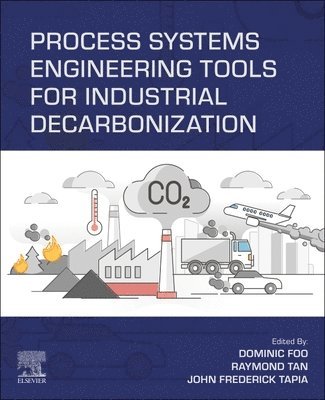
    Process Systems Engineering Tools for Industrial Decarbonization

    AvDominic Foo,Raymond Tan

    Häftad, Engelska, 2026

    1 771 kr

    Beställningsvara. Skickas inom 10-15 vardagar. Fri frakt över 249 kr.

    Beskrivning

    Process Systems Engineering Tools for Industrial Decarbonization explores the latest mathematical methods driving large-scale adoption of technologies aimed at reducing carbon emissions in industrial systems. By examining systematic strategies for planning, decision-making, and designing low-carbon industrial processes, the book offers readers-both experts and newcomers-a comprehensive understanding of how recent advances in process engineering can support a sustainable future. Special emphasis is placed on the integration and optimization of cutting-edge technologies such as Carbon Capture, Utilization, and Storage (CCUS), Negative Emission Technologies (NETs), and other innovative decarbonization solutions as they mature and become viable at scale.

    Beyond technical frameworks, the book addresses the urgent need to manage rising atmospheric CO? levels, which now average 420 ppm-well above safe thresholds. It highlights the importance of using decision-making tools to efficiently deploy and systematize available technologies, ensuring the industrial sector contributes effectively to climate mitigation.


    • Presents the most recent developments in process systems engineering of technologies for industrial decarbonization
    • Introduces methods for decision-making involving low- carbon technologies under uncertainty
    • Explores case studies that demonstrate the use of mathematical tools for CCUS systems
    • Provides insights into developing strategies for deploying technologies for industrial decarbonization

    Produktinformation

    • Utgivningsdatum:2026-06-26
    • Mått:191 x 235 x 20 mm
    • Vikt:450 g
    • Format:Häftad
    • Språk:Engelska
    • Antal sidor:344
    • Förlag:Elsevier Science
    • ISBN:9780443217210

    Utforska kategorier

    • Energiteknik inom Naturvetenskap och teknik
    • Lantbruksteknik inom Naturvetenskap och teknik
    • Miljöteknik inom Naturvetenskap och teknik

    Mer om författaren

    Dominic C.Y. Foo is a professor of process design and integration at the Universityof Nottingham Malaysia and founding director of the Centre for Green Technologies.A fellow of the Institution of Chemical Engineers (IChemE), Institution of EngineersMalaysia (IEM), and Academy of Sciences Malaysia, he is a leading scholar in resourceconservation and CO2 reduction. He has also been on the Stanford University List ofWorld Top 2% Scientists since the year 2020. Raymond R. Tan is a full professor, university fellow, and Vice-Chancellor forResearch and Innovation at De La Salle University, Philippines. He specializies inprocess systems engineering and process integration. He is a National Scientist of thePhilippines, and has also been on the Stanford University List of World Top 2% Scientistsince year 2020. John Frederick D. Tapia is a professor at De La Salle University, Philippines. Hiswork focuses on optimization tools for carbon capture, utilization and storage (CCUS)and the oil palm value chain. Current research interests include development of decision-making tools and optimization models under neutrosophic uncertainty, applied tosystems such as CCUS, process networks, and decarbonization technologies. He has alsobeen on the Stanford University List of World Top 2% Scientists for 2025.

    Innehållsförteckning

    • Section 1: Carbon Capture, Utilisation & Storage (CCUS)1. A Universal Platform for the Development and Evaluation of Various CO₂ Conversion Processes2. Design of Carbon Capture and Storage Network – A Case Study in Malaysia3. Evaluation of CO₂ Storage with Process System Engineering Methods – A Case Study in China4. Selection of Geological Sinks for CO₂ Utilization and Storage under Neutrosophic Environment5. Bilevel Optimization of CO₂ Networks with P-graphSection 2: Negative Emission Technologies6. Multi-footprint Optimization of Integrated Negative Emissions Technology Portfolios7. Criticality Analysis in Negative Emissions Technologies Network8. Development of a Rough Set-Based Model for Predicting the Change in Biochar Properties after Field ApplicationSection 3: Carbon Footprint Reduction9. Carbon Footprint Reduction for an Infant Milk Production Process10. Graphical Approach to Multi-Scope Carbon Footprint Reduction11. Systematic Graphical Framework for Multiple Footprints Reduction for a Multi-Product PlantSection 4: Energy Efficiency12. Heat Exchange Network Design and Optimisation13. Design and Optimization Approach for Sustainable Rankine Cycle SystemsConcluding14. Research Roadmap for Computing Solutions in Carbon Management