• Fri frakt över 249 kr
  • •
  • Snabba leveranser
  • •
  • Billiga böcker
Kundservice

Du är på sajten för privatpersoner.

Företag, bibliotek eller offentlig verksamhet?

Du handlar på classic.bokus.com, där alla dina funktioner finns intakta.
Till classic.bokus.com
Bokus logotyp. Gå till startsidan.
  • Erbjudanden
  • Nyheter
  • Student
  • Topplistor
  • Barn & ungdom
  • Bokus Play
  • E-böcker
  • Pocketböcker
  • Spel & pussel

10% rabatt på allt med kod: NYSTART10 →

Sidfot

Mina sidor

    Hjälp

    • Kundservice
    • Vanliga frågor och svar
    • Frakt och leverans
    • Retur vid ångerrätt
    • Reklamera vara
    • Betalning
    • Köpvillkor
    • Allmänna villkor
    • Information om webbplatsens tillgänglighet

    Om Bokus

    • Om oss
    • Pressrum
    • För studenter
    • För företag
    • För bibliotek och offentlig verksamhet
    • För leverantörer
    • Hållbarhet

    Populärt

    • Aktuella erbjudanden
    • Presentkort
    • Studentlitteratur
    • Nya böcker
    • Topplistor
    • Signerade böcker
    • Engelska böcker

    Inspiration

    • Boktips
    • BookTok
    • Populära bokserier
    • Barnbokskaraktärer
    • Populära författare
    Logotyp för Bokus
    Följ oss på Facebook (extern länk)Följ oss på Instagram (extern länk)Följ oss på YouTube (extern länk)Följ oss på TikTok (extern länk)
    bokus @ CookiesAnpassa cookiesIntegritetspolicyKöpvillkor
    Till Citymail hemsida (extern länk)Till Budbee hemsida (extern länk)Till Postnord hemsida (extern länk)Till Schenker hemsida (extern länk)Till Early Bird hemsida (extern länk)Till Walleys hemsida (extern länk)
    1. Naturvetenskap och teknik
    2. Matematik och naturvetenskap
    3. Biologi
    4. Cellbiologi

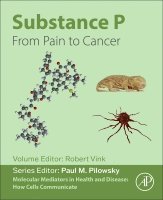
    Substance P

    From Pain to Cancer

    AvRobert Vink

    Häftad, Engelska, 2024

    Del i serien Molecular Mediators in Health and Disease: How Cells Communicate

    2 038 kr

    Beställningsvara. Skickas inom 10-15 vardagar. Fri frakt över 249 kr.

    Beskrivning

    Substance P: From Pain to Cancer, a volume in the Molecular Mediators in Health and Disease: How Cells Communicate series, provides a complete discussion of substance P biology, its role in normal physiology and a variety of diseases.

    The volume provides an introduction to substance P and its pharmacology, followed by exploring its role across the human body including cardiovascular function, micturition, learning and memory, emesis, respiration and sleep. It then discusses the critical role of substance P in several disease states including acute brain injury, neurodegeneration, seizures, depression and anxiety, cancer, musculoskeletal disorders, and viral infection, including COVID-19. The book closes with a look towards future perspectives for substance P.

    Substance P: From Pain to Cancer is an ideal reference for researchers across the life sciences interested in understanding the role of this multi-functioning mediator and its biological significance.

    • Provides a comprehensive overview of the role of substance P across different organ systems, including the nervous, cardiovascular and musculoskeletal systems and renal function
    • Includes detailed coverage of the specific actions of substance P in various disease states and conditions, such as inflammation, cancer, acute brain injury, mood disorders, Parkinson’s disease, Alzheimer’s disease and viral infection including COVID-19
    • Examines substance P as a modulator of the immune response and pain perception
    • Includes expertise from a range of interdisciplinary areas including molecular biology, pharmacology, physiology, neuroscience, anatomy, and therapeutics

    Produktinformation

    • Utgivningsdatum:2024-11-08
    • Mått:191 x 235 x undefined mm
    • Vikt:1 500 g
    • Format:Häftad
    • Språk:Engelska
    • Serie:Molecular Mediators in Health and Disease: How Cells Communicate
    • Antal sidor:550
    • Förlag:Elsevier Science
    • ISBN:9780443221941

    Utforska kategorier

    • Cellbiologi inom Naturvetenskap och teknik

    Mer om författaren

    Robert Vink is an Emeritus Professor at the University of South Australia and is currently Chair of the Board for Connectivity: Traumatic Brain Injury Australia. He was previously appointed as the Professor and Chair of Neurosurgical Research and Head of School, Medical Sciences at the University of Adelaide, Australia. Throughout his time as a teaching/research academic he led a highly productive research group and maintained an extensive publication output. He is the author of over 260 articles and book chapters. He has supervised more than 30 graduate research students, many of whom now hold significant academic and other positions throughout Australia and internationally.He is known internationally for his work in traumatic brain injury and has received numerous prestigious awards and appointments related to this. He currently provides research consulting services to universities and the pharmaceutical industry.

    Innehållsförteckning

    • 1. The synthesis, release, and binding of substance PBrendan A. Hilliard, Robert Vink, and Mary F. Barbe2. Distribution of substance P receptors in mammalsHonoo Satake, Akira Shiraishi, and Tsuyoshi Kawada3. Substance P in nonmammalian biology: Evolutionarily conserved tachykinin signalingDick R. Nassel4. Methodological foundations of substance P detectionNuray Erin5. Substance P receptor antagonistsFrancisco D. Rodrıguez and Rafael Covenas6. Substance P in the cardiovascular systemMagdalena Chottova Dvorakova and Shashank Pandey7. Substance P in lower urinary tract function and dysfunctionMitsuharu Yoshiyama8. Role of the substance P in learning and memoryNatalia Favila and Paul G. Overton9. Substance P in nausea and vomitingPaul L.R. Andrews, John A. Rudd, and Gareth J. Sanger10. Substance P in the central control of respirationNicholas J. Burgraff and Jan-Marino Ramirez11. Substance P in bone metabolismTanja Niedermair and Susanne Grassel12. Life without substance P: The naked mole ratAishi Zhao, Jiwon Lee, Weronika Gryszkiewicz, and Thomas J. Park13. Substance P in inflammationSophie E. Sipprell and Ian Marriott14. Substance P in oxidative stressSeyed Isaac Hashemy and Safieh Ebrahimi15. Substance P in painRobert Vink16. Substance P in cancerMiguel Munoz, Marisa Rosso, Riffat Mehboob, and Francisco Esteban17. Substance P in cardiac dysfunctionScott P. Levick and Alexander Widiapradja18. Substance P in neurotraumaRebecca George, Justin Krieg, and Frances Corrigan19. Substance P in strokeAnnabel Sorby-Adams20. Substance P in Alzheimer’s and Parkinson’s diseaseSeverini Cinzia21. Substance P receptor antagonists for major depressive disorderNadia M.J. Rupniak and Mark S. Kramer22 From a putative antidepressant to a validated mouse model of ADHD via NK1 receptorsS.C. Stanford23. Substance P in stress and anxietyKarl Ebner and Nicolas Singewald24. Substance P-neurokinin 1 receptor pathway in musculoskeletal disordersBrendan A. Hilliard and Mary F. Barbe25. Substance P and sudden infant death syndrome (SIDS)F. Bright, Robert Vink, and R.W. Byard26. Immunobiology and pharmacology of neuropeptide substance PEhsan Aslam, Asina Gijasi, Caroline Perner, Rob van Wijk, Anne-Grete Martson, Gerard J.P. van Westen, Ilze Bot, Laura H. Heitman, and Alireza Mashaghi27. Substance P in viral diseases—Especially coronavirus diseaseRiffat Mehboob, Mariam Hashim, and Miguel Munoz28. Substance P: Perspectives and future directionsRobert Vink