Inbunden, Engelska, 2024
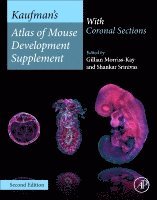
Kaufman's Atlas of Mouse Development Supplement
With Coronal Sections
Av Gillian Morriss-Kay, Shankar Srinivas
1829 kr
Beställningsvara. Skickas inom 11-20 vardagar. Fri frakt över 249 kr.
Beskrivning
Kaufman's Atlas of Mouse Development Supplement, Second Edition continues the stellar reputation of the original Atlas by providing updated, in-depth anatomical content and morphological views of organ systems. The book explores the developmental origins of the organ systems, following the original atlas as a continuation of the standard in the field for developmental biologists and researchers across biological and biomedical sciences studying mouse development. In this new edition, each chapter has been updated to include the latest research, along with while new chapters on the functional aspects of mouse and human heart development, the immune system, and the inner ear.
These additions ensure an up-to-date resource for all biomedical scientists who use the mouse as a model species for understanding the normal and abnormal development of human systems.
- Offers in-depth anatomy and morphological views of organ systems and their developmental origins
- Includes the latest techniques for visualizing gene expression and other functional aspects of tissue and organ development
- Explores the links between mouse and human developmental processes
- Features high-quality color images to help readers visualize key developmental processes and structures
Produktinformation
- Utgivningsdatum: 2024-12-05
- Mått: 216 x 276 x 30 mm
- Vikt: 1 560 g
- Format: Inbunden
- Språk: Engelska
- Antal sidor: 498
- Upplaga: 2
- Förlag: Elsevier Science
- ISBN: 9780443237393
Utforska kategorier
Mer om författaren
Gillian Morriss-Kay is Emeritus Professor of Developmental Anatomy at the University of Oxford, where she taught embryology, histology and anatomy to medical students. Her research goal, using first rat, then mouse embryos, was to enhance understanding of normal and abnormal human development, especially of the craniofacial region and neural tube. This led to collaborative mouse-human work on the developmental genetics and morphogenesis of craniosynostosis. She was editor of the Journal of Anatomy for ten years. Shankar Srinivas has a research career spanning 30 years, focusing on mouse developmental genetics (kidney, peri-implantation embryology, gastrulation and early cardiogenesis). More recently his work involves also using human embryos to understand early cell type diversification and cardiogenesis. He teaches anatomy and embryology to medical students. In 2004 Dr. Srinivas started his independent group at the University of Oxford as a Wellcome Trust Career Development Fellow and as Zeitlyn Fellow and Tutor in Medicine at Jesus College. In 2016 he became Professor of Developmental Biology. His research group studies how the coordinated cell movements that shape the early mammalian embryo prior to and during gastrulation are controlled and understanding how the heart forms and starts to beat. His group takes a multidisciplinary and collaborative approach to address these questions, using techniques spanning molecular genetics, lightsheet and confocal time-lapse imaging, single cell approaches, proteomics and embryo explant culture.
Betyg & recensioner
0 recensioner
Inga recensioner tillgängliga.