• Fri frakt över 249 kr
  • •
  • Snabba leveranser
  • •
  • Billiga böcker
Kundservice

Du är på sajten för privatpersoner.

Företag, bibliotek eller offentlig verksamhet?

Du handlar på classic.bokus.com, där alla dina funktioner finns intakta.
Till classic.bokus.com
Bokus logotyp. Gå till startsidan.
  • Erbjudanden
  • Nyheter
  • Student
  • Topplistor
  • Barn & ungdom
  • Bokus Play
  • E-böcker
  • Pocketböcker
  • Spel & pussel

10% rabatt på allt med kod NYSTART10 →

Sidfot

Mina sidor

    Hjälp

    • Kundservice
    • Vanliga frågor och svar
    • Frakt och leverans
    • Retur vid ångerrätt
    • Reklamera vara
    • Betalning
    • Köpvillkor
    • Allmänna villkor
    • Information om webbplatsens tillgänglighet

    Om Bokus

    • Om oss
    • Pressrum
    • För studenter
    • För företag
    • För bibliotek och offentlig verksamhet
    • För leverantörer
    • Hållbarhet

    Populärt

    • Aktuella erbjudanden
    • Presentkort
    • Studentlitteratur
    • Nya böcker
    • Topplistor
    • Signerade böcker
    • Engelska böcker

    Inspiration

    • Boktips
    • BookTok
    • Populära bokserier
    • Barnbokskaraktärer
    • Populära författare
    Logotyp för Bokus
    Följ oss på Facebook (extern länk)Följ oss på Instagram (extern länk)Följ oss på YouTube (extern länk)Följ oss på TikTok (extern länk)
    bokus @ CookiesAnpassa cookiesIntegritetspolicyKöpvillkor
    Till Citymail hemsida (extern länk)Till Budbee hemsida (extern länk)Till Postnord hemsida (extern länk)Till Schenker hemsida (extern länk)Till Early Bird hemsida (extern länk)Till Walleys hemsida (extern länk)
    1. Naturvetenskap och teknik
    2. Teknik och industri
    3. Tillverkningsteknik

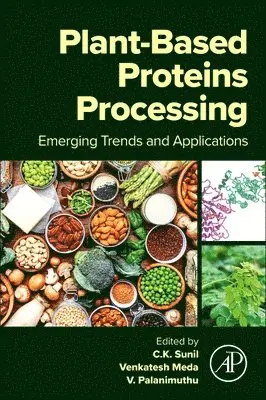
    Plant-Based Proteins Processing

    Emerging Trends and Applications

    AvC.K. Sunil,Venkatesh Meda

    Häftad, Engelska, 2025

    1 776 kr

    Beställningsvara. Skickas inom 10-15 vardagar. Fri frakt över 249 kr.

    Beskrivning

    Plant-Based Proteins Processing: Emerging Trends and Applications covers sources, extraction, properties, bioavailability, modification, applications, and marketing opportunities, in addition to the conventional and emerging technologies applied for obtaining plant-based proteins. This book consists of five sections, starting with Section A which includes chapters on overview, sources, digestibility and bioavailability, nutritional properties, and food byproducts as a source of protein. Section B covers the extraction of plant-based proteins, which has chapters on the chemical, enzyme, and novel techniques for extraction of plant proteins. Section C chapters focus on the modification of the plant protein, including all the modification methods (Thermal, Non-thermal, Biological, and Chemical methods) and their effects on the protein. Section D includes the applications of the proteins, and the last Section, E, covers the market, challenges, and future opportunities for plant-based proteins. Plant-Based Proteins Processing is a complete guide for students, researchers, professionals, consumers, food manufacturers, and others who are engaged in plant-based protein production.

    • Covers all aspects of plant-based proteins, such as sources, properties, bioavailability, extraction, modification, applications and market challenges
    • Explores nutritional, physiochemical, and functional qualities of plant proteins
    • Includes chemical, enzyme, and novel techniques for extraction of plant proteins
    • Includes all the modification methods (Thermal, Non-Thermal, Biological and chemical methods) and their effect on plant proteins
    • Includes application of plant proteins in various foods.

    Produktinformation

    • Utgivningsdatum:2025-12-08
    • Mått:216 x 276 x undefined mm
    • Vikt:450 g
    • Format:Häftad
    • Språk:Engelska
    • Antal sidor:412
    • Förlag:Elsevier Science
    • ISBN:9780443339554

    Utforska kategorier

    • Tillverkningsteknik inom Naturvetenskap och teknik

    Mer om författaren

    Dr. C. K. Sunil is currently working in the Department of Food Process Engineering and Centre of Excellence for Grain Sciences at the National Institute of Food Technology, Entrepreneurship and Management-Thanjavur (NIFTEM-T), Tamil Nadu, India (An institute of National Importance). He has over two decades of experience in teaching, research, and industry. He has published scientific papers, book chapters and books in peer-reviewed journals, books and international publishers. His area of research includes processing of millet, design and development of processing machinery, non-destructive technologies, application of novel thermal and nonthermal technologies, macromolecules processing (starch and protein) and valorisation of processing waste. He teaches in different areas of food processing/food engineering, such as unit operations, introduction to food processing, advances in food processing, processing of cereals, pulses and oilseeds, thermal and non-thermal processing of foods. He serves as editorial board member for few international journals. He also serves as a peer reviewer for several international food research journals. Dr. Venkatesh Meda is currently working as a Professor in the Department of Chemical and biological Engineering at the University of Saskatchewan, Saskatoon, Canada and is main research focus is oriented on “Post-harvest value-added processing of food / biomaterials using novel technologies”. Dr. Meda has been recognized for this leadership and visionary qualities towards the effort he is investing on a global and sustainable food security. He has published over 100 peer reviewed Scientific publications, 6 book chapters, 200 conference proceedings and supervised more than a dozen of post-graduate students and visiting scholars. He has been invited as a keynote speaker at International conferences in countries such as New Zealand, Turkey, Brazil, Austria, France, England, USA, and other Asia pacific region. He has been actively involved in Collaborations in India including Karunya University, NIFTEM, IIT-Delhi, NABI-CIAB, IICPT, IIT-Kharagpur, UAS, Bangalore, and TNAU.Dr. V. Palanimuthu is currently working as the Director of National Institute of Food Technology, Entrepreneurship and Management-Thanjavur, India. He has an experience of over 30 years under various capacities of teaching/research/extension. He has served as special officer, college of Agricultural Engineering, GKVK and as university head (Agril. Engg) Division, University of Agricultural Sciences, Bengaluru. Dr. Palanimuthu has published peer reviewed scientific publications, book chapters and conference proceedings. He has supervised around 30 post gradute students and Ph.D students. He has developed and commercialised various agricultural processing gadgets/machines and process technologies. He has also handled 19 externally funded projects and 49 ICAR-AICRP projects. He has also established centre of excellence (Small millets) for processing and value addition in GKVK. He is member of several professional bodies. He has received best teacher award from UAS, Bengaluru, India.

    Innehållsförteckning

    • SECTON A: Introduction to Plant-based proteins1. An overview2. Plant-based protein Sources - Grains, Fruits, Vegetables, and other plant sources3. Plant-based byproducts as a source of plant-based protein4. Nutritional quality and Properties of Plant-based proteins5. Plant-based protein digestibility and BioavailabilitySECTION B: Extraction of Plant-based proteins6. Chemical extraction of Plant protein: Methods, Mechanism, and recent advances7. Enzyme-assisted extraction of Plant protein: Methods, Mechanism, and recent advances8. Novel techniques for extraction of plant protein: Methods, Mechanism, and recent advancesSECTION C: Modification of Plant-based proteins9. Heat treatment - Conventional, Microwave, Radiofrequency, Ohmic and Infrared heating10. Radiation methods – Gamma, Electron beam irradiation and Ultraviolet radiation11. Pulsed electric field Treatment for modification of Plant Based Protein12. High-Pressure Treatment for modification of Plant Based Protein13. Ultrasonication Treatment for modification of Plant Based Protein14. Cold Atmospheric Plasma treatment for modification of Plant Based Protein15. Chemical modification of Plant-based proteins16. Biological modification methods of Plant-based proteins17. Hydrolysis of Plant-based proteinsSECTION D: Applications of Plant-based proteins18. Plant-based protein applications: Fat replacers, Stabiliser/Emulsifier, Edible coating or films, Bioactive peptides or Hydrolysates, Hydrogels19. Plant-based protein for food enrichment and fortification20. Plant-based protein Beverages and Fermented products21. Plant-based Protein Meat analogues and Fish alternatives22. Plant-based protein as Animal FeedSECTION E23. Plant-based proteins and Alternate proteins: Trends, Legislation processes and guidelines, Market, consumers and their behaviour, acceptability, challenges, and future opportunities24. Artificial Intelligence, Machine Learning and Block chain approaches to plant protein linkages