• Fri frakt över 249 kr
  • •
  • Snabba leveranser
  • •
  • Billiga böcker
Kundservice

Du är på sajten för privatpersoner.

Företag, bibliotek eller offentlig verksamhet?

Du handlar på classic.bokus.com, där alla dina funktioner finns intakta.
Till classic.bokus.com
Bokus logotyp. Gå till startsidan.
  • Erbjudanden
  • Student
  • Topplistor
  • Barn & ungdom
  • Bokus Play
  • E-böcker
  • Ljudböcker
  • Pocketböcker
  • Spel och pussel

Pocketfynda! Hundratals böcker för 49 kr/st →

Sidfot

Mina sidor

    Hjälp

    • Kundservice
    • Vanliga frågor och svar
    • Frakt och leverans
    • Retur vid ångerrätt
    • Reklamera vara
    • Betalning
    • Köpvillkor
    • Allmänna villkor
    • Information om webbplatsens tillgänglighet

    Om Bokus

    • Om oss
    • Pressrum
    • För studenter
    • För företag
    • För bibliotek och offentlig verksamhet
    • För leverantörer
    • Hållbarhet

    Populärt

    • Aktuella erbjudanden
    • Presentkort
    • Studentlitteratur
    • Nya böcker
    • Topplistor
    • Signerade böcker
    • Engelska böcker

    Inspiration

    • Boktips
    • BookTok
    • Barnbokskaraktärer
    • Populära författare
    Logotyp för Bokus
    Följ oss på Facebook (extern länk)Följ oss på Instagram (extern länk)Följ oss på YouTube (extern länk)Följ oss på TikTok (extern länk)
    bokus @ CookiesAnpassa cookiesIntegritetspolicyKöpvillkor
    Till Citymail hemsida (extern länk)Till Budbee hemsida (extern länk)Till Postnord hemsida (extern länk)Till Schenker hemsida (extern länk)Till Early Bird hemsida (extern länk)Till Walleys hemsida (extern länk)
    1. Data och IT
    2. Programmeringsböcker

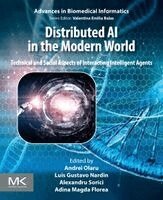
    Distributed AI in the Modern World

    Technical and Social Aspects of Interacting Intelligent Agents

    AvAndrei Olaru,Luis Gustavo Nardin

    Häftad, Engelska, 2026

    Del i serien Advances in Biomedical Informatics

    1 824 kr

    Beställningsvara. Skickas inom 10-15 vardagar. Fri frakt över 249 kr.

    Beskrivning

    Distributed AI in the Modern World: Technical and Social Aspects of Interacting Intelligent Agents presents state-of-the-art insights into the various forms of distribution of artificial intelligence, with practical application instances. Sections provide readers with practical solutions at an architectural level, with solutions presented on the distribution of the learning process and the utilization of machine learning models in a distributed system, tools that enable the distribution and interaction of artificial learning entities, how multi-agent systems and machine learning can be combined, the physical embodiment of intelligent agents, and the interaction of intelligent computing units bound to physical space.

    Following sections emphasize the challenges that are common to all scenarios and solutions that apply in a wider range of cases. This book does not analyze the internal workings of machine learning models (for instance, in the case of multi-agent reinforcement learning), but instead provides readers with an overview of the challenges brought by the need of artificially intelligent entities to interact with other entities and with their environments, along with practical solutions at an architectural level.

    • Presents leading-edge insights on the diverse ways artificial intelligence is distributed, along with real-world application examples
    • Offers readers a summary of the challenges posed by the necessity for artificially intelligent entities to engage with other entities and their surroundings
    • Proposes practical architectural-level solutions
    • Explores communication in local networks, on the web, and within physical environments
    • Examines machine learning distributed across a network into software agents using machine learning models to make decisions, and into agents working on the web, in socio-technical networks, and in AI embodied in robots

    Produktinformation

    • Utgivningsdatum:2026-06-16
    • Mått:216 x 276 x 15 mm
    • Vikt:450 g
    • Format:Häftad
    • Språk:Engelska
    • Serie:Advances in Biomedical Informatics
    • Antal sidor:264
    • Förlag:Elsevier Science
    • ISBN:9780443446795

    Utforska kategorier

    • Programmeringsböcker inom Data och IT
    • Systemvetenskap och AI inom Data och IT
    • Nätverk och kommunikation inom Data och IT

    Mer om författaren

    Dr. Andrei Olaru is an Associate Professor with the National University of Science and Technology POLITEHNICA Bucharest (UNSTPB), and a member of the Artificial Intelligence and Multi-agent Systems Laboratory, specialized in multi-agent systems, ambient intelligence, and context-awareness. He has received a double M.Sc. Degree from University Politehnica of Bucharest (UPB, now UNSTPB) and from University of Nantes, and a double Ph.D. Degree from UPB and University Pierre et Marie Curie (now Sorbonne University). Among other subjects, he teaches a course on Multi-Agent Systems to master students at UNSTPB. He is the coordinator of the Financial Computing Master's Degree at UNSTPB. Dr. Olaru has been the director of 2 national research grants and 1 international grant. He is a member of ACM and a member of the Romanian Association for Artificial Intelligence. Dr. Luis Gustavo Nardin is an associate professor in the Department of Computer Science and Intelligent Systems at IMT Mines Saint-Étienne (MSE) and a member of the Laboratory of Informatics, Modelling and Optimization of the Systems (LIMOS UMR 6158). He holds a M.Sc. (2009) and Ph.D. (2015) degrees in Electrical Engineering with specialization in Artificial Intelligence from the University of São Paulo, Brazil. He teaches multi-agent system (MAS), software engineering, and cloud computing courses to the undergraduate students and the Cyber-Physical and Social Systems (CPS2) master students at MSE. His main research interests are models, tools, and methodologies for the regulation of MAS. He also conducts research on agent-based simulation focused on understanding the impacts of social and human behaviors and institutional policies on the emergent properties of complex adaptive systems. Dr. Nardin has previously held faculty positions in the School of Computing at the National College of Ireland and the Brandenburg University of Technology in Cottbus, Germany, after spending some time in a Postdoctoral Fellowship position at the Center for Modeling Complex Interactions at the University of Idaho, USA. Dr. Nardin is the coordinator of the international project ANR-FAPESP Normative Artificial Intelligence for Regulating Manufacturing (NAIMAN) in collaboration with the University of São Paulo, developing normative models and mechanisms for regulating the manufacturing industry. He also leads the organization of the Summer School on AI Technologies for Trust, Interoperability, Autonomy and Resilience in Industry 4.0 (AI4Industry) in collaboration with a broad range of academic institutions and industrial partners. He participates in the ANR-SNF HyperAgents project in developing regulation ontologies and mechanisms for supporting the deployment of world-wide hybrid communities of people and artificial agents on the Web, and in the ANR ACCELER-AI project at developing models and mechanisms for the multi-faceted bounding of the learning of ethical behavior.Dr. Alexandru Sorici is a Lecturer in the Department of Computer Science, National University of Science and Technology POLITEHNICA and a member of the AI-MAS Laboratory. Dr. Sorici holds a Ph.D. in Computer Science from UPB and École Nationale Supérieure des Mines de Saint-Étienne. His research interests encompass context management, agent-oriented programming, human activity recognition, and ambient intelligence (which extends to research in assisted robotics, autonomous driving, and wearable device data analysis in a medical context). Currently, Dr. Sorici is leading the postdoc project CASHMERE, where he works on developing services that ensure dynamic context-dependent authorization for the discovery and use of web resources by software agents in hypermedia agent systems. Dr. Sorici is also a member of the HORIZON 2020 ALAMEDA project, which focuses on studying the predictive power of data from wearable devices and patient logs in determining the health status of patients suffering from neurological diseases such as Multiple Sclerosis, Parkinson's, and stroke recovery. Within the project he is responsible for the management of the patient data collection protocol and interfacing between the medical and technical teams. Dr. Sorici serves as the Secretary of the Romanian Association for Artificial Intelligence (ARIA). In this role, he has contributed to organizing several events aimed at education and raising public awareness about Artificial Intelligence.Dr. Adina Magda Florea is Professor in the Department of Computer Science of the National University of Science and Technology POLITEHNICA Bucharest and is the Director of the International Center of Excellence in Artificial Intelligence of the university. Her research interests are in multi-agent systems, machine learning, ambient intelligence, active and assisted living, social robots, and human-robot interaction. Dr. Florea founded and holds the chair of Artificial Intelligence at UNSTPB, was the director of over 25 national RDI grants and 6 international grants and coordinated the development of the PRECIS Research Center. Dr. Florea has been an invited professor at several European universities and had a one-year invited professorship at Worcester Polytechnic Institute, MA, USA. She is Senior Member of IEEE, Senior Member of ACM, President of the Romanian Association for Artificial Intelligence, and Chair of IEEE Romanian Section Chapter of Computational Intelligence.

    Innehållsförteckning

    • PrefacePart 1Preamble1.1 Federated Learning for ICD Classification with Lightweight Models and Pretrained Embeddings1.2 Autonomy in the Web of Things1.3 Addressing AI Trustworthiness in the Architectural Design of Web Systems1.4 Modelling Theory of Mind: A multi-agent oriented approachPart 2Preamble2.1 Context Management in Hypermedia Multi-Agent Systems2.2 Integrating MAS with Microservices2.3 Declarative Protocols for Engineering MAS: the Integration of BSPL and SARL2.4 Integrating Prediction Models with Multi-Agent System FrameworksPart 3Preamble3.1 Distributed and Embedded Multi-Agent Systems3.2 Distributed Self-Coordination for Non-Holonomic Psychical Embodied Robot Swarms3.3 Comprehensive Services for Robotic Platforms: Enhancing Human Assistance and Interaction3.4 Tools for Deployment and Monitoring of Distributed MAS