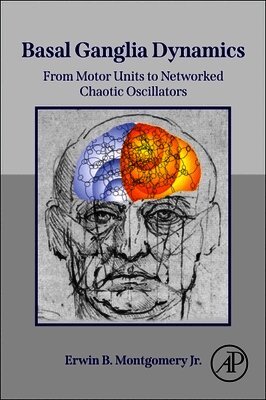
Häftad, Engelska, 2026
Basal Ganglia Dynamics
2035 kr
Beställningsvara. Skickas inom 10-15 vardagar. Fri frakt över 249 kr.
Beskrivning
Basal Ganglia Dynamics: From Motor Units to Networked Chaotic Oscillators addresses the critical need for new theoretical frameworks in understanding the basal ganglia-thalamic cortical system, particularly in the context of movement disorders such as Parkinson’s disease. Despite significant therapeutic advances, current dopamine replacement and Deep Brain Stimulation therapies remain limited due to incomplete and oversimplified prevailing theories. This reference provides a comprehensive alternative approach grounded in complexity science, nonlinear dynamics, and Chaotic Systems theory. The contents span foundational concepts, including motor unit orchestration, networked nonlinear oscillators, information theory, and methodological considerations. Detailed chapters cover the shortcomings of current models, the application of Chaotic System mathematics to basal ganglia physiology, and the implications for pathophysiology and treatment. The book also includes extensive simulations, operational hypotheses, and a rigorous critique of existing paradigms, supported by principles such as Causational and Informational Synonymy.
. Presents a novel theory embracing the complexity and nonlinearity of basal ganglia physiology
. Applies principles of Chaotic Systems to movement disorders like Parkinson’s disease
. Integrates Information theory and mathematical philosophy for new insights
. Explores motor unit orchestration with implications for neuronal control
. Provides detailed simulations and operational hypotheses for future research
. Presents a novel theory embracing the complexity and nonlinearity of basal ganglia physiology
. Applies principles of Chaotic Systems to movement disorders like Parkinson’s disease
. Integrates Information theory and mathematical philosophy for new insights
. Explores motor unit orchestration with implications for neuronal control
. Provides detailed simulations and operational hypotheses for future research
Produktinformation
- Utgivningsdatum: 2026-07-24
- Mått: 152 x 229 x 38 mm
- Vikt: 450 g
- Format: Häftad
- Språk: Engelska
- Antal sidor: 702
- Förlag: Elsevier Science
- ISBN: 9780443458194
Utforska kategorier
Betyg & recensioner
0 recensioner
Inga recensioner tillgängliga.