• Fri frakt över 249 kr
  • •
  • Snabba leveranser
  • •
  • Billiga böcker
Kundservice

Du är på sajten för privatpersoner.

Företag, bibliotek eller offentlig verksamhet?

Du handlar på classic.bokus.com, där alla dina funktioner finns intakta.
Till classic.bokus.com
Bokus logotyp. Gå till startsidan.
  • Erbjudanden
  • Nyheter
  • Student
  • Topplistor
  • Barn & ungdom
  • Bokus Play
  • E-böcker
  • Pocketböcker
  • Spel & pussel

10% rabatt på allt med kod NYSTART10 →

Sidfot

Mina sidor

    Hjälp

    • Kundservice
    • Vanliga frågor och svar
    • Frakt och leverans
    • Retur vid ångerrätt
    • Reklamera vara
    • Betalning
    • Köpvillkor
    • Allmänna villkor
    • Information om webbplatsens tillgänglighet

    Om Bokus

    • Om oss
    • Pressrum
    • För studenter
    • För företag
    • För bibliotek och offentlig verksamhet
    • För leverantörer
    • Hållbarhet

    Populärt

    • Aktuella erbjudanden
    • Presentkort
    • Studentlitteratur
    • Nya böcker
    • Topplistor
    • Signerade böcker
    • Engelska böcker

    Inspiration

    • Boktips
    • BookTok
    • Populära bokserier
    • Barnbokskaraktärer
    • Populära författare
    Logotyp för Bokus
    Följ oss på Facebook (extern länk)Följ oss på Instagram (extern länk)Följ oss på YouTube (extern länk)Följ oss på TikTok (extern länk)
    bokus @ CookiesAnpassa cookiesIntegritetspolicyKöpvillkor
    Till Citymail hemsida (extern länk)Till Budbee hemsida (extern länk)Till Postnord hemsida (extern länk)Till Schenker hemsida (extern länk)Till Early Bird hemsida (extern länk)Till Walleys hemsida (extern länk)
    1. Naturvetenskap och teknik
    2. Teknik och industri
    3. Miljöteknik

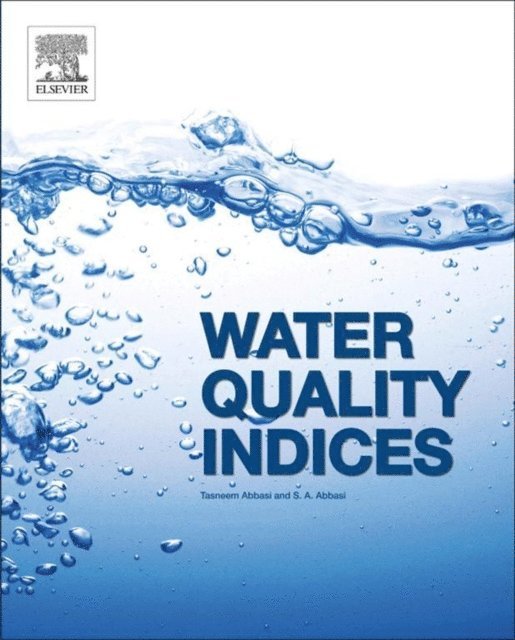
    Water Quality Indices

    AvTabassum Abbasi,S. A. Abbasi

    Häftad, Engelska, 2016

    989 kr

    Beställningsvara. Skickas inom 10-15 vardagar. Fri frakt över 249 kr.

    Beskrivning

    This book covers water quality indices (WQI) in depth - it describes what purpose they serve, how they are generated, what are their strengths and weaknesses, and how to make the best use of them. It is a concise and unique guide to WQIs for chemists, chemical/environmental engineers and government officials.

    Whereas it is easy to express the quantity of water, it is very difficult to express its quality because a large number of variables determine the water quality. WQIs seek to resolve the difficulty by translating a set of a large number of variables to a one-digit or a two-digit numeral. They are essential in communicating the status of different water resources in terms of water quality and the impact of various factors on it to policy makers, service personnel, and the lay public. Further they are exceedingly useful in the monitoring and management of water quality.

    With the importance of water and water quality increasing exponentially, the importance of this topic is also set to increase enormously because only with the use of indices is it possible to assess, express, communicate, and monitor the overall quality of any water source.


    • Provides a concise guide to WQIs: their purpose and generation
    • Compares existing methods and WQIs and outlines strengths and weaknesses
    • Makes recommendations on how the indices should be used and under what circumstances they apply

    Produktinformation

    • Utgivningsdatum:2016-08-19
    • Mått:191 x 235 x 20 mm
    • Vikt:500 g
    • Format:Häftad
    • Språk:Engelska
    • Antal sidor:384
    • Förlag:Elsevier Science
    • ISBN:9780444638366

    Utforska kategorier

    • Miljöteknik inom Naturvetenskap och teknik

    Mer om författaren

    Tabassum-Abbasi has received her BTech, MTech, and PhD degrees in instrumentation and control engineering, environmental engineering, and environmental technology, respectively – all from Pondicherry University. She too has been a class topper throughout, receiving gold medals. She has been working as Assistant Professor at the University ofPetroleum & Energy Studies, Dehradun since January 2019, attaining senior grade (Level 2) in 2022, and selection grade (Level 3) recently. She has spent an year (2023- 24) in post-doctoral research at the University of Edinburgh as a British Council Women in Science Fellow. Besides research papers on bioprocess engineering and sustainability in highly cited journals, she has received three patents, and has registered another two. S. A. Abbasi, presently Distinguished Professor, School of Advanced Engineering, University of Petroleum and Energy Studies (UPES), Dehradun, has earlier been a full university professor and director (1987- 2015), and Emeritus Professor (2015-2024) at the Centre for Pollution Control and Environmental Engineering, Pondicherry University. Prior to it he was the founder Head of the Water Quality & Environment Division at the Centre for Water Resources, Kozhikode (1979-87), and a Visiting-cum-adjunct Professor at California State University (1984- 1987). He has also been a Visiting Professor at the universities of Minnesota, Florida, Nevada, California−Berkeley, Malaya and Al-Ahsa.Prof Abbasi is considered among the world’s foremost experts in the fields of bioprocess engineering, process safety, and environmental engineering. Among numerous coveted honours and awards received by Prof Abbasi are the National Design Award in Environmental Engineering, the IPCL award for Safety and Hazard Management in Petroleum Industries, the National Hydrology Award, the International Desalination Association’s prize, The Trever Kletz award, and fellowships of the National Academy of Sciences and the Indian Institute of Chemical Engineers.

    Innehållsförteckning

    • Part 1: Water Quality Indices Based Predominantly on Physico-chemical characteristics1. Why water quality indices2. Approaches to WQI formulation3. Conventional Indices for determining fitness of waters for different uses4. Combating uncertainities in indice-based assessment of water quality: The use of more advanced statistics, probability theory, and artificial intelligence5. Indices based on relatively advanced statistical analysis of water quality data6. Water quality indices based on fuzzy logic and other methods of artificial intelligence7. Probabilistic or stochastic water quality indices8. Planning or decision – making indices9. Indices for assessing groundwater quality10. Water quality indices of USA and Canada11. WQI generating software and a WQI-based virtual instrumentPart 2: Water Quality Indices Based on Bioassessment12. Water quality indices based on bioassessment: an introduction13. The biotic indices14. Indices of biological integrity or the multimetric indices15. Multivariate approaches for bioassessment of water qualityPart 3: Looking Back, Looking Ahead16. Water quality indices : Looking back, looking ahead