• Fri frakt över 249 kr
  • •
  • Snabba leveranser
  • •
  • Billiga böcker
Kundservice

Du är på sajten för privatpersoner.

Företag, bibliotek eller offentlig verksamhet?

Du handlar på classic.bokus.com, där alla dina funktioner finns intakta.
Till classic.bokus.com
Bokus logotyp. Gå till startsidan.
  • Erbjudanden
  • Nyheter
  • Student
  • Topplistor
  • Barn & ungdom
  • Bokus Play
  • E-böcker
  • Pocketböcker
  • Spel & pussel

Må bättre, för mindre! Upp till 50% rabatt på hälsoböcker

Sidfot

Mina sidor

    Hjälp

    • Kundservice
    • Vanliga frågor och svar
    • Frakt och leverans
    • Retur vid ångerrätt
    • Reklamera vara
    • Betalning
    • Köpvillkor
    • Allmänna villkor
    • Information om webbplatsens tillgänglighet

    Om Bokus

    • Om oss
    • Pressrum
    • För studenter
    • För företag
    • För bibliotek och offentlig verksamhet
    • För leverantörer
    • Hållbarhet

    Populärt

    • Aktuella erbjudanden
    • Presentkort
    • Studentlitteratur
    • Nya böcker
    • Topplistor
    • Signerade böcker
    • Engelska böcker

    Inspiration

    • Boktips
    • BookTok
    • Populära bokserier
    • Barnbokskaraktärer
    • Populära författare
    Logotyp för Bokus
    Följ oss på Facebook (extern länk)Följ oss på Instagram (extern länk)Följ oss på YouTube (extern länk)Följ oss på TikTok (extern länk)
    bokus @ CookiesAnpassa cookiesIntegritetspolicyKöpvillkor
    Till Citymail hemsida (extern länk)Till Budbee hemsida (extern länk)Till Postnord hemsida (extern länk)Till Schenker hemsida (extern länk)Till Early Bird hemsida (extern länk)Till Walleys hemsida (extern länk)
    1. Ekonomi och Ledarskap
    2. Nationalekonomi

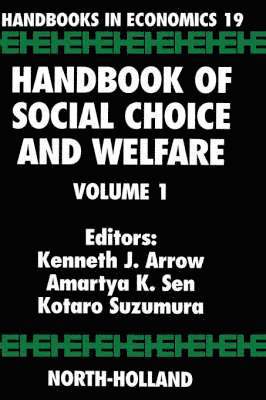
    Handbook of Social Choice and Welfare

    AvK. J. Arrow,M. A. K. Sen

    Inbunden, Engelska, 2002

    Del 19 i serien Handbooks in Economics

    1 337 kr

    Beställningsvara. Skickas inom 10-15 vardagar. Fri frakt över 249 kr.

    Beskrivning

    The Handbook of Social Choice and Welfare presents, in two volumes, essays on past and on-going work in social choice theory and welfare economics. The first volume consists of four parts. In Part 1 (Arrovian Impossibility Theorems), various aspects of Arrovian general impossibility theorems, illustrated by the simple majority cycle first identified by Condorcet, are expounded and evaluated. It also provides a critical survey of the work on different escape routes from impossibility results of this kind. In Part 2 (Voting Schemes and Mechanisms), the operation and performance of voting schemes and cost-sharing mechanisms are examined axiomatically, and some aspects of the modern theory of incentives and mechanism design are expounded and surveyed. In Part 3 (structure of social choice rules), the positional rules of collective decision-making (the origin of which can be traced back to a seminal proposal by Borda), the game-theoretic aspects of voting in committees, and the implications of making use of interpersonal comparisons of welfare (with or without cardinal measurability) are expounded, and the status of utilitarianism as a theory of justice is critically examined. It also provides an analytical survey of the foundations of measurement of inequality and poverty. In order to place these broad issues (as well as further issues to be discussed in the second volume of the Handbook) in perspective, Kotaro Suzumura has written an extensive introduction, discussing the historical background of social choice theory, the vistas opened by Arrow's Social Choice and Individual Values, the famous "socialist planning" controversy, and the theoretical and practical significance of social choice theory. The primary purpose of this Handbook is to provide an accessible introduction to the current state of the art in social choice theory and welfare economics. The expounded theory has a strong and constructive message for pursuing human well-being and facilitating collective decision-making.

    *Advances economists' understanding of recent advances in social choice and welfare

    *Distills and applies research to a wide range of social issues

    *Provides analytical material for evaluating new scholarship

    *Offers consolidated reviews and analyses of scholarship in a framework that encourages synthesis.

    Produktinformation

    • Utgivningsdatum:2002-08-15
    • Mått:156 x 234 x 44 mm
    • Vikt:1 130 g
    • Format:Inbunden
    • Språk:Engelska
    • Serie:Handbooks in Economics
    • Antal sidor:680
    • Förlag:Elsevier Science
    • ISBN:9780444829146

    Utforska kategorier

    • Nationalekonomi inom Ekonomi och Ledarskap
    • Socialt arbete och välfärd inom Samhälle och politik

    Mer om författaren

    Kenneth Arrow is the Joan Kenney Professor of Economics and Professor of Operations Research, emeritus; a CHP/PCOR fellow; and an FSI senior fellow by courtesy. He is the joint winner of the Nobel Memorial Prize in Economics with John Hicks in 1972. To date, he is the youngest person to have received this award, at 51. In economics, he is a figure in post-World War II neo-classical economic theory. Many of his former graduate students have gone on to win the Nobel Memorial Prize themselves. His most significant works are his contributions to social choice theory, notably "Arrow's impossibility theorem", and his work on general equilibrium analysis. He has also provided foundational work in many other areas of economics, including endogenous growth theory and the economics of information. He has been co-editor of the Handbooks in Economics series since the mid-1980s.

    Recensioner i media

    "This book, together with the forthcoming second volume, presents careful surveys of various aspects of social choice and welfare. Each chapter is written by a well-cast expert in the area. ...Suzumura also summarizes the main lines of ongoing and future research." --Journal of Economic Literature, 2004

    Innehållsförteckning

    • Preface to Volume 1 (K. Arrow, A. Sen, K. Suzumura). Introduction (K. Suzumura). Part 1. Arrovian Impossibility Theorems. 1. Impossibility theorems in the Arrovian framework (D. Campbell, J. Kelly). 2. Categories of Arrovian voting schemes (F. Aleskerov). 3. Domain restrictions (W. Gaertner). Part 2. Voting Schemes and Mechanisms. 4. Voting procedures (S. Brams, P. Fishburn). 5. Implementation theory (E. Maskin, T. Sjöström). 6. Axiomatic cost and surplus-sharing (H. Moulin). Part 3. Structure of Social Choice Rules. 7. Positional rules of collective decision-making (P. Pattanaik). 8. Game-Theoretic Analysis of voting in committees (B. Peleg). 9. Representative democracy and social choice theory (N. Schofield). Part 4. Welfare, Justice and Poverty. 10. Social welfare functionals and interpersonal comparability (C. d'Aspremont, L. Gevers). 11. Utilitarianism and the theory of justice (C. Blackorby, W. Bossert, D. Donaldson). 12. Inequality, poverty and welfare (B. Dutta).