• Fri frakt över 249 kr
  • •
  • Snabba leveranser
  • •
  • Billiga böcker
Kundservice

Du är på sajten för privatpersoner.

Företag, bibliotek eller offentlig verksamhet?

Du handlar på classic.bokus.com, där alla dina funktioner finns intakta.
Till classic.bokus.com
Bokus logotyp. Gå till startsidan.
  • Erbjudanden
  • Nyheter
  • Student
  • Topplistor
  • Barn & ungdom
  • Bokus Play
  • E-böcker
  • Pocketböcker
  • Spel & pussel

Må bättre, för mindre! Upp till 50% rabatt på hälsoböcker

Sidfot

Mina sidor

    Hjälp

    • Kundservice
    • Vanliga frågor och svar
    • Frakt och leverans
    • Retur vid ångerrätt
    • Reklamera vara
    • Betalning
    • Köpvillkor
    • Allmänna villkor
    • Information om webbplatsens tillgänglighet

    Om Bokus

    • Om oss
    • Pressrum
    • För studenter
    • För företag
    • För bibliotek och offentlig verksamhet
    • För leverantörer
    • Hållbarhet

    Populärt

    • Aktuella erbjudanden
    • Presentkort
    • Studentlitteratur
    • Nya böcker
    • Topplistor
    • Signerade böcker
    • Engelska böcker

    Inspiration

    • Boktips
    • BookTok
    • Populära bokserier
    • Barnbokskaraktärer
    • Populära författare
    Logotyp för Bokus
    Följ oss på Facebook (extern länk)Följ oss på Instagram (extern länk)Följ oss på YouTube (extern länk)Följ oss på TikTok (extern länk)
    bokus @ CookiesAnpassa cookiesIntegritetspolicyKöpvillkor
    Till Citymail hemsida (extern länk)Till Budbee hemsida (extern länk)Till Postnord hemsida (extern länk)Till Schenker hemsida (extern länk)Till Early Bird hemsida (extern länk)Till Walleys hemsida (extern länk)
    1. Medicin
    2. Medicin: allmänt
    3. Medicinsk utrustning och medicinska tekniker

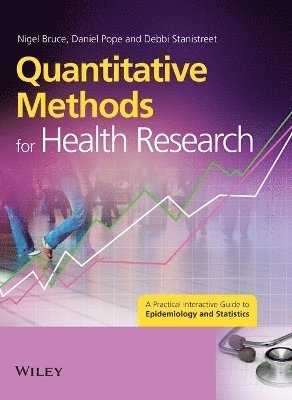
    Quantitative Methods for Health Research

    A Practical Interactive Guide to Epidemiology and Statistics

    AvNigel Bruce,Daniel Pope

    Inbunden, Engelska, 2008

    1 905 kr

    Beställningsvara. Skickas inom 5-8 vardagar. Fri frakt över 249 kr.

    Fler format och utgåvor

    Häftad

    739 kr

    Beskrivning

    Quantitative Research Methods for Health Professionals: A Practical Interactive Course is a superb introduction to epidemiology, biostatistics, and research methodology for the whole health care community. Drawing examples from a wide range of health research, this practical handbook covers important contemporary health research methods such as survival analysis, Cox regression, and meta-analysis, the understanding of which go beyond introductory concepts.The book includes self-assessment exercises throughout to help students explore and reflect on their understanding and a clear distinction is made between a) knowledge and concepts that all students should ensure they understand and b) those that can be pursued by students who wish to do so.The authors incorporate a program of practical exercises in SPSS using a prepared data set that helps to consolidate the theory and develop skills and confidence in data handling, analysis and interpretation.

    Produktinformation

    • Utgivningsdatum:2008-06-27
    • Mått:196 x 254 x 36 mm
    • Vikt:1 193 g
    • Format:Inbunden
    • Språk:Engelska
    • Antal sidor:560
    • Förlag:John Wiley & Sons Inc
    • ISBN:9780470022740

    Utforska kategorier

    • Medicinsk utrustning och medicinska tekniker inom Medicin

    Mer om författaren

    Nigel Bruce, PhD is Emeritus Professor of Public Health at the Department of Public Health and Policy, University of Liverpool, UK.Daniel Pope, PhD is Senior Lecturer in Epidemiology and Public Health at the Department of Public Health and Policy, University of Liverpool, UK.Debbi Stanistreet, PhD is Senior Lecturer and Faculty Director of Widening Participation at the Department of Public Health and Policy, University of Liverpool, UK.

    Innehållsförteckning

    • Preface. Acknowledgements.1. Philosophy of science and introduction to epidemiology.Introduction and learning objectives.1.1 Approaches to scientific research.1.2 Formulating a research question.1.3 Rates: incidence and prevalence.1.4 Concepts of prevention.1.5 Answers to self-assessment exercises.2. Routine data sources and descriptive epidemiology.Introduction and learning objectives.2.1 Routine collection of health information.2.2 Descriptive epidemiology.2.3 Information on the environment.2.4 Displaying, describing and presenting data.2.5 Summary of routinely available data.2.6 Descriptive epidemiology in action.2.7 Overview of epidemiological study designs.2.8 Answers to self-assessment exercises.3. Standardisation.Introduction and learning objectives.3.1 Health inequalities in Merseyside.3.2 Indirect standardisation: calculation of the standardised mortality ratio (SMR).3.3 Direct standardisation.3.4 Standardisation for factors other than age.3.5 Answers to self-assessment exercises.4. Surveys.Introduction and learning objectives.4.1 Purpose and context.4.2 Sampling methods.4.3 The sampling frame.4.4 Sampling error, confidence intervals and sample size .4.5 Response.4.6 Measurement.4.7 Data types and presentation.4.8 Answers to self-assessment exercises.5. Cohort studies.Introduction and learning objectives.5.1 Why do a cohort study?.5.2 Obtaining the sample.5.3 Measurement.5.4 Follow-up.5.5 Basic presentation and analysis of results.5.6 How large should a cohort study be?.5.7 Confounding.5.8 Simple linear regression.5.9 Introduction to multiple linear regression.5.10 Answers to self-assessment exercises.6. Case-control studies.Introduction and learning objectives.6.1 Why do a case-control study?.6.2 Key elements of study design.6.3 Basic unmatched and matched analysis.6.4 Sample size for a case-control study.6.5 Confounding and logistic regression.6.6 Answers to self-assessment exercises.7. Intervention studies.Introduction and learning objectives.7.1 Why do an intervention study?.7.2 Key elements of intervention study design.7.3 The analysis of intervention studies.7.4 Testing more complex interventions.7.5 How big should the trial be?.7.6 Further aspects of intervention study design and analysis.7.7 Answers to self-assessment exercises.8. Life tables, survival analysis and Cox regression.Introduction and learning objectives.8.1 Survival analysis.8.2 Cox regression.8.3 Current life tables.8.4 Answers to self-assessment exercises.9. Systematic reviews and meta analysis.Introduction and learning objectives.9.1 The why and how of systematic reviews.9.2 The methodology of meta-analysis.9.3 Systematic reviews and meta-analyses of observational studies.9.4 The Cochrane Collaboration.9.5 Answers to self-assessment exercises.10. Prevention strategies and evaluation of screening .Introduction and learning objectives.10.1 Concepts of risk.10.2 Strategies of prevention.10.3 Evaluation of screening programmes.10.4 Cohort and period effects.10.5 Answers to self-assessment exercises.11. Probability distributions, hypothesis testing and Bayesian methods.Introduction and learning objectives.11.1 Probability distributions.11.2 Data that do not ‘fit’ a probability distribution.11.3 Hypothesis testing.11.4 Choosing an appropriate hypothesis test.11.5 Bayesian methods.11.6 Answers to self-assessment exercises.Bibliography.Index.