• Fri frakt över 249 kr
  • •
  • Snabba leveranser
  • •
  • Billiga böcker
Kundservice

Du är på sajten för privatpersoner.

Företag, bibliotek eller offentlig verksamhet?

Du handlar på classic.bokus.com, där alla dina funktioner finns intakta.
Till classic.bokus.com
Bokus logotyp. Gå till startsidan.
  • Erbjudanden
  • Nyheter
  • Student
  • Topplistor
  • Barn & ungdom
  • Bokus Play
  • E-böcker
  • Pocketböcker
  • Spel & pussel

10% rabatt på allt med kod NYSTART10 →

Sidfot

Mina sidor

    Hjälp

    • Kundservice
    • Vanliga frågor och svar
    • Frakt och leverans
    • Retur vid ångerrätt
    • Reklamera vara
    • Betalning
    • Köpvillkor
    • Allmänna villkor
    • Information om webbplatsens tillgänglighet

    Om Bokus

    • Om oss
    • Pressrum
    • För studenter
    • För företag
    • För bibliotek och offentlig verksamhet
    • För leverantörer
    • Hållbarhet

    Populärt

    • Aktuella erbjudanden
    • Presentkort
    • Studentlitteratur
    • Nya böcker
    • Topplistor
    • Signerade böcker
    • Engelska böcker

    Inspiration

    • Boktips
    • BookTok
    • Populära bokserier
    • Barnbokskaraktärer
    • Populära författare
    Logotyp för Bokus
    Följ oss på Facebook (extern länk)Följ oss på Instagram (extern länk)Följ oss på YouTube (extern länk)Följ oss på TikTok (extern länk)
    bokus @ CookiesAnpassa cookiesIntegritetspolicyKöpvillkor
    Till Citymail hemsida (extern länk)Till Budbee hemsida (extern länk)Till Postnord hemsida (extern länk)Till Schenker hemsida (extern länk)Till Early Bird hemsida (extern länk)Till Walleys hemsida (extern länk)
    1. Naturvetenskap och teknik
    2. Teknik och industri
    3. Elektronik och kommunikationer

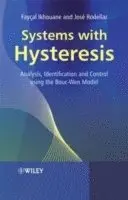
    Systems with Hysteresis

    Analysis, Identification and Control Using the Bouc-Wen Model

    AvFayçal Ikhouane,José Rodellar

    Inbunden, Engelska, 2007

    1 553 kr

    Beställningsvara. Skickas inom 11-20 vardagar. Fri frakt över 249 kr.

    Beskrivning

    Hysterisis is a system property that is fundamental to a range of engineering applications as the components of systems with hysterisis are able to react differently to different forces applied to them. Control theory is used to model these complex systems and cause them to behave in the desired manner; the Bouc-Wen model is a well-known semi-physical model that is used extensively to describe the hysterisis of systems in the areas of smart structures and civil engineering. The Bouc-Wen model for system hysterisis has increased in popularity due to its capability of capturing in an analytical form a range of shapes of hysteretic cycles that match the behaviour of a wide class of hysteretic systems. “Systems with Hysterisis: Analysis, Identification and Control using the Bouc-Wen Model” deals with the analysis, identification and control of these systems, and offers a comprehensive and self-contained framework for the study of the Bouc-Wen model. Includes the latest techniques for modelling smart structures and materialsProvides a rigorous mathematical treatment of the subject along with practical comments, numerical solutions and a case study of magentorheological (MR) dampers.Begins by analysing the compatibility of the Bouc-Wen model with the laws of physics, and continues to cover the relationship between the model parameters and hysterisis loop, identification of the model parameters and control of systems that include a hysteretic part described by the Bouc-Wen model.Includes case studies covering the identification and control of smart material transducers for use in automotive, aerospace and structural controlSystems with Hysterisis: Analysis, Identification and Control using the Bouc-Wen Model offers an invaluable source of ideas, concepts and insights for engineers, researchers, lecturers and senior/ postgraduate students involved in the research, design and development of smart structures and related areas within civil and mechanical engineering. It will also be of interest to readers involved in the wider disciplines of electrical & control engineering, applied mathematics, applied physics and material science.

    Produktinformation

    • Utgivningsdatum:2007-07-06
    • Mått:158 x 236 x 18 mm
    • Vikt:440 g
    • Format:Inbunden
    • Språk:Engelska
    • Antal sidor:222
    • Förlag:John Wiley & Sons Inc
    • ISBN:9780470032367

    Utforska kategorier

    • Elektronik och kommunikationer inom Naturvetenskap och teknik
    • Byggnadsteknik inom Naturvetenskap och teknik
    • Maskinteknik och material inom Naturvetenskap och teknik

    Mer om författaren

    Fayçal Ikhouane, Universitat Politècnica de Catalunya,  Departament de Matemàtica Aplicada III, Escola Universitària d’Enginyeria Tècnica Industrial de Barcelona. C/ Comte d’Urgell, 187, 08036, Barcelona, Spain.Fayçal Ikhouane currently holds both a research and teaching post with the Control, Dynamics and Applications group at the Technical University of Catalunya, Spain. He has been in this job since 2002, after having been a visiting scholar at the University of California in Santa Barbara, and a lecturer and associate researcher with the Ecole Nationale d’Industrie Minérale and the Ecole Mohammadia d’Ingénieurs in Morocco. He also worked in industry as a control engineer at the Société des Ciments d’Agadir, Morocco. Dr Ikhouane is now conducting research on modelling, identification and control of mechanical systems and smart structures with nonlinearities such as hysteresis and friction, and is helping to set up a new research laboratory on these topics. He has co-authored around 10 journal papers and 20 papers and presentations at major conferences. José Rodellar, Universitat Politècnica de Catalunya, Departament de Matemàtica Aplicada III, Escola Tècnica Superior d’Enginyers de Camins, Canalsi Ports, Campus Nord UPC, C2, 08034, Barcelona, Spain.José Rodellar is currently a Professor in the School of Civil Engineering at the Technical University of Catalunya, Spain. He has been at the university since 1976, and is now Director of the Control, Dynamics and Applications group, which carries out theoretical and applied research on modelling and control, with applications in structural control and smart structures. Previous to this, he has been visiting professor at the Department of Civil Engineering, at the State University of New York, Buffalo (USA), and visiting scholar at the Department of Mechanical Engineering, University of California, Berkeley. He is a member of the Board of Directors of the International Association for Structural Control and Monitoring, has co-authored and edited five books, including Adaptive Predictive Control:  From the Concepts to Plant Optimization (Prentice Hall, 1995), Smart Structures and NATO Workshop (Kluwer, 1998), and co-authored around 160 journal and conference papers.

    Innehållsförteckning

    • Preface. List of Figures.List of Tables.                                                                                           1. Introduction                                                                      1.1 Objective and contents of the book1.2 The Bouc-Wen model: origin and literature review2. Physical consistency of the Bouc-Wen model          2.1 Introduction 2.2 BIBO stability of the Bouc-Wen model2.2.1 The model2.2.2 Problem statement2.2.3 Classi¯cation of the BIBO stable Bouc-Wen models      2.2.4 Practical remarks2.3 Free motion of a hysteretic structural system2.3.1 Problem statement2.3.2 Asymptotic trajectories2.3.3 Practical remarks2.4 Passivity of the Bouc-Wen model2.5 Limit cases2.5.1 The limit case n = 12.5.2 The limit case ® = 12.5.3 The limit case ® = 02.5.4 The limit case ¯ + ° = 02.6 Conclusion3 Forced limit cycle characterization of the Bouc-Wen model            3.1 Introduction 3.2 Problem statement3.2.1 The class of inputs3.2.2 Problem statement3.3 The normalized Bouc-Wen model3.4 Instrumental functions3.5 Characterization of the asymptotic behavior of the hystereticoutput3.5.1 Technical Lemmas3.5.2 Analytic description of the forced limit cycles for theBouc-Wen model3.6 Simulation example3.7 Conclusion 4 Variation of the hysteresis loop with the Bouc-Wen model parameters                                                                                       4.1 Introduction4.2 Background results and methodology of the analysis4.2.1 Background results4.2.2 Methodology of the analysis4.3 Maximal value of the hysteretic output4.3.1 Variation with respect to ±4.3.2 Variation with respect to ¾4.3.3 Variation with respect to n4.3.4 Summary of the obtained results4.4 Variation of the zero of the hysteretic output4.4.1 Variation with respect to ±4.4.2 Variation with respect to ¾4.4.3 Variation with respect to n4.4.4 Summary of the obtained results4.5 Variation of the hysteretic output with the Bouc-Wen modelparameters4.5.1 Variation with respect to ±4.5.2 Variation with respect to ¾4.5.3 Variation with respect to n4.5.4 Summary of the obtained results4.6 The four regions of the Bouc-Wen model4.6.1 The linear region Rl4.6.2 The plastic region Rp4.6.3 The transition regions Rt and Rs4.7 Interpretation of the normalized Bouc-Wen model parameters       4.7.1 The parameters ½ and ±4.7.2 The parameter ¾4.7.3 The parameter n4.8 Conclusion5 Robust identification of the Bouc-Wen model parameters          5.1 Introduction5.2 Parameter identi¯cation for the Bouc-Wenmodel5.2.1 Class of inputs5.2.2 Identi¯cation methodology5.2.3 Robustness of the identi¯cation method 5.2.4 Numerical simulation example5.3 Modeling and identi¯cation of a magnetorheological damper     5.3.1 Some insights into the viscous + Bouc-Wen model forshear mode MR dampers5.3.2 Alternatives to the viscous + Bouc-Wen model forshear mode MR dampers5.4 Identi¯cation methodology for the viscous + Dahl model . .          5.4.1 Numerical simulations 5.5 Conclusion6 Control of a system with a Bouc-Wen hysteresis                 6.1 Introduction and problem statement6.2 Control design and stability analysis6.3 Numerical simulation6.4 Conclusion A Mathematical background                                                              A.1 Existence and uniqueness of solutionsA.2 Concepts of stabilityA.3 Passivity and absolute stabilityA.3.1 Passivity in mechanical systemsA.3.2 Positive realnessA.3.3 Sector functionsA.3.4 Absolute stabilityA.4 Input-output propertiesReferences.Index.