• Fri frakt över 249 kr
  • •
  • Snabba leveranser
  • •
  • Billiga böcker
Kundservice

Du är på sajten för privatpersoner.

Företag, bibliotek eller offentlig verksamhet?

Du handlar på classic.bokus.com, där alla dina funktioner finns intakta.
Till classic.bokus.com
Bokus logotyp. Gå till startsidan.
  • Erbjudanden
  • Nyheter
  • Student
  • Topplistor
  • Barn & ungdom
  • Bokus Play
  • E-böcker
  • Pocketböcker
  • Spel & pussel

10% rabatt på allt med kod NYSTART10 →

Sidfot

Mina sidor

    Hjälp

    • Kundservice
    • Vanliga frågor och svar
    • Frakt och leverans
    • Retur vid ångerrätt
    • Reklamera vara
    • Betalning
    • Köpvillkor
    • Allmänna villkor
    • Information om webbplatsens tillgänglighet

    Om Bokus

    • Om oss
    • Pressrum
    • För studenter
    • För företag
    • För bibliotek och offentlig verksamhet
    • För leverantörer
    • Hållbarhet

    Populärt

    • Aktuella erbjudanden
    • Presentkort
    • Studentlitteratur
    • Nya böcker
    • Topplistor
    • Signerade böcker
    • Engelska böcker

    Inspiration

    • Boktips
    • BookTok
    • Populära bokserier
    • Barnbokskaraktärer
    • Populära författare
    Logotyp för Bokus
    Följ oss på Facebook (extern länk)Följ oss på Instagram (extern länk)Följ oss på YouTube (extern länk)Följ oss på TikTok (extern länk)
    bokus @ CookiesAnpassa cookiesIntegritetspolicyKöpvillkor
    Till Citymail hemsida (extern länk)Till Budbee hemsida (extern länk)Till Postnord hemsida (extern länk)Till Schenker hemsida (extern länk)Till Early Bird hemsida (extern länk)Till Walleys hemsida (extern länk)
    1. Naturvetenskap och teknik
    2. Matematik och naturvetenskap
    3. Kemi
    4. Fysikalisk kemi

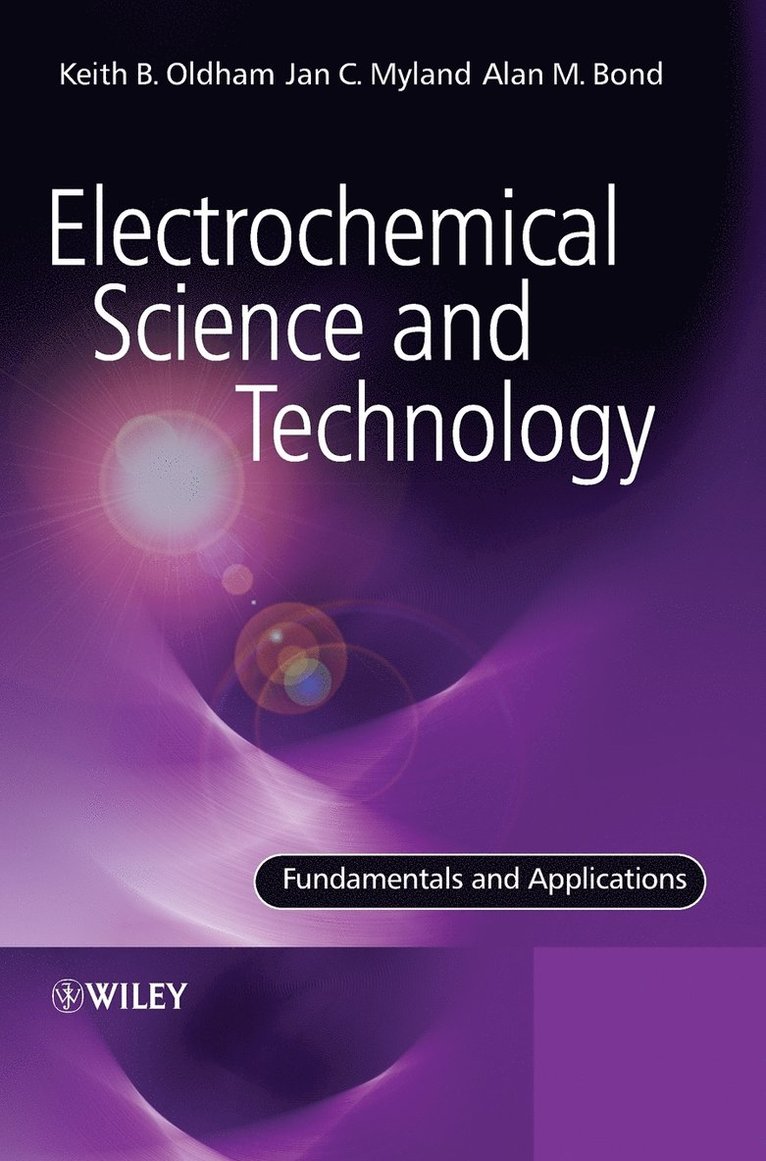
    Electrochemical Science and Technology

    Fundamentals and Applications

    AvKeith Oldham,Jan Myland

    Inbunden, Engelska, 2011

    1 961 kr

    Beställningsvara. Skickas inom 5-8 vardagar. Fri frakt över 249 kr.

    Fler format och utgåvor

    Häftad

    724 kr

    Beskrivning

    Electrochemistry is a discipline of wide scientific and technological interest. Scientifically, it explores the electrical properties of materials and especially the interfaces between different kinds of matter. Technologically, electrochemistry touches our lives in many ways that few fully appreciate; for example, materials as diverse as aluminum, nylon, and bleach are manufactured electrochemically, while the batteries that power all manner of appliances, vehicles, and devices are the products of electrochemical research.  Other realms in which electrochemical science plays a crucial role include corrosion, the disinfection of water, neurophysiology, sensors, energy storage, semiconductors, the physics of thunderstorms, biomedical analysis, and so on. This book treats electrochemistry as a science in its own right, albeit resting firmly on foundations provided by chemistry, physics, and mathematics. Early chapters discuss the electrical and chemical properties of materials from which electrochemical cells are constructed. The behavior of such cells is addressed in later chapters, with emphasis on the electrodes and the reactions that occur on their surfaces. The role of transport to and from electrodes is a topic that commands attention, because it crucially determines cell efficiency. Final chapters deal with voltammetry, the methodology used to investigate electrode behavior. Interspersed among the more fundamental chapters are chapters devoted to applications of electrochemistry: electrosynthesis, power sources, “green electrochemistry”, and corrosion.Electrochemical Science and Technology is addressed to all who have a need to come to grips with the fundamentals of electrochemistry and to learn about some of its applications. It will constitute a text for a senior undergraduate or graduate course in electrochemistry. It also serves as a source of material of interest to scientists and technologists in various fields throughout academia, industry, and government – chemists, physicists, engineers, environmentalists, materials scientists, biologists, and those in related endeavors.This book: Provides a background to electrochemistry, as well as treating the topic itself.Is accessible to all with a foundation in physical science, not solely to chemists.Is addressed both to students and those later in their careers.Features web links (through http://www.wiley.com/go/EST to extensive material that is of a more tangential, specialized, or mathematical nature.Includes questions as footnotes to support the reader’s evolving comprehension of the material, with fully worked answers provided on the web.Provides web access to Excel® spreadsheets which allow the reader to model electrochemical events.Has a copious Appendix of relevant data.

    Produktinformation

    • Utgivningsdatum:2011-12-02
    • Mått:174 x 247 x 24 mm
    • Vikt:936 g
    • Format:Inbunden
    • Språk:Engelska
    • Antal sidor:418
    • Förlag:John Wiley & Sons Inc
    • ISBN:9780470710852

    Utforska kategorier

    • Fysikalisk kemi inom Naturvetenskap och teknik
    • Tillverkningsteknik inom Naturvetenskap och teknik

    Mer om författaren

    Keith B. Oldham is Emeritus Professor at Trent University in Canada. His research interests are drawn from the fields of electrochemistry, applied mathematics and environmental issues focusing on the electrochemical applications of mathematical and computational techniques. He has co-authored several books, contributed to numerous others, and has published over 200 articles. Alan Bond is based in the School of Chemistry at Monash University and teaches undergraduate electrochemistry and redox chemistry His research focuses on applications of modern electroanalytical techniques to solve problems in inorganic, analytical and biological chemistry. He has authored over 500 papers, patents and books. Recipient of a Fulbright Fellowship (1972), the Rennie Medal (1975) of the Royal Australian Chemical Institute, the David Syme Prize (1977), the Analytical Chemistry Division Medal of the Royal Australian Chemical Institute (1989), the Stokes medal awarded by the Electrochemistry Division of the Royal Australian Chemical Institute (1992), the Liversidge Award (The Australian New Zealand Association for the Advancement of Science), the Federation of Asian Chemical Societies Foundation Lectureship (1993) and a range of other awards. Membership of Council of the Academy of Science and the Australian Research Council. Jan Myland is a Research Associate within Professor Oldhams' research group and has co-authored several books and accompanying software with Professor Oldham.

    Recensioner i media

    “Students will find it a good starting point to discover electrochemistry, which was pointed out as the primary objective by the authors. Job well done!.”  (Chromatographia, 1 August 2013)

    Innehållsförteckning

    • Preface xi 1 Electricity 1Electric Charge 1Charges at Rest 3Capacitance and Conductance 8Mobilities 18Electrical Circuits 21Alternating Electricity 23Summary 282 Chemistry 29Chemical Reactions 29Gibbs Energy 30Activity 33Ionic Solutions 38Ionic Activity Coefficients 41Chemical Kinetics 46Summary 523 Electrochemical Cells 55Equilibrium Cells 55Cells not at Equilibrium 60Cells with Junctions 64Summary 694 Electrosynthesis 71Metal Production 71The Chloralkali Industry 74Organic Electrosynthesis 75Electrolysis of Water 77Selective Membranes 79Summary 835 Electrochemical Power 85Types of Electrochemical Power Source 85Battery Characteristics 86Primary Batteries 88Secondary Batteries 94Fuel Cells 100Summary 1046 Electrodes 105Electrode Potentials 105Standard Electrode Potentials 109The Nernst Equation 111Electrochemical Series 113Working Electrodes 117Summary 1237 Electrode Reactions 125Faraday’s Law 125Kinetics of a Simple Electron Transfer 130Multi-step Electrode Reactions 137Summary 1448 Transport 145Flux Density 145Three Transport Modes 148Migration 149Diffusion 154Diffusion and Migration 158Convection 161Fluxes at Electrodes and in the Bulk 165Summary 1709 Green Electrochemistry 171Sensors for Pollution Control 171Stripping Analysis 177Electrochemical Purification of Water 182Electrochemistry of Biological Cells 186Summary 19210 Electrode Polarization 193Three Causes of Electrode Polarization 193Ohmic Polarization 197Kinetic Polarization 200Transport Polarization 202Multiple Polarizations 205Polarizations in Two- and Three-Electrode Cells 208Summary 21211 Corrosion 213Vulnerable Metals 213Corrosion Cells 215Electrochemical Studies 217Concentrated Corrosion 222Fighting Corrosion 224Extreme Corrosion 228Summary 22912 Steady-State Voltammetry 231Features of Voltammetry 232Microelectrodes and Macroelectrodes 234Steady-State Potential-Step Voltammetry 237The Disk Microelectrode 245Rotating Disk Voltammetry 248Shapes of Reversible Voltammograms 252Summary 25813 The Electrode Interface 259Double Layers 259Adsorption 266The Interface in Voltammetry 271Nucleation and Growth 281Summary 28514 Other Interfaces 287Semiconductor Electrodes 287Phenomena at Liquid*Liquid Interfaces 291Electrokinetic Phenomena 298Summary 30215 Electrochemistry With Periodic Signals 303Nonfaradaic Effects of A.C. 304Faradaic Effects of A.C. 305Equivalent Circuits 313A.C. Voltammetry 318Fourier-Transform Voltammetry 322Summary 32816 Transient Voltammetry 329Modeling Transient Voltammetry 329Potential-Step Voltammetry 334Pulse Voltammetries 339Ramped Potentials 346Multiple Electron Transfers 355Chemistry Combined with Electrochemistry 357Controlling Current Instead of Potential 362Summary 364Appendix 365Glossary 365Absolute and Relative Permittivities 382Properties of Liquid Water 383Contents ixConductivities and Resistivities 384Elements with Major Importance in Electrochemistry 386Transport Properties 388Standard Gibbs Energies 390Standard Electrode Potentials 392Index 393