• Fri frakt över 249 kr
  • •
  • Snabba leveranser
  • •
  • Billiga böcker
Kundservice

Du är på sajten för privatpersoner.

Företag, bibliotek eller offentlig verksamhet?

Du handlar på classic.bokus.com, där alla dina funktioner finns intakta.
Till classic.bokus.com
Bokus logotyp. Gå till startsidan.
  • Erbjudanden
  • Nyheter
  • Student
  • Topplistor
  • Barn & ungdom
  • Bokus Play
  • E-böcker
  • Pocketböcker
  • Spel & pussel

10% rabatt på allt med kod NYSTART10 →

Sidfot

Mina sidor

    Hjälp

    • Kundservice
    • Vanliga frågor och svar
    • Frakt och leverans
    • Retur vid ångerrätt
    • Reklamera vara
    • Betalning
    • Köpvillkor
    • Allmänna villkor
    • Information om webbplatsens tillgänglighet

    Om Bokus

    • Om oss
    • Pressrum
    • För studenter
    • För företag
    • För bibliotek och offentlig verksamhet
    • För leverantörer
    • Hållbarhet

    Populärt

    • Aktuella erbjudanden
    • Presentkort
    • Studentlitteratur
    • Nya böcker
    • Topplistor
    • Signerade böcker
    • Engelska böcker

    Inspiration

    • Boktips
    • BookTok
    • Populära bokserier
    • Barnbokskaraktärer
    • Populära författare
    Logotyp för Bokus
    Följ oss på Facebook (extern länk)Följ oss på Instagram (extern länk)Följ oss på YouTube (extern länk)Följ oss på TikTok (extern länk)
    bokus @ CookiesAnpassa cookiesIntegritetspolicyKöpvillkor
    Till Citymail hemsida (extern länk)Till Budbee hemsida (extern länk)Till Postnord hemsida (extern länk)Till Schenker hemsida (extern länk)Till Early Bird hemsida (extern länk)Till Walleys hemsida (extern länk)
    1. Kultur
    2. Musikböcker

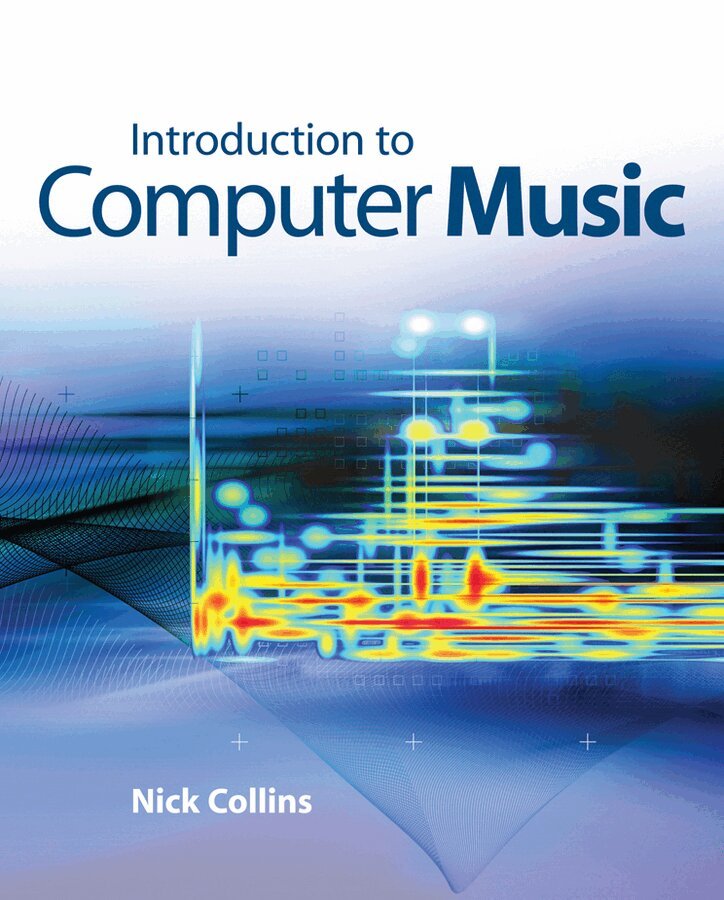
    Introduction to Computer Music

    AvNick Collins

    Häftad, Engelska, 2009

    589 kr

    Tillfälligt slut

    Beskrivning

    An up-to-date, core undergraduate text, Introduction to Computer Music deals with both the practical use of technology in music and the key principles underpinning the discipline. It targets both musicians exploring computers, and technologists engaging with music, and does so in the confidence that both groups can learn tremendously from the cross-disciplinary encounter. It is designed to approach computer music as its own subject and strongly bridge the arts to computing divide, benefiting and reconciling both musicians and computer scientists. You will need little or no prior experience of computer programming itself, and may not have an extensive background in mathematics or music, but this highly engaging textbook will help you master many disciplines at once, with a focus on both fascinating theories and exciting practical applications.

    Produktinformation

    • Utgivningsdatum:2009-11-06
    • Mått:185 x 231 x 23 mm
    • Vikt:726 g
    • Format:Häftad
    • Språk:Engelska
    • Antal sidor:400
    • Förlag:John Wiley & Sons Inc
    • ISBN:9780470714553

    Utforska kategorier

    • Musikböcker inom Kultur
    • Grafik och bildbehandling inom Data och IT

    Mer om författaren

    Dr Nick Collins is a composer, performer and researcher in the field of computer music. He lectures at the University of Sussex, running the music informatics degree programmes and research group. Research interests include machine listening, interactive and generative music, audiovisual performance, sound synthesis and music psychology. He co-edited the Cambridge Companion to Electronic Music (Cambridge University Press), and is fond of the non sequitur.He is an experienced pianist and computer music performer, and active in both instrumental and electronic music composition.

    Innehållsförteckning

    • About the Author. Preface.Acknowledgments.1 Introduction.1.1 What is Computer Music?1.1.1 Some Examples of Computer Music.1.1.2 Sociable Computer Musicians.1.1.3 Why Investigate Computer Music?1.2 Quickstart Guide to Computer Music.1.2.1 Sound Waves and the Brain.1.2.2 The Time Domain.1.2.3 Periodicity.1.2.4 The Frequency Domain.1.2.5 Digital Audio.1.2.6 Filters.1.2.7 Timbre.1.2.8 Space.1.2.9 Patching, Signal Flow and Unit Generators.1.2.10 Computer Music Software.1.2.11 Programming and Computer Music.1.2.12 Representing Music on a Computer.1.3 A Whirlwind History of Computer Music.1.4 Summary.1.5 Exercises.1.6 Further Reading.2 Recording.2.1 Recording: A History.2.2 Musical Instrument Digital Interface.2.3 Virtual Studios.2.4 File Formats and Audio Codecs.2.5 Spatialization.2.5.1 Spatial Hearing and Room Acoustics Primer.2.5.2 Surround Sound Configurations and Multichannel Formats.2.6 Recording Tips and Tricks.2.7 Sampling.2.7.1 A History of Sampling.2.7.2 Copyright.2.7.3 Sample Playback.2.8 Summary.2.9 Exercises.2.10 Further Reading.3 Analysis.3.1 Sound Analysis.3.2 Fourier Analysis and the Phase Vocoder.3.2.1 Short-time Fourier Transform.3.2.2 Further Refinements to Fourier Analysis.3.2.3 Resynthesis after Sinusoidal Modeling.3.2.4 Not All Sounds are Periodic: Coping with Noise.3.3 Alternative Representations for Analyzing Sound.3.4 Auditory Models.3.4.1 Physiologically Inspired Models of the Auditory System.3.4.2 Computational Auditory Scene Analysis.3.4.3 Perceptual Audio Coding.3.5 Feature Extraction.3.5.1 Pitch Detection.3.5.2 Onset Detection.3.5.3 Beat Tracking.3.6 The Transcription Problem.3.7 Machine Listening and Causal Realtime Analysis.3.8 Summary.3.9 Exercises.3.10 Further Reading.4 Processing.4.1 More on Signals.4.1.1 Signals and Sampling Rates.4.1.2 Ring and Amplitude Modulation.4.1.3 Mixing and Splicing.4.1.4 Delays.4.2 Convolution and Filters.4.2.1 Impulse Responses and the Convolution Operation.4.2.2 Convolution and Multiplication.4.2.3 More on Filters.4.2.4 Examples: Comb andAll-pass Filters.4.3 ACompendium of Marvelous Digital Audio Effects.4.3.1 Dynamics Processing, Distortion and Waveshaping.4.3.2 Time Stretching and Pitch Shifting.4.3.3 Implementing Spatialization.4.4 Summary.4.5 Exercises.4.6 Further Reading.5 Synthesis.5.1 The Space of Sound SynthesisAlgorithms.5.1.1 ClassicAlgorithms.5.1.2 Waveforms and Wavetables.5.1.3 Frequency Modulation.5.1.4 Granular Synthesis.5.1.5 Feature-based Synthesis.5.2 Physical Modeling.5.2.1 Waveguide Synthesis.5.2.2 Singing Voice Synthesis.5.3 Summary.5.4 Exercises.5.5 Further Reading.6 Interaction.6.1 Introduction to Interaction.6.1.1 Defining Interaction.6.1.2 Directness of Control and the Physicality of Gesture.6.2 Interfacing.6.2.1 A Survey of Input Devices.6.2.2 OfficeComputing forMusic.6.2.3 Audio and Video Tracking.6.2.4 Physical Computing.6.2.5 Physiological State.6.3 Interaction Scenarios.6.3.1 Installations.6.3.2 Computer Games.6.3.3 Concert Performance.6.4 LiveMusical Agents.6.4.1 Automatic Accompaniment.6.4.2 Robot Musicians.6.4.3 Programming the 'Brain' of aVirtual Musician.6.5 Evaluation.6.6 Summary.6.7 Exercises.6.8 Further Reading.7 Networks.7.1 Introduction to Networks.7.1.1 Network Technology.7.1.2 Network Music and Installations.7.1.3 Further Network Music Ensembles and the Laptop Orchestra.7.1.4 Mobile Music.7.1.5 Online Music Distribution.7.2 Music Information Retrieval.7.2.1 Content Analysis.7.2.2 Annotation and Evaluation.7.2.3 MIR Deployments.7.3 Summary.7.4 Exercises.7.5 Further Reading.8 Composition.8.1 Composers and Computers.8.1.1 Musical Decisions: TheAct of Composition.8.1.2 Roles for Computers in Composition.8.1.3 Computer Music and Musical Style.8.2 Organizing Sound.8.2.1 Sound Objects and Parameters.8.2.2 Pitch.8.2.3 Timbre.8.2.4 Space.8.2.5 Time.8.2.6 Local Structures.8.2.7 Musical Form.8.3 Formalizing Music.8.3.1 Algorithmic Composition.8.3.2 Implementing Algorithmic Composition.8.4 Summary.8.5 Exercises.8.6 Further Reading.9 Modeling.9.1 TheAct of Modeling.9.2 Representations.9.3 Automating Musicological Analysis.9.4 Modeling of Musical Expression.9.5 Sonification.9.6 The Information Characteristics of Music.9.7 Summary.9.8 Exercises.9.9 Further Reading.10 Conclusions.10.1 Exercises.References.Index.